
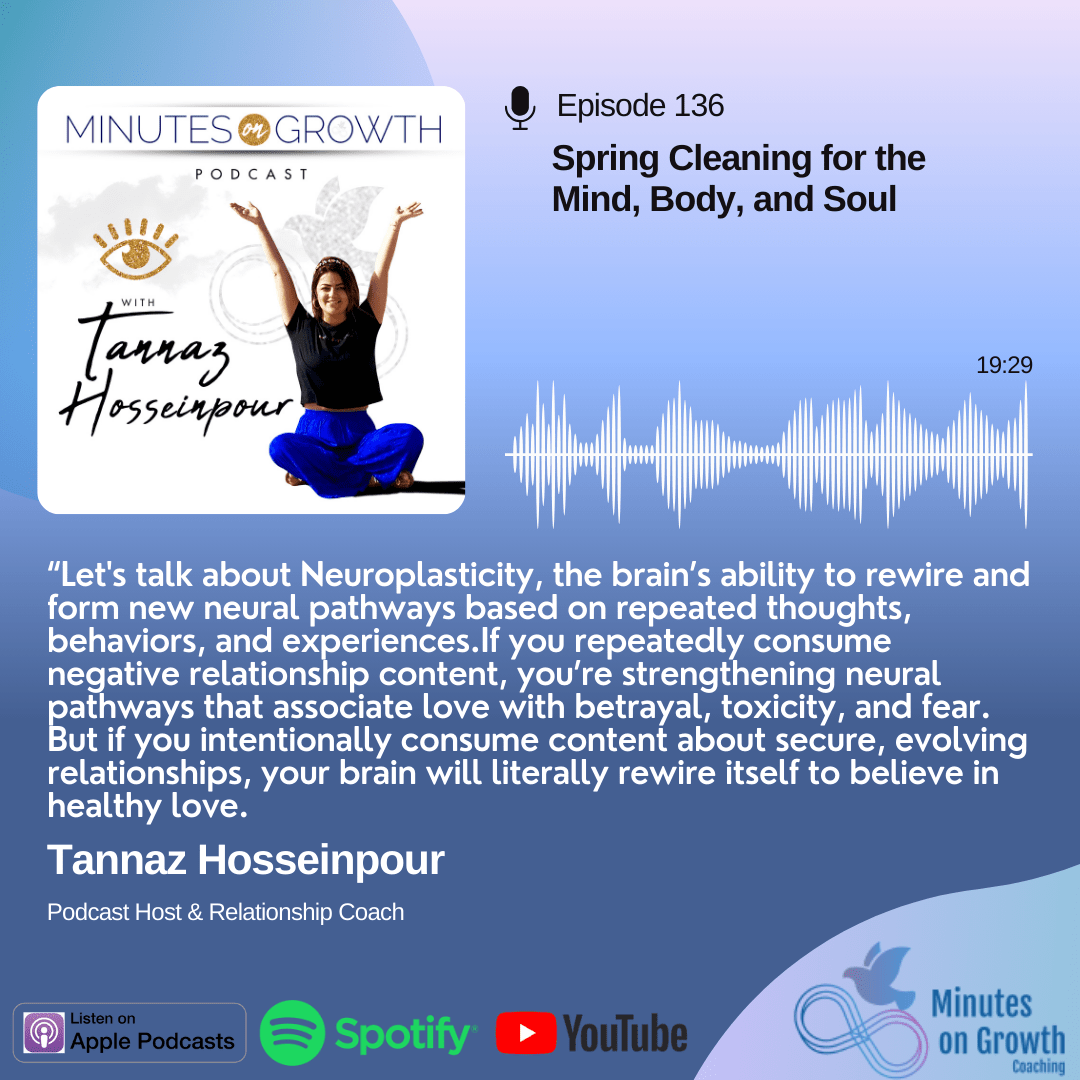
Click here to listen to Episode 136 of the Minutes on Growth Podcast on Spotify, on Apple Podcast or to watch it on Youtube
Hi Soul Friends, it’s Tannaz Hosseinpour, and welcome back to another short solo episode of the Minutes on Growth podcast. Today, we’re talking about spring cleaning—but not just in the way we usually think about it. Yes, we’re going to talk about clearing out the clutter in our homes, but we’re also going to go deeper. Because spring isn’t just about refreshing our physical spaces—it’s about detoxing our minds, beliefs, and relationships as well.
Spring is a season of renewal, and the spring equinox is the perfect time to step into a new version of ourselves by letting go of what no longer serves us. Today, we’re going to explore:
- How decluttering our physical space impacts our energy
- How to detox limiting beliefs that are keeping us stagnant
- How to take inventory of our relationships and create space for more reciprocal, aligned connections
So let’s begin.
Decluttering Your Physical Space = Clearing Energetic Blockages
Look around your home right now. What are you holding on to that it’s time to let go of?
Maybe it’s clothes that don’t fit anymore—not just physically, but energetically. Maybe it’s items from your past self, from a version of you that no longer exists. Maybe you’re holding on to things “just in case,” but in reality, they’re just anchoring you to an old identity.
Spring cleaning isn’t just about organizing—it’s about making space for expansion. When we let go of what no longer aligns with who we are today, we create room for new energy to flow in. And I know this can be hard, especially when we attach meaning to objects.
For example, if you’re holding on to clothes that don’t fit anymore in the hopes that one day you’ll wear them again, I invite you to ask yourself:
- Am I holding on to an old version of myself?
- Am I resisting accepting myself as I am today?
Because true transformation doesn’t come from shame or judgment. We don’t change by criticizing ourselves into a new version—we change by accepting where we are and moving forward with love.
Trust that if and when the time comes, you can always call new things into your life. But for now, release the old and create space for something new.
Detoxing Your Limiting Beliefs
Now, let’s go deeper.
We declutter our homes, but how often do we declutter our minds?
Take a moment to reflect: What limiting beliefs are you still carrying into this new season?
- Are you telling yourself I should be doing this or I can’t do that?
- Are you looking for evidence against yourself instead of evidence for your potential?
- Where are these beliefs coming from? Are they truly yours, or were they conditioned into you by family, society, or past experiences?
One of my friends recently got out of a bad relationship, and she kept sending me videos with titles like “All men are narcissists” and “All men cheat.” It became a constant cycle—she was consuming this content, sharing it, and reinforcing the belief that healthy love wasn’t possible.
I told her, “You need to stop entertaining this content, because your algorithm is going to flood you with more of it.”
Then I asked her, “How does watching these videos actually make you feel?”
She paused for a moment and admitted, “It makes me feel worse.”
So I asked her, “And what do you ultimately want? What’s your desire?”
She said, “I want to be in a healthy relationship.”
So I told her, “Then is it serving you to keep consuming content that reinforces the belief that healthy relationships don’t exist?”
She thought about it and said, “No.”
So I asked, “What would actually help you feel more empowered? What would bring more hope into your life?”
She said, “If I saw more examples of healthy couples.”
And I said, “Exactly. Train your algorithm to show you that. Seek out evidence that what you want is possible.”
This isn’t just about social media—it’s about how our brains work. Let me share the science behind it.
So the Reticular Activating System (RAS) is a network in our brainstem that acts as a filter—it prioritizes what we pay attention to based on what we already believe.
If you tell yourself, “All men are cheaters,” your brain will subconsciously seek out evidence to support that belief. It will notice stories of infidelity, reinforce the idea, and ignore counter-evidence of healthy relationships.
This is confirmation bias—our brain actively looks for proof that aligns with our preexisting beliefs, while discarding anything that contradicts it.
Now let’s talk about Neuroplasticity , the brain’s ability to rewire and form new neural pathways based on repeated thoughts, behaviors, and experiences.If you repeatedly consume negative relationship content, you’re strengthening neural pathways that associate love with betrayal, toxicity, and fear.
But if you intentionally consume content about secure, evolving relationships, your brain will literally rewire itself to believe in healthy love.
Don’t just take my word for it – Studies show that what we consume online affects our emotional state. Research from the Journal of Cyberpsychology, Behavior, and Social Networking found that exposure to negative content online increases anxiety, stress, and hopelessness.
Conversely, studies from positive psychology research show that consuming uplifting content can increase feelings of optimism, motivation, and even impact our actions.
you know as a relationship coach—and as someone who wants to experience deep, fulfilling love—I make a conscious effort to engage with content that supports my belief in healthy relationships.
I follow therapists, neuroscientists, and couples who share research-backed tools for building love. I study neuroplasticity, relational intelligence, and communication techniques. And because I only interact with content that reflects healthy relationships, my algorithm has adjusted—I don’t even see that limiting content anymore.
And the same is true for life beyond social media.
What we choose to focus on, believe in, and repeatedly expose ourselves to shapes our subconscious mind, our expectations, and ultimately, our lived experience.
So if you want to shift your beliefs and rewire your brain for something more expansive, start by curating your inputs:
- Audit Your Content Consumption
- Take a look at your social media, books, conversations—what themes are dominating?
- Are you consuming content that reinforces hope and possibility or fear and limitation?
- Start Seeking Out the Opposite Evidence
- If you believe healthy relationships don’t exist, start searching for stories of couples who have done the work and built beautiful partnerships.
- If you believe financial abundance isn’t possible for you, follow people who have transformed their financial reality through mindset shifts and action.
- Engage With What You Want to Believe
- Every like, comment, and share teaches the algorithm (and your subconscious) what to prioritize.
- Want to believe in healthy relationships? Follow accounts that highlight secure attachment, growth, and love that evolves over time.
- Want to believe in abundance? Read stories of people who have shifted their financial narrative.
- Be Conscious of the Story You’re Feeding Yourself
- Just like your social media algorithm, your mind is also running on an algorithm—it prioritizes what you repeatedly give attention to.
- What are you training your mind to expect?
- What “mental feed” are you scrolling through every day?
So if you’re stepping into this new season with doubts, ask yourself:
- How is my life a reflection of my beliefs?
- Where am I looking for evidence against myself instead of for myself?
- How can I shift my perspective to align with the reality I want to create?
Taking Inventory of Your Relationships
Now, let’s move on to something even deeper—our relationships.
Spring is the perfect time to take inventory of the people in our lives.
Ask yourself:
- Are my relationships reciprocal? Do the people in my life pour into me as much as I pour into them?
- Which relationships feel expansive, and which feel draining?
- Are there conversations I’ve been avoiding that need to happen?
And let’s take this even further—because self-awareness isn’t just about evaluating others. It’s about reflecting on how we show up in our relationships, too.
- Am I being a good friend, partner, or family member?
- Am I showing up for the people I love in a way that aligns with my values?
- In my romantic relationship, am I bringing the energy I want to receive?
One of my best friends, Alex, is in a relationship, and we often talk about growth within relationships. Because the truth is, relationships aren’t just about what we get—they’re about what we contribute.
If we want to experience deep, fulfilling, soul-nourishing relationships, we have to be willing to do the work—to reflect, to adjust, to communicate, and to show up as the highest version of ourselves.
So as we step into spring, let’s not just clean out our closets—let’s clean out our energy, our minds, and our connections.
So soul-friends, spring is a season of rebirth and renewal. It’s the ideal time to:
- Release what no longer serves us physically, mentally, and emotionally
- Create space for new, aligned energy to enter
- Shift our mindset and subconscious patterns to support our growth
So as you go about your day, I invite you to ask yourself:
- What am I ready to let go of?
- What new beliefs, habits, or relationships am I ready to step into?
Because just like nature, we are always evolving. And true transformation begins when we clear the space for something new to emerge.
Thank you for joining me today. If this episode resonated with you, let me know—I’d love to hear what you’re releasing this season. Until next time, take care and keep growing.
 Minutes on Growth