Episode 175 – Stop Glorifying the Bare Minimum & Expect More From Men

Click here to listen to Episode 175 of the Minutes on Growth Podcast on Apple Podcast, on Spotify or to watch it on Youtube.

Hi soul friends, this is Tannaz Hosseinpour, and welcome back to another short solo episode of the Minutes on Growth podcast.

I want to talk about men today.

And before we go anywhere with this conversation, I want to start here:

There are incredible men in this world.

Men who are present. Men who are kind. Men who are caring. Men who are phenomenal husbands, incredible fathers, loving sons, supportive brothers, loyal friends, and contributing members of their communities.

I know these men. I see these men. I’m living with one. And I hear about these men in my work.

And acknowledging that doesn’t mean we can’t simultaneously acknowledge another reality.

There are also abusive men.

There are neglectful husbands.

There are absent fathers.

There are men who refuse to take accountability, who don’t know how to regulate their anger, who consistently offer the bare minimum in their relationships and expect their partners to carry the rest.

Both realities can exist at the same time.

And I think we need to be able to have nuanced conversations about that without immediately falling into either men are terrible or not all men.

Of course not all men.

But enough women are experiencing these dynamics that they’re worth talking about.

And today, I don’t really want to talk about what women can do to make men change.

Because we can’t control another human being.

I want to talk about what we participate in.


We Are Not Their Therapists

Women, particularly women who are naturally nurturing, can sometimes slip into a role in their relationships that was never supposed to belong to them.

Therapist.

Mother.

Emotional regulator.

Life coach.

Manager.

Fixer.

We start reminding.

Teaching.

Explaining.

Regulating.

Making appointments.

Giving the same relationship lesson for the eighteenth time.

Trying to find exactly the right words that will finally make someone understand why their behaviour is hurting us.

And somewhere along the way, we’ve stopped being their partner.

I want to be really clear here.

Supporting your partner is part of a healthy relationship.

There will be seasons where your partner carries you more.

There will be seasons where you carry them more.

That’s partnership.

But supporting someone is different from assuming responsibility for their development.

Your partner’s emotional regulation is ultimately their responsibility.

Their healing is their responsibility.

Their relationship with their children is their responsibility.

Their willingness to communicate is their responsibility.

Their ambition is their responsibility.

Their integrity is their responsibility.

You can encourage.

You can support.

You can communicate.

But you cannot do someone’s internal work for them.


And this brings me to something I think we desperately need to normalize:

Stop glorifying breadcrumbs.

If someone remembers your birthday, that’s lovely.

If a father takes care of his children, that’s important.

If your partner listens when you’re struggling, wonderful.

If someone cleans the house they also live in, great.

Appreciate those things.

Express gratitude for those things.

But we have to be careful about turning basic relational responsibility into extraordinary heroism.

Because when we repeatedly celebrate the bare minimum as exceptional, we can inadvertently lower the standard for what partnership actually looks like.

And when we entertain the bare minimum over and over again, we’re communicating something too.

We’re saying:

This is enough for me to stay.


Raise the Expectation Because You Believe They’re Capable

I think about eldest daughters here.

So many eldest daughters grow up hearing:

“You have so much potential.”

“You can do so much.”

“You’re capable of more.”

“Keep going.”

“Be responsible.”

“Be successful.”

Now, there’s another entire podcast episode we could have about the enormous pressure that can place on girls and women.

Because sometimes that message becomes:

I always have to perform.

I can’t rest.

I can’t fail.

And that’s not what I’m advocating for.

I’m not asking us to replace unhealthy expectations placed on women with unhealthy expectations placed on men.

I’m asking:

What would happen if we believed in men’s capacity for growth just as deeply?

Not from:

“You’re inadequate.”

But from:

“I believe you’re capable.”

I expect men to be capable of learning emotional regulation.

I expect men to be capable of apologizing.

I expect men to be capable of nurturing their children.

I expect men to be capable of having difficult conversations.

I expect men to want to become better husbands, fathers, friends, brothers, sons, leaders, and human beings.

Not because women deserve perfect men.

Perfect men don’t exist.

Perfect women don’t exist.

But because men deserve access to their own potential too.

Having standards for someone isn’t necessarily an insult.

Sometimes it’s an acknowledgment of their capacity.


And here’s where this becomes uncomfortable for some of us.

If we want someone else to step up…

sometimes we have to stop stepping in.

We have to notice the part of ourselves that immediately says:

“I’ll fix it.”

“I’ll handle it.”

“I’ll remind him.”

“I’ll make it easier.”

“I’ll compensate.”

“I’ll explain it one more time.”

Because sometimes we become so uncomfortable watching another person struggle that we rescue them before they ever have the opportunity to develop the capacity to handle it themselves.

And this is where I would bring in parts work.

Get curious.

What part of me needs to fix this?

What does that part fear would happen if I didn’t?

Does it believe the relationship would fall apart?

Does it believe I won’t be loved?

Does it believe everything will descend into chaos unless I’m managing it?

Does being needed make me feel secure?

Was I rewarded for being responsible growing up?

Did I learn that love meant taking care of everyone?

That’s our work.

Because otherwise, we can call something “support” when underneath it is actually anxiety, overfunctioning, people pleasing, or fear.


There’s a concept in Kabbalah that I love: earning the light.

And one way I think about that in relationships is that we shouldn’t expect intimacy, trust, connection, partnership, and a beautiful relationship to simply appear without participation.

Both people have to participate.

Both people have to invest.

Both people have to stretch.

Both people have to take responsibility for what they bring into the relationship.

You earn the light of the relationship together.

And that doesn’t mean keeping score.

It doesn’t mean:

“I did the dishes three times, you did them twice.”

It doesn’t mean relationships are 50/50 every single day.

Sometimes they’re 80/20.

Sometimes they’re 30/70.

Life happens.

Someone gets sick.

Someone loses a parent.

Someone loses their job.

Someone goes through depression or grief or an incredibly difficult season.

There will be times when one person has more to give.

The question isn’t whether the relationship is perfectly equal every day.

The question is:

Are both people committed to showing up?


And I want to talk about something else.

Sometimes being destructive is easier.

It’s easier to scream than regulate.

It’s easier to lash out than communicate what’s underneath the anger.

It’s easier to disappear than tolerate the discomfort of vulnerability.

It’s easier to blame than take accountability.

It’s easier to stay exactly who we’ve always been than confront the parts of ourselves that are hurting the people we love.

Growth is uncomfortable.

Learning emotional regulation is uncomfortable.

Learning to communicate when nobody taught you how is uncomfortable.

Apologizing when your ego wants to defend itself is uncomfortable.

Going to therapy can be uncomfortable.

Breaking generational patterns is uncomfortable.

Being vulnerable when you’ve spent your entire life protecting yourself is uncomfortable.

But discomfort isn’t always a sign that something is wrong.

Sometimes discomfort is the doorway to development.

And this applies to all of us.

Men and women.

Because if I’m asking someone else to confront their patterns, I need to be willing to confront mine.

If I’m asking someone else to regulate their anger, I need to examine how I regulate mine.

If I’m asking someone else to grow, I have to remain committed to my own growth too.


And actually, there’s a fictional character who kept coming to mind while I was thinking about this episode:

Ted Lasso.

If you’ve watched the show, you know Ted isn’t portrayed as some perfect, endlessly emotionally regulated man.

He’s hurting.

He experiences anxiety and panic attacks.

His marriage ends.

He carries profound grief connected to losing his father to suicide.

He gets angry.

He makes mistakes.

There are moments when he doesn’t know what to do with what he’s feeling.

And yet, what I find so beautiful about his character is that his pain doesn’t become permission to consistently hurt everyone around him.

There’s this idea embedded in his character that kindness is a choice. Curiosity is a choice. Empathy is a choice.

And I think that’s important because sometimes we talk about kindness as though it’s simply a personality trait.

“Oh, he’s just a nice guy.”

But being kind when everything is going your way isn’t particularly difficult.

Who are you when you’re hurt?

Who are you when you’re rejected?

Who are you when your ego is bruised?

Who are you when somebody disappoints you?

What do you do with your pain when you have every reason to be angry?

That’s where character starts to become visible.

Ted isn’t without anger.

He isn’t without pain.

He isn’t without trauma.

He simply repeatedly attempts to do something constructive with it.

And I think that’s the kind of masculinity I want us to expect more of.

Not men who never struggle.

Not men who never get angry.

Not men who never experience depression, anxiety, insecurity, jealousy, grief, or fear.

That’s not realistic.

And frankly, that’s another form of emotional suppression.

I want men to know:

You are allowed to struggle.

You are allowed to need help.

You are allowed to cry.

You are allowed to say:

“I don’t know what to do with what I’m feeling right now.”

You are allowed to go to therapy.

You are allowed to lean on your friends.

You are allowed to be vulnerable.

But there is a difference between having pain and making everybody around you pay for your pain.

And I think that’s such an important distinction.

Because when we say:

“Well, that’s just how men are.”

When a man can’t communicate…

can’t regulate his anger…

can’t apologize…

can’t be emotionally present…

or refuses to work on himself…

I actually don’t think we’re doing men any favors.

We’re lowering our expectations of what they’re capable of.

And I don’t want to do that.

I want us to look at men and say:

I believe you are capable of more.

I believe you’re capable of experiencing anger without becoming abusive.

I believe you’re capable of experiencing pain without becoming cruel.

I believe you’re capable of vulnerability without believing it makes you weak.

I believe you’re capable of accountability without believing it diminishes you.

I believe you’re capable of being ambitious and emotionally available.

Strong and tender.

Independent and deeply connected.

Ted Lasso isn’t an example of a man without wounds.

He’s an example of a man whose wounds don’t have to become his identity.

And importantly, other people support him.

But they don’t do all of his emotional work for him.

That’s the distinction I want us to make in our relationships too.

We can love men.

We can encourage men.

We can hold space for men.

We can believe deeply in their potential.

Without becoming their mothers, their therapists, or the managers of their emotional lives.

Because believing in someone’s potential also means believing they’re capable of doing their own work.


And there’s an important distinction here.

Having standards doesn’t mean forcing someone to meet them.

That’s not a boundary.

That’s control.

You can say:

“This is what partnership means to me.”

“This is how I expect to be communicated with.”

“This is what I need in a marriage.”

“This behaviour isn’t something I’m willing to participate in.”

And then the other person gets to decide what they do with that information.

Your power isn’t in making them change.

Your power is in deciding what you do when they don’t.

That’s the part I think we sometimes forget.

We can spend years trying to extract someone’s potential from them.

But potential is not the same thing as participation.

Someone can have the potential to be an incredible partner and still choose not to do the work required to become one.

And loving their potential doesn’t require you to build a life around their unwillingness.


So maybe part of loving men is expecting more from them.

Not perfection.

Not emotional performance.

Not unrealistic standards.

More responsibility.

More accountability.

More emotional literacy.

More involvement as fathers.

More investment as husbands.

More willingness to confront the things that hurt themselves and the people around them.

And then allowing them the dignity of doing that work themselves.

We don’t have to mother grown men into becoming the men we believe they could be.

We don’t have to therapize them into emotional awareness.

We don’t have to overfunction so they never experience the consequences of underfunctioning.

Sometimes we need to hold back the fixer.

Hold back the rescuer.

Hold back the part that wants to compensate.

And create enough space for another adult to show us what they’re willing to do.


So I’ll leave you with this.

There are extraordinary men in this world.

And I want more men to experience the fullness of what they’re capable of becoming.

Not just because women deserve great partners.

Children deserve present fathers.

Friends deserve emotionally available friends.

Communities benefit from emotionally healthy men.

And men themselves deserve relationships, lives, and identities that aren’t restricted by the idea that emotional avoidance, rage, detachment, or doing the bare minimum is somehow all that’s expected of them.

But their growth belongs to them.

And ours belongs to us.

Our job isn’t to drag another person toward their potential.

Our job is to stop shrinking our standards to accommodate someone’s refusal to reach for it.

To stop glorifying breadcrumbs.

To stop confusing fixing with loving.

To do our own uncomfortable work.

And to build relationships where both people are willing to earn the light.

Because perhaps one of the greatest ways we can love another person isn’t by doing their work for them…

but by believing they’re capable of doing it themselves.

Thank you for spending these minutes with me, soul friends.

I’ll see you in the next episode.

Episode 174 – Do We Attract People or Do We Entertain Them?

Click here to listen to Episode 174 of the Minutes on Growth Podcast on Spotify, on Apple Podcast or watch it on Youtube.

Hi soul friends, its Tannaz Hosseinpour, and welcome back to another short solo episode of the Minutes on Growth podcast.

Today’s episode begins with a question that I hear all the time.

“I don’t know why I keep attracting emotionally unavailable people.”

“I always attract narcissists.”

“I keep attracting people who don’t want commitment.”

And while I completely understand why people ask that question…

I actually think there’s a more empowering one.

Because the truth is…

we can’t control who enters our lives.

We’re going to attract…or simply encounter…a wide variety of people throughout our lifetime.

People with secure attachment.

People with anxious attachment.

People with avoidant attachment.

People who are emotionally available.

People who aren’t.

People who are intentional with doing the inner work…

People who are still carrying a lot of unresolved pain they’re unaware of.

We don’t get to choose who crosses our path.

But we do get to choose who we continue walking with.

So perhaps the more empowering question isn’t…

“Why do I keep attracting this type of person?”

It’s…

“Why do I keep entertaining them?”

Because that question shifts our attention from the external…

to the internal.

And that’s where change becomes possible.


One of the biggest concepts we talk about in attachment theory is familiarity.

Our nervous systems are drawn toward what feels familiar.

Not necessarily what feels healthy.

If chaos was familiar…

calm can feel boring.

If inconsistency was familiar…

consistency can actually feel uncomfortable.

If you had to earn love growing up…

effortless love might feel suspicious.

Our nervous systems often confuse familiarity with safety.

Even when that familiarity hurt us.

And that’s why we sometimes find ourselves repeatedly entertaining similar relationship dynamics.

Not because we’re choosing pain…

but because our nervous system recognizes the pattern.


There’s something Dr. Gabor Maté says that has always stayed with me.

He talks about how, as children, we didn’t have control over many of the experiences that shaped us.

But as adults…

we sometimes unconsciously recreate similar situations in an attempt to change the ending.

Think about that for a moment.

Maybe you’re hoping that this emotionally unavailable person…

will finally choose you.

Maybe this time…

someone will stay.

Maybe this time…

someone will validate you.

Maybe this time…

you’ll finally receive what you didn’t receive back then.

The relationship isn’t just about the person in front of you.

Sometimes…

it’s also about the unfinished story behind you.


Now, I also want to offer another perspective that I really appreciate from couples therapist Terry Real.

He says:

“We all marry the next step in our own psychological development.”

I love that reframe.

Because instead of asking,

“What’s wrong with me?”

It asks,

“What is this relationship inviting me to learn?”

Every relationship shines a light on something.

Our boundaries.

Our communication.

Our attachment wounds.

Our capacity for intimacy.

Our fears.

Our patterns.

Relationships become mirrors.

Not because they’re here to complete us…

but because they’re here to reveal us.


& This is where I love bringing in the Internal Family Systems, or IFS modality into the therapy room.

Instead of asking,

“Why am I doing this again?”

We become curious.

What part of me is showing up?

Is it the part that’s terrified of abandonment?

The part that believes love has to be earned?

The caretaker?

The fixer?

The people pleaser?

The part that’s afraid that if I set a boundary…

I’ll lose the relationship?

When we shift from judgment…

to curiosity…

everything changes.

Because every part of us developed for a reason.


So the next time you notice yourself pulled toward a relationship that doesn’t feel healthy…

pause.

Instead of focusing only on the other person…

turn inward.

Ask yourself:

What part of me is getting activated?

What emotions are coming up?

What familiar pattern is repeating itself?

What story am I telling myself?

When was the last time I remember feeling this way?

What are my earliest memories of this feeling?

Where do I notice it in my body?

Because our bodies often remember long before our minds do.

Maybe it’s a tightness in your chest.

A pit in your stomach.

A lump in your throat.

Those sensations carry information.

Listen to them.


Because one of the most empowering realizations we can have is this:

Not everyone who enters your life deserves access to your heart.

Compatibility isn’t just about chemistry.

It’s about emotional health.

Shared values.

Consistency.

Reciprocity.

Safety.

And just because someone activates something familiar…

doesn’t mean they’re your person.

Sometimes they’re your lesson.


So the next time you catch yourself saying,

“Why do I keep attracting these people?”

Try asking a different question.

Who am I choosing to entertain?

And what does that choice teach me about my inner world?

Because healing isn’t about controlling who shows up.

Healing is learning to recognize who aligns with the life you’re creating…

and having the courage to let go of what simply repeats the past.

Thank you so much for spending these minutes with me, soul friends.

Until next time…

Stay curious.

Because curiosity, not judgment, is where healing begins.

Episode 173 – The Art of Slowing Down

Click here to listen to Episode 173 of the Minutes on Growth Podcast on Apple Podcast, Spotify or to watch it on Youtube.

Hi soul friends, its Tannaz Hosseinpour, and welcome back to another short solo episode of the Minutes on Growth podcast.

Today’s episode was inspired by something that happened on a recent trip Ash and I took to New Brunswick.

We decided to do a guided kayak tour at the Bay of Fundy, and honestly, I thought it was just going to be a fun afternoon in nature.

I didn’t realize it was also going to become therapy.

Because isn’t that how life works sometimes?

The most ordinary moments end up revealing the most extraordinary things about ourselves.

There were about ten or twelve people on the tour and three guides.

Within the first fifteen minutes, Ash and I noticed we kept drifting farther and farther behind everyone else.

One of the guides stayed with us the entire time because they never wanted anyone paddling alone.

And almost immediately…

I noticed something happening inside me.

I kept saying,

“Ash, come on.”

“We need to paddle faster.”

“We’re holding everyone up.”

“We’re making him stay behind because of us.”

I couldn’t relax.

I couldn’t fully enjoy where I was because I was so focused on where everyone else was.

Meanwhile…

Ash was having the complete opposite experience.

He kept smiling and saying,

“Why?”

“Look around.”

“This is beautiful.”

“Slow down.”

I’d finally look up.

The cliffs.

The water.

The silence.

I’d take one deep breath…

and then my eyes would wander back to the group.

“We’re falling behind again.”

It became this cycle.

Until finally I turned to our guide and apologized.

I said,

“I’m so sorry we’re slowing you down.”

“I feel bad that you have to stay back with us.”

And his response completely shifted something inside me.

He smiled and said,

“Don’t worry.”

“I get to spend more time on the water.”

“And I love being on the water.”

That’s it.

One sentence.

But it hit me.

Because the entire story I had been carrying…

was a story I had written in my own mind.


Which reminded me of something I often tell clients.

Every situation in life is an opportunity to get to know yourself better.

Not because life is constantly testing you…

but because life constantly reflects you.

Someone cuts you off in traffic.

Someone doesn’t text back.

Your partner forgets something important.

A coworker gives you feedback.

You fall behind on a kayak tour.

None of these situations create your beliefs.

They reveal them.

And what that kayaking experience revealed to me…

was a younger part of myself.

The part that learned…

Don’t be difficult.

Don’t inconvenience people.

Be easy.

Don’t take up too much space.

Don’t need too much.

Don’t slow anyone down.

That part wasn’t thinking about the scenery.

It was thinking about survival.

Because when we’re triggered…

our nervous system doesn’t respond to what’s happening.

It responds to what something reminds us of.


Anyways, afterwards I found myself wondering something.

How many people on that tour were rushing?

Not because they wanted to…

But because somewhere along the way…

they learned that faster is better.

That productivity equals worth.

That slowing down means falling behind.

And then I thought…

Isn’t that exactly what so many of us are doing in life?

We’re rushing through breakfast.

Rushing conversations.

Rushing weekends.

Rushing vacations.

Rushing childhood.

Rushing healing.

Always thinking about what’s next.

Always arriving somewhere…

without actually being where we already are.

Sometimes we move through life so quickly…

that we miss the life we’re trying so hard to build.


I think its important to note that somewhere along the way…

our culture confused slowing down with laziness.

But they’re not the same thing.

Slowing down doesn’t mean doing less.

It means becoming more present.

It means allowing yourself to actually experience your own life.

To taste your coffee.

To notice the trees.

To hear your child’s laughter.

To really listen when someone is talking.

To feel the sunshine instead of photographing it.

Presence isn’t passive.

Presence is participation.


I also want to note that I think one of the greatest gifts we can give ourselves…

is curiosity.

Instead of asking,

“Why am I like this?”

Ask,

“What part of me just showed up?”

“What is this moment trying to teach me?”

“What belief just got activated?”

Maybe your story is,

“I have to earn love.”

Maybe it’s,

“I can’t disappoint people.”

“I have to be perfect.”

“I have to be useful.”

“I can’t ask for help.”

Every trigger becomes information.

Not evidence that something is wrong with you…

but an invitation to know yourself more deeply.


I also kept thinking about our guide.

Because nowhere in that interaction…

did he experience me the way I was experiencing myself.

He wasn’t annoyed.

He wasn’t impatient.

He wasn’t wishing we’d hurry up.

He was simply enjoying more time doing something he loved.

How often do we assume we’re burdening people…

when that story only exists inside our own minds?

How many unnecessary pressures do we place on ourselves because we’re living inside assumptions instead of reality?


So this week…

I’d love to invite you to slow down.

Not because life isn’t important.

But because it is.

Take five extra minutes on your walk.

Eat one meal without your phone.

Watch one sunset.

Sit outside.

Drive without rushing.

And maybe even ask yourself…

“What part of me is showing up right now?”

Because every moment—

even something as simple as a kayak tour—

can become an opportunity to know yourself a little more deeply.


So soul-friends, I’ll leave you with this:

Life isn’t a race to the finish line.

The goal isn’t to get through it as quickly as possible.

The goal is to actually be here for it.

To notice it.

To experience it.

To allow yourself to move at a pace where you can fully receive your own life.

Because sometimes…

the most beautiful views are found by the people who aren’t rushing past them.

Thank you so much for spending these minutes with me, soul friends.

Until next time…

Slow down.

Your life is happening now.

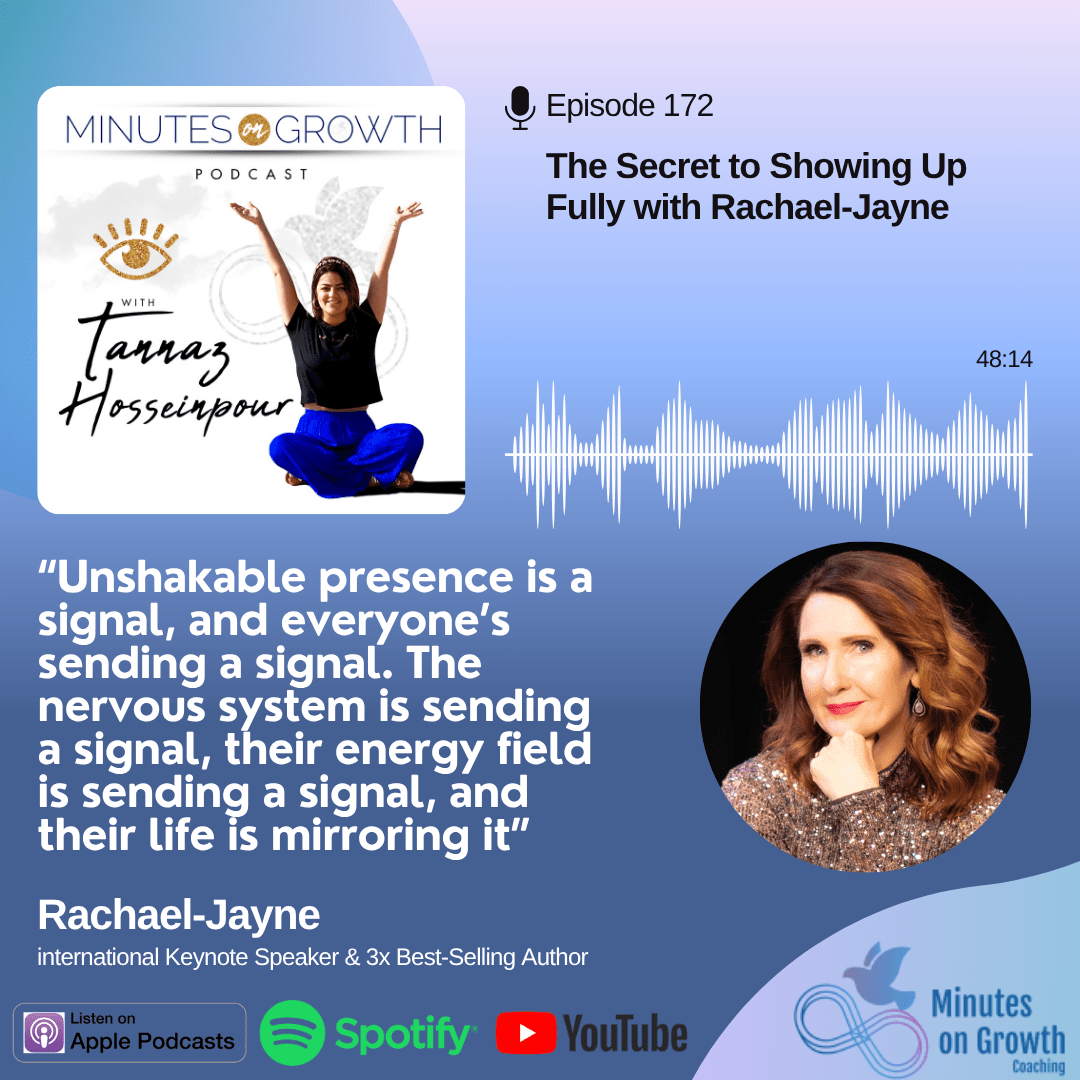
Episode 172 – The Secret to Showing Up Fully with Rachael-Jayne

Click here to listen to Episode 172 of the Minutes on Growth Podcast on Spotify, on Apple Podcast or watch the video on Youtube.

In this 48-minute episode, I sit with Rachael-Jayne, international keynote speaker, TEDx presenter, three-time best-selling author, and founder of The Awakened School, for a powerful conversation about presence, visibility, and magnetic energy. Rachael shares how her work began with her own fear of being seen, and how healing that resistance transformed her life, relationships, and business.

We explore the difference between performance and true embodiment, why so many of us slip into self-consciousness or overgiving, and how our energy field communicates before we even speak. Rachael breaks down her Unshakable Presence framework, including the five primary star codes that support deeper embodiment, receptivity, expression, liberation, and authenticity.

She also shares practical insight on people-pleasing, saying no with clarity, staying grounded under pressure, and reclaiming your life force so you can feel safe, centered, and fully present in any room. If you’ve ever struggled with visibility, burnout, or feeling like you have to be “on” all the time, this conversation offers a fresh and empowering perspective on how to return home to yourself.

In this 48-minute episode, I sit with Rachael Jane, international keynote speaker, TEDx presenter, three-time best-selling author, and founder of The Awakened School, for a powerful conversation about presence, visibility, and magnetic energy. Rachael shares how her work began with her own fear of being seen, and how healing that resistance transformed her life, relationships, and business.

We explore the difference between performance and true embodiment, why so many of us slip into self-consciousness or overgiving, and how our energy field communicates before we even speak. Rachael breaks down her Unshakable Presence framework, including the five primary star codes that support deeper embodiment, receptivity, expression, liberation, and authenticity.

She also shares practical insight on people-pleasing, saying no with clarity, staying grounded under pressure, and reclaiming your life force so you can feel safe, centered, and fully present in any room. If you’ve ever struggled with visibility, burnout, or feeling like you have to be “on” all the time, this conversation offers a fresh and empowering perspective on how to return home to yourself.

To connect with Rachael-Jayne:

Click here for her website

Click here to watch her TEDx video 

Click here to watch her videos on Youtube 

Click here to follow her on Instagram

Click here to follow her on Facebook

Click here to check out your Unshakable Presence Score

Click here to watch the Free Masterclass: An Introduction to Unshakable Presence

Click here to Get Your Ticket to Spiritual & Successful LIVE

Episode 171 – Navigating The Loneliness Epidemic

Click here to listen to Episode 171 of the Minutes on Growth Podcast on Apple Podcast, on Spotify or watch it on Youtube.

Hi soul friends, its Tannaz Hosseinpour and welcome back to another short solo episode of the Minutes on Growth podcast.

Today, I want to talk about something that I genuinely believe is one of the biggest emotional and societal issues of our time.

Loneliness.

And not just physically being alone.

But emotional loneliness.
Feeling unseen.
Feeling disconnected.
Feeling like you’re surrounded by people… yet still somehow feeling emotionally far away from everyone.

I think we’re living through a loneliness epidemic.

And what’s interesting is that this is happening during a time where we are technically more “connected” than ever before.

We can text instantly.
We can FaceTime.
We can follow hundreds or thousands of people online.
We can know what someone ate for breakfast

And yet so many people are craving deeper connection.


The Research on Loneliness

This conversation has become so significant that in 2023, the U.S. Surgeon General released a report called Our Epidemic of Loneliness and Isolation.

And the findings were honestly staggering.

The report found that chronic loneliness has health impacts comparable to smoking 15 cigarettes a day.

And chronic loneliness was associated with increased risk for:

  • depression
  • anxiety
  • cardiovascular disease
  • dementia
  • and even early mortality

Which tells us something really important:

Social connection is not a luxury.
It is a biological need.

Humans are wired for connection.

Historically, we were tribal people. We survived through community, through interdependence, through belonging.

And I think modern culture has slowly convinced many people that needing others is weakness… when actually, needing connection is deeply human.


Being Alone vs Feeling Lonely

And I think it’s important to distinguish something here.

Being alone and feeling lonely are not the same thing.

Solitude can actually be beautiful.

It can be restorative. Peaceful. Creative. Self-connecting.

Loneliness, however, feels different.

Loneliness is emotional disconnection.
It’s feeling like you don’t truly belong.
Like you’re not emotionally met.
Not emotionally safe.

And I think this is important because a lot of people aren’t necessarily lacking proximity to people…

They’re lacking emotional intimacy.

They’re lacking spaces where they feel safe enough to fully be themselves.


Fitting In vs Belonging

This reminds me of something from Brené Brown that I think about often.

She talks about the difference between fitting in and belonging.

Fitting in is:

  • performing
  • masking
  • people pleasing
  • changing yourself to be accepted

But belonging is being accepted as your authentic self.

And I think many people today are surrounded by people who know the curated version of them… but not the real version.

Many people are perceived… but not truly known.

And that creates loneliness too.


Why Are We More Lonely Despite Technology?

And I think this is one of the biggest paradoxes of modern life.

Why are we more lonely despite having more access to communication?

I think part of it is because convenience has started replacing gathering.

We scroll instead of participating.
We consume instead of connecting.

Social media can absolutely create beautiful connections … I’ve genuinely built meaningful community online myself, but it can also create performative connection.

We become updated on people’s lives without actually being emotionally connected to them.

And comparison can intensify loneliness too.

You’re sitting there feeling disconnected while watching everyone else appear fulfilled, connected, thriving.


Attachment, Vulnerability & Fear of Intimacy

I also think many people deeply crave intimacy… while simultaneously fearing vulnerability.

And that paradox is huge.

A lot of people grew up learning:

  • emotions are weakness
  • asking for help is unsafe
  • self-sufficiency equals strength

So people become hyper-independent.

Or emotionally avoidant.

Or anxious and terrified of rejection.

And then later in life, they want deep connection… but vulnerability feels unsafe.

But the reality is:

You cannot deeply connect while emotionally armored all the time.

As Brené Brown says, vulnerability is not weakness — it is the foundation of connection.

Love requires vulnerability.
Trust requires vulnerability.
Belonging requires vulnerability.

And healthy vulnerability is not trauma dumping or oversharing.

It’s honesty.
Emotional openness.
Asking for support.
Allowing yourself to be seen.


Blue Zones & The Power of Community

And this is where I want to bring in something fascinating: the Blue Zones research.

Blue Zones are regions in the world where people statistically live longer and have lower rates of chronic disease.

Places like:

  • Okinawa in Japan
  • Sardinia in Italy
  • Ikaria in Greece
  • Nicoya Peninsula in Costa Rica
  • and Loma Linda in California

And what’s interesting is that many people think Blue Zones are only about diet.

But one of the strongest themes researchers repeatedly found across all of them… was community.

Strong family systems.
Daily social interaction.
Intergenerational living.
Shared rituals.
Purpose.
Belonging.

In Okinawa, there’s something called a Moai ;a lifelong social support group where people emotionally support one another throughout life.

And honestly… community is almost treated like preventative healthcare.

People eat together.
Walk together.
Pray together.
Celebrate together.
Care for elders together.

And I think one of the biggest differences between many Blue Zone cultures and modern Western culture is this:

Belonging is woven into everyday life instead of treated like an extra task.


The Nervous System & Co-Regulation

And this connects so deeply to nervous system health.

Humans regulate through safe connection.

This is called co-regulation.

Things like:

  • eye contact
  • touch
  • laughter
  • shared meals
  • synchronized experiences
  • safe conversations

all help regulate the nervous system.

And this is why healing often happens in relationship, not isolation.

Have you ever noticed how different your body feels around certain people?

Around some people, your nervous system tightens.
You monitor yourself.
You feel anxious.

And around others… your body softens.

You breathe deeper.
You feel safer.
More like yourself.

That matters.

Belonging is not just emotional.

It’s physiological.


The Loss of Third Spaces

There’s also a sociological concept called third spaces.

These are places outside of home and work where connection naturally happens.

Places like:

  • cafés
  • gyms
  • churches or temples
  • book clubs
  • volunteering spaces
  • community centers

Modern life has dramatically reduced many of these spaces.

People are overworked.
Burnt out.
Remote working.
Moving frequently.

And I think our nervous systems feel that loss.

Because humans were never designed to live in chronic isolation.


Healing the Loneliness Epidemic

So what do we do about this?

I think healing loneliness starts smaller than people realize.

Not through grand gestures.

But through small, consistent acts of connection.

Things like:

  • joining a class
  • sending the text first
  • voice notes
  • weekly dinners
  • volunteering
  • participating instead of only consuming
  • deepening existing relationships
  • allowing yourself to be emotionally honest

And this part is important:

Belonging doesn’t usually come before participation.

A lot of people think:
“When I feel confident, I’ll go.”
“When I stop feeling awkward, I’ll reach out.”
“When I feel accepted, I’ll speak.”

But often it works the other way around.

You take the small step while awkwardness is still in the room.

You say hello while your mind predicts rejection.

You allow yourself to slowly build evidence that connection is possible.


Closing

So if you’ve been feeling lonely lately…

I hope this episode reminds you that you are not broken.

Longing for connection is deeply human.

And I genuinely believe people today are starving not just for connection… but for authentic connection.

For spaces where they can be real.
Where they feel emotionally safe.
Where they feel seen beyond performance.

Connection is medicine.

And healing often happens in safe relationships.

I’m really grateful you’re here, soul friends.

And if this episode resonated with you, feel free to share it with someone who might need this reminder too.

I’ll see you in the next episode 💛

Episode 170 – The Psychology of Abuse: How It Starts and How It Spreads

Click here to listen to Episode 170 of the Minutes on Growth Podcast on Spotify, on Apple Podcast or watch it on Youtube.

Hi soul friends, its Tannaz and welcome back to another short solo episode of the Minutes on Growth Podcast.

Today I want to talk about a difficult but deeply important topic: abuse.

Not all harmful conflict is the same. Not all aggression comes from the same place. And if we fail to understand the difference, we risk giving the wrong advice, staying in dangerous situations, or normalizing patterns that can scale from the home… all the way to governments and institutions.

Today we’re going to talk about two different patterns often discussed in relationship research and clinical work:

  • Situational violence or situational abuse
  • Characterological abuse, often linked with coercive control, domination, and chronic intimidation.

We’ll talk about what the research says, how childhood shapes these patterns, what healing can look like, and why understanding abuse in the home can help us understand abuse in society.


Let me start with this: not all conflict is the same

Two people yelling during a heated argument is not the same as one person systematically controlling, terrifying, humiliating, or harming another.

Those are very different dynamics.

Researchers often differentiate between:

1. Situational Couple Violence

This tends to arise during conflict escalation.

It can happen when both people lack emotional regulation skills, communication tools, trauma awareness, or conflict repair strategies.

It may include yelling, pushing, reactive behavior, threats, or emotional harm during intense moments.

This does not make it okay.

But the key distinction is that the violence is not rooted in an ongoing strategy of domination.

It is rooted in dysregulation, poor conflict management, unresolved wounds, and destructive patterns.

2. Characterological Abuse

This is different.

This pattern is about power and control.

It can include:

  • intimidation
  • fear tactics
  • isolation
  • surveillance
  • blame shifting
  • humiliation
  • financial control
  • coercion
  • threats
  • repeated physical or emotional harm
  • lack of remorse
  • punishment when the victim asserts themselves

This is not “we both need communication skills.”

This is one person using power to dominate another.

That distinction matters.


So let’s look at what the Gottmans Say About Situational Conflict

John Gottman and Julie Gottman have spent decades studying couples.

Their work shows that many distressed couples are not evil people. They are flooded people.

They get triggered.

They become defensive.

They criticize instead of expressing needs.

They shut down instead of repairing.

They repeat painful cycles.

In their work, including themes explored in Fight Right, they emphasize that successful couples are not couples who never fight.

They are couples who know how to repair.

That means:

  • taking breaks when flooded
  • softening start-ups
  • validating each other
  • expressing needs without contempt
  • returning after conflict
  • apologizing
  • making small bids for connection

Many situationally aggressive couples can improve significantly when they learn these tools, trauma regulation, and accountability.

That’s hopeful.

Because sometimes what people need are skills, healing, boundaries, and support.

But this only applies when both people are willing to take responsibility and safety is present.


But what about when It’s Not a Skills Problem

If one person says:

  • “You made me do this.”
  • “If you didn’t talk back, I wouldn’t hit you.”
  • “Look what you made me become.”
  • “You’re crazy.”
  • “No one will believe you.”
  • “If you leave, I’ll ruin your life.”

That is not a communication problem.

That is abuse.

And this is where many people lose years of their life trying to “communicate better” with someone whose real goal is control.

You cannot use healthy communication to heal someone committed to domination.


So let’s dive deeper into it. Where Does Characterological Abuse Begin?

Often, it starts in childhood.

Imagine a child hearing:

“Don’t make daddy mad or he’ll hit you.”

“Be quiet so mommy doesn’t explode.”

“Just listen, or this will happen.”

What is the child learning?

Not:

“Violence is wrong.”

They are learning:

  • if I get hurt, it’s my fault
  • power has the right to punish
  • anger excuses cruelty
  • the victim causes the abuse
  • silence keeps me safe

These beliefs can go underground and become subconscious truths.

Then later in life:

The child may tolerate abuse.

Or become abusive.

Or excuse abusive leaders.

Or fear speaking truth.


& that Abuse can manifest on the Macro Level

What happens in homes can happen in nations.

The same psychology scales upward.

In abusive relationships, someone says:

“If you didn’t challenge me, I wouldn’t hurt you.”

In abusive systems, governments say:

“If you protest, we will punish you.”

“If you speak up, we’ll do worse next time.”

“If you don’t want to be harmed, stay silent.”

That is the same logic.

Victim blaming.

Power avoiding accountability.

Fear used as control.

We see these dynamics in many places throughout history and in modern societies, including the pain many people reference regarding Iran and the treatment of protesters.

When a state says obedience is the only path to safety, it mirrors abusive dynamics.


So if You Are in a Characterologically Abusive Relationship

Please hear me clearly:

This is not about trying harder.

This is not about being more patient.

This is not about saying it the perfect way.

Priority becomes:

Safety.

  • Document incidents if safe to do so
  • Reach out to trusted supports
  • Speak with a therapist trained in abuse dynamics
  • Contact a domestic violence hotline or shelter
  • Create a safety plan
  • Protect finances and documents
  • Do not announce exits if danger may escalate
  • Trust patterns, not promises

Many abusive people apologize after consequences.

Watch behavior, not speeches.


I’d like to make space for this Public Service Announcement

If someone controls your movement, isolates you, threatens you, monitors you, degrades you, scares you, or hurts you physically or emotionally—you do not need bruises to call it abuse.

If you are afraid of your partner’s reactions, that matters.

If your nervous system is always on edge, that matters.

If you keep shrinking to stay safe, that matters.

Please reach out for help.

Domestic violence resources, shelters, crisis lines, trusted family, therapists, and community organizations exist for a reason.

You deserve safety.

You deserve dignity.

You deserve a life where love does not require fear.


& here are my Final Thoughts

Conflict can be healed.

Abuse must be named.

Some relationships need skills.

Some relationships need distance.

Some systems need reform.

Some systems need resistance.

And healing begins when we stop asking victims to be quieter… and start asking power to be accountable.

If this episode spoke to you, please share it with someone who may need these words.

As always thank you for listening and speak soon.

Episode 169 – Should Couples Go To Bed Angry?

Click here to listen to Episode 169 of the Minutes on Growth Podcast on Spotify, on Apple Podcast or to watch it on Youtube.

Hi soul friends, its Tannaz Hosseinpour, and welcome back to another short solo episode of the Minutes on Growth podcast.

Today’s episode is inspired by something I recently came across on social media.

I saw a comment that said, “Good couples never go to bed angry.”
And it had so much engagement — people agreeing, reinforcing it, almost treating it like a rule for a healthy relationship.

And I left a comment gently offering a different perspective… and it really resonated with a lot of people.

So I thought — okay, we need to talk about this.

Because what if I told you… sometimes, the healthiest thing you can do in your relationship is actually to go to bed angry?


What Happens When We’re Dysregulated

Let’s start with what’s happening in your brain during conflict.

When you’re calm and regulated, your prefrontal cortex — the part of your brain responsible for logic, empathy, reasoning, and perspective-taking — is online.

This is where you can say:
“I hear you.”
“Let me understand your perspective.”
“Let’s work through this.”

But when you’re triggered, your nervous system shifts.

Your amygdala, which is your brain’s threat detector, takes over.

This is what we often call amygdala hijack.

And when that happens, your prefrontal cortex essentially goes offline.

So now you’re not responding from a grounded, thoughtful place — you’re reacting from survival.

Fight. Flight. Freeze.

And this is where things like:

  • Saying things you don’t mean
  • Raising your voice
  • Shutting down
  • Getting defensive

start to happen.


Physiological Flooding

now you might have heard me share something similar when I was discussing the 4 horsemen. In Gottman’s research, when we’re stonewalling one of the 4 horsemen,  physiological flooding takes place

Your heart rate increases, your body is activated, and you are no longer in a state where productive conversation is even possible.

And this is the part that’s really important:

You cannot solve a problem when your body feels like it’s under threat.

So forcing yourself to “resolve it before bed” in that state?

It often creates more harm than good.

Speaking of the Gottman Institute, one of the maladaptive communication patterns that can show up in relationships (& cause harm) is something called stonewalling, which is one of the Four Horsemen identified by John Gottman.

Stonewalling is when someone shuts down, withdraws, or disengages — often because they’re overwhelmed.

Have you ever found yourself talking to your partner and they’re just staring back at you with a blank face? Or they’re mindlessly scrolling while you’re speaking, and you’re thinking… hello? am I talking to a wall?

And on the other side, the listener might be thinking: there’s so much I want to say, but I don’t have the words… or they just won’t come out.

That’s what we mean by stonewalling….

And here’s the nuance:

Stonewalling isn’t always intentional.
Sometimes it’s actually a nervous system response to being flooded.

But if it’s done without communication, it can feel like abandonment to the other partner.

So the goal is not to force connection when flooded
and it’s also not to completely disconnect without repair.

The goal is a regulated pause.

Pausing is not avoidance.

Pausing is protecting the relationship from unnecessary damage.

But how you pause matters.

It might sound like:

“Hey, I can feel myself getting overwhelmed right now. I really care about this conversation, and I don’t want to say something I don’t mean. Can we take a break and come back to this in a couple of hours or tomorrow?”

Notice what’s happening there:

  • You’re naming your internal state
  • You’re reassuring your partner
  • You’re committing to coming back

This is especially important if your partner has a more anxious attachment style, where pauses can feel like disconnection or abandonment.

So we don’t just walk away.
We communicate the pause.

btw you might be thinking—that’s a lot of talking for someone who’s experiencing emotional flooding. And you’re right. That’s why I often recommend that couples choose a simple code word that represents “pause.” So when words feel hard to access in the moment, they can use that word to let their partner know they need space, without escalating the situation.


Now back to the pause, here’s a really important piece that often gets missed.

If you say, “Let’s talk about this tomorrow,”
you need to come back to it.

And when tomorrow comes, you check in with yourself:

“Am I actually regulated enough to have this conversation?”

If yes — you initiate it.

If not — you communicate again:

“I know we said we’d talk today, and I really want to have this conversation. I’m noticing I’m still not fully regulated. Can we revisit this later today or tomorrow?”

This is how you build:

  • Trust
  • Reliability
  • Emotional safety

Because your partner learns: we don’t avoid — we repair.


Now let’s talk about what to actually do during that pause.

Because the pause isn’t just time passing — it’s intentional regulation.

Here are a few ways you can support your nervous system:

  • Take a walk and get some fresh air
  • Do slow, deep breathing (long exhales help calm the body)
  • Move your body — stretch, shake, or do light exercise
  • Splash cold water on your face or hold something cold
  • Journal what you’re feeling without filtering
  • Listen to calming music
  • Sit in silence and allow the emotion to move through
  • Practice grounding: name 5 things you can see, 4 you can feel, 3 you can hear, 2 you can smell and 1 you can taste

The goal is to bring your body back to safety.

Because once your body feels safe… your mind can think clearly again.


So let’s come back to the original statement:

“Good couples never go to bed angry.”

I would reframe that as:

Healthy couples don’t force resolution when they’re dysregulated.

Sometimes, the most loving thing you can do is say:
“We’re both overwhelmed. Let’s rest. Let’s come back to this when we can actually hear each other.”

Because sleep itself can be regulating.

And often, things feel very different in the morning.


So if you’ve ever gone to bed feeling unresolved, that doesn’t mean your relationship is unhealthy.

What matters is:

  • How you pause
  • How you communicate
  • And how you come back together

Love isn’t about never getting angry.

It’s about learning how to navigate anger in a way that protects the connection.

Thank you for listening,

Speak soon

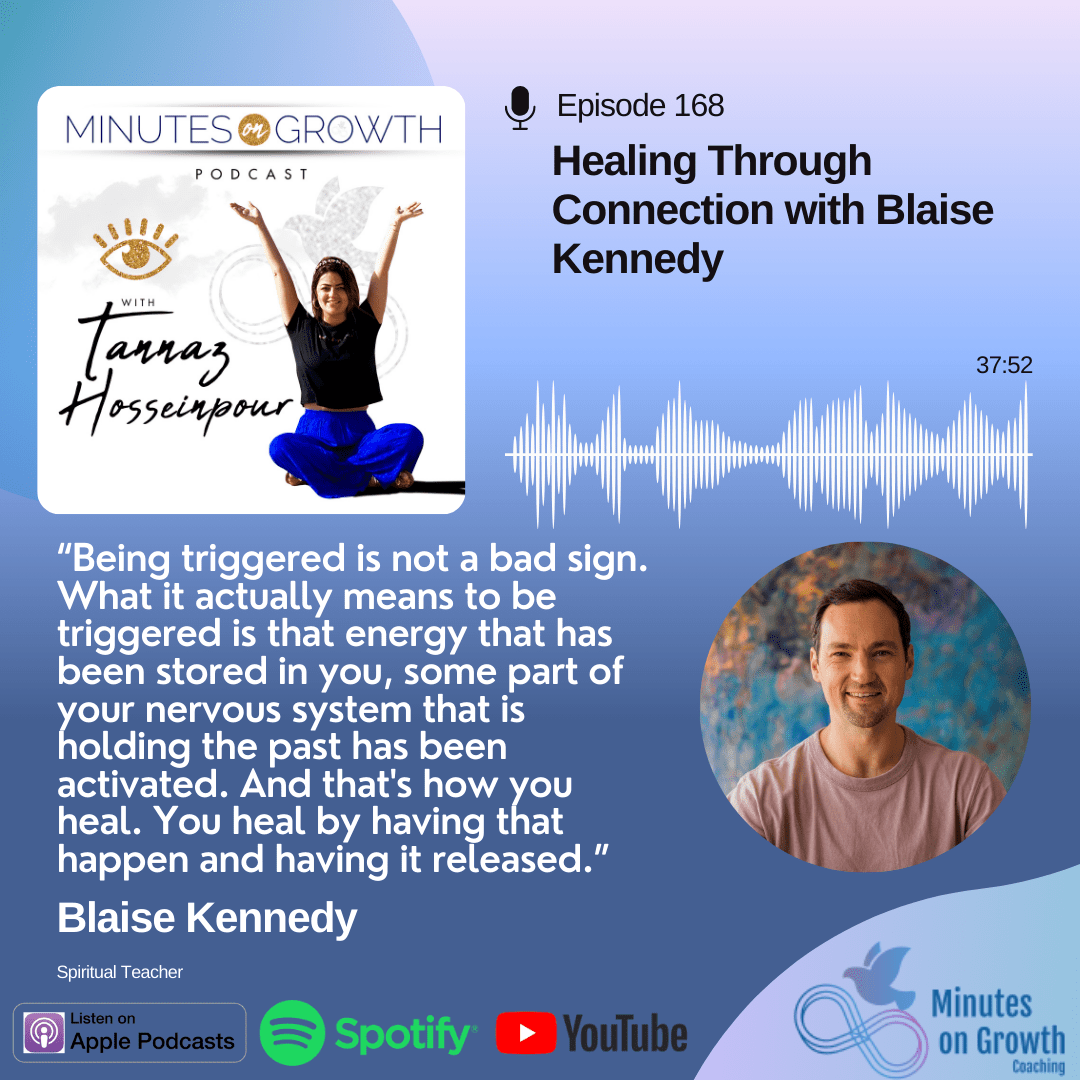
Episode 168 – Healing Through Connection with Blaise Kennedy

Click here to listen to Episode 168 of the Minutes on Growth Podcast on Spotify, on Apple Podcast or watch it on Youtube.

In this episode, I sit with spiritual teacher, Blaise Kennedy, to explore Developmental Architecture; a relational, body-centered approach to healing and awakening.

Blaise explains how presence and co-regulation (being with another who truly listens) accelerate healing, allowing stored developmental material to be felt, released, and integrated rather than replayed as triggers. 

We discuss how trauma creates adaptive strategies of disconnection, and how consistent, attuned relationships can progressively rewrite those patterns.

Blaise shares practical guidance for cultivating emotional awareness when you don’t have an ideal support system: cultivate curiosity, practice returning attention to the body, and seek fields of care that model safety.

He clarifies why intellectual understanding isn’t enough and offers metaphors and simple practices to begin sensing your body history;from noticing where energy is held to tracing the source of recurring reactions.

Whether you’re new to embodiment work or deepening an existing practice, this episode offers a clear roadmap for moving from self-reliance to interdependence and reclaiming your presence.

To learn more about Blaise’s work and to connect with him, click here

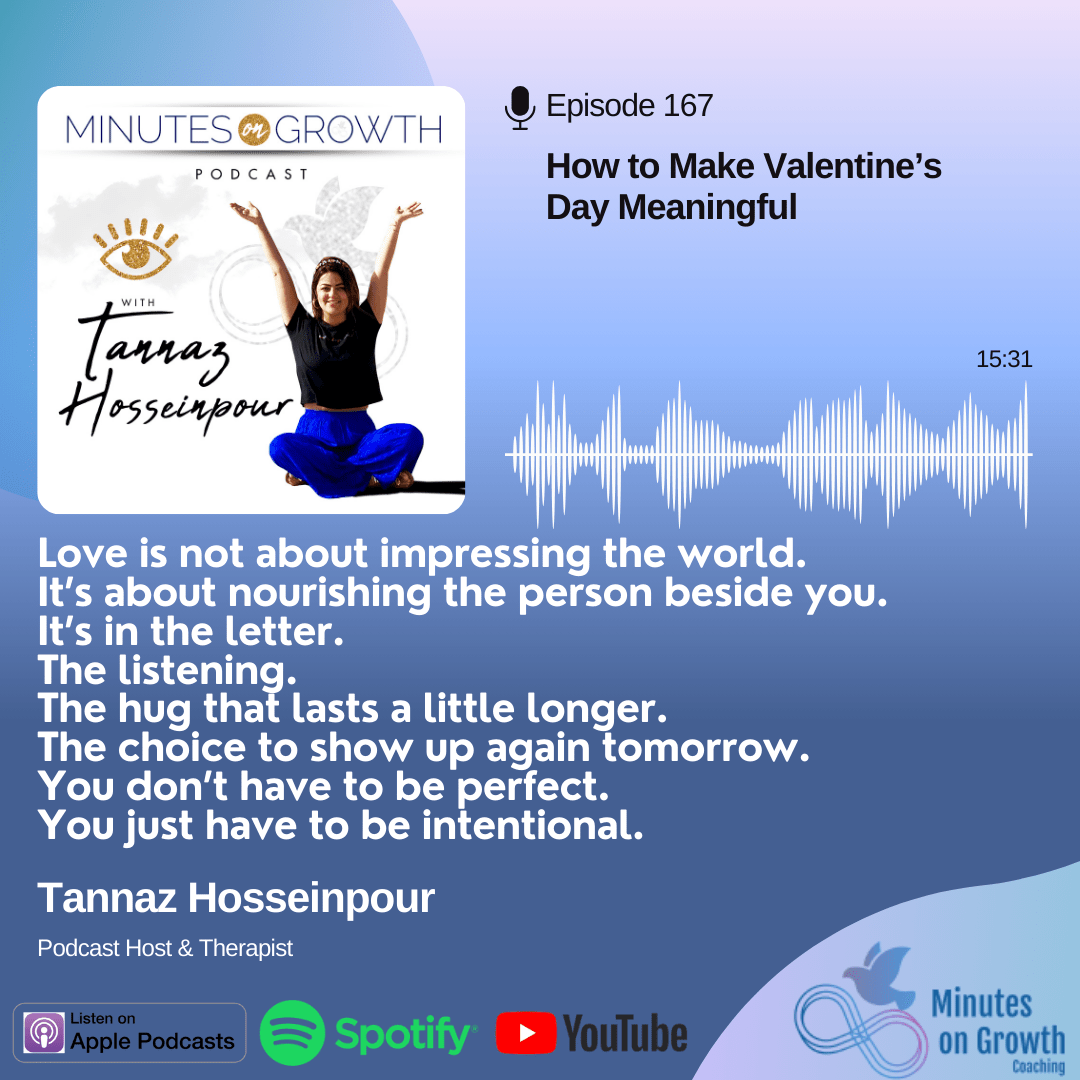
Episode 167 – How to Make Valentine’s Day Meaningful

Click here to listen to Episode 167 of the Minutes on Growth Podcast on Spotify, on Apple Podcast or to watch it on Youtube.

Hi soul friends, its Tannaz Hosseinpour and welcome back to another short solo episode of the Minutes on Growth podcast.

With Valentine’s Day coming up, I wanted to talk about something a little different today.

Because lately, in my sessions and in conversations with people in my community, I’ve been hearing that a lot of those who celebrate Valentine’s Day are feeling stressed — whether it’s because of finances, the state of the economy, or simply the emotional heaviness that can come from the state of the world.

For that last piece especially, I recently came across a beautiful reflection from another therapist about the importance of intentionally seeking micro-joys while moving through big pain — those small, meaningful moments that don’t erase what’s hard, but gently remind our nervous systems that warmth, connection, and goodness still exist alongside it.

for the former, I want to gently remind you — despite what social media might suggest — romance is not about money. It’s about attention and thoughtfulness. That’s not to say money isn’t important or that it’s bad — quite the contrary. Money can be a beautiful tool that enhances the quality of our lives when used intentionally. But in the realm of love, money doesn’t automatically equal romance.

Because at the end of the day, love isn’t built on grand gestures once a year. It’s built in the small, intentional micro moments of connection we create every single day.

So today we’re talking about how to make Valentine’s Day special in a meaningful, grounded, emotionally connected way.

Some of the most powerful things you can do cost absolutely nothing.

You could write your partner a love letter. And I don’t mean a quick “I love you.” I mean a real one. Tell them:

  • What you admire about them
  • A memory that still makes you smile
  • A moment when you felt especially grateful for them
  • What you’re excited to experience together in the future

There is something deeply regulating and bonding about being seen in words. A letter is something they can come back to on hard days. It becomes emotional security in paper form.

You could also recreate your first date at home. Play the same music, cook something simple, or even just sit together and talk about how you both felt when you first met.

Romance isn’t performance. It’s presence.

Speaking of presence, how we show up emotionally especially during hard seasons might look different too, because Valentine’s Day doesn’t land in a vacuum. Life is still happening.

Some people are dealing with long winters, work stress, financial pressure, family issues, or emotional heaviness. For example, Iranians worldwide are grieving the loss of 90,000 people who were massacred by the regime in the month of January. All of these circumstances can impact mood, energy, and emotional capacity.

Loving someone well means being attuned to their emotional climate, not just the calendar.

Instead of asking, “What big thing should we do for Valentine’s Day?” you might ask:

  • “How have you been feeling lately?”
  • “What would feel supportive to you right now?”
  • “Do you want connection, fun, rest, or space?”

Emotional attunement is one of the strongest predictors of relationship satisfaction. It says, I see where you are, not where I wish you were.

Sometimes the most romantic thing you can say is,
“I know you’ve been overwhelmed. I’m here with you.”

Speaking of romantic, one gentle reminder I like to bring up often in my couple’s therapy sessions is that the goal is to love our partners how they’d like to be loved, and not necessarily how we’d like to be loved.


You’ve probably heard of love languages from The Five Love Languages by Gary Chapman — but Valentine’s Day is the perfect time to actually use this knowledge.

If you haven’t come across them before, love languages are the different ways people tend to give and receive love. There are five: Words of Affirmation (verbal appreciation and encouragement), Acts of Service (helpful actions that ease your partner’s life), Receiving Gifts (thoughtful tokens that symbolize care), Quality Time (undivided attention and shared experiences), and Physical Touch (affectionate, comforting contact). Knowing your partner’s primary love language helps you express love in a way that truly lands for them — not just in the way that feels natural to you.

In other words, it isn’t about giving love the way you naturally do. It’s about giving love the way your partner receives it best.

Here are the five love languages, with simple Valentine’s ideas for each:

1️⃣ Words of Affirmation
Write them a note. Send a thoughtful text during the day. Tell them specifically what you appreciate about who they are & not just what they do.

2️⃣ Acts of Service
Take something off their plate. Clean, cook, run an errand, fix something they’ve been putting off. Acts of service say, I care about your stress level.

3️⃣ Quality Time
Put your phones away. Go for a walk. Have a deep conversation. Play a game. Watch a show and actually cuddle and talk about it after. Presence is the gift.

4️⃣ Physical Touch
Longer hugs. Sitting close. Holding hands. A back rub. Gentle, affectionate touch increases oxytocin and feelings of safety.

5️⃣ Receiving Gifts
This doesn’t have to be expensive. A favorite snack, a printed photo of you two, a flower picked on a walk — the meaning matters more than the price tag. And if you do have the financial means to go all out and that feels joyful and aligned for both of you, that’s beautiful too. Whatever works for your relationship.

And I also want to name this gently: if you’re in a season of financial constraint and your partner is expecting something expensive, it’s okay — and actually healthy — to have that conversation. this can actually be an opportunity for deeper connection. Letting them into your inner world might sound like, “I know that gift means a lot to you, and I wish I could do that right now. At the moment, I’m not in a place financially to make that happen — but I still really want to make you feel loved and special.”

Open, honest conversations about money build emotional safety. They help you move from secrecy or pressure into teamwork. It shifts the dynamic from me versus you to us as a team navigating life together.And just because you can’t show up financially in the way you might want to doesn’t mean you can’t show up in other meaningful ways — through presence, effort, care, and emotional availability. That, too, is love.

So yes, loving someone in their language says, I took the time to learn how your heart works.

How beautiful is that? because at the end of the day, don’t we all have the same desire to feel seen, heard, understood and valued?


Which brings me to this… Valentine’s Day is beautiful but a healthy relationship is built in the ordinary Tuesdays.

You don’t have to show up perfectly every day. Life happens. Stress happens. We get tired. We get distracted.

But what matters is the intentional effort we put in to show up to the best of our ability, whatever our best looks like that day.

Waking up and thinking:
“How can I show up for us today, even in a small way?”

Research from John Gottman at The Gottman Institute shows that strong couples maintain about a 5 to 1 ratio of positive to negative interactions. That means small daily kindnesses — smiles, gratitude, affection, humor — create emotional resilience in the relationship. Think of it as deposits in our relational piggy bank.

The Gottmans also talk about the importance of “turning toward” your partner’s bids for connection. When they share something small, ask for attention, make a joke, or sigh after a long day — those are invitations. And responding with warmth instead of distraction builds trust over time.

These are all evidence that love isn’t proven in grand gestures. It’s proven in daily responsiveness.


So this Valentine’s Day, remember:

Love is not about impressing the world.
It’s about nourishing the person beside you.

It’s in the letter.
The listening.
The hug that lasts a little longer.
The choice to show up again tomorrow.

You don’t have to be perfect.
You just have to be intentional.

Happy Valentine’s Day, soul friends.
May your love feel safe, seen, and deeply valued.

I’ll see you in the next episode 💛


Episode 166 – Responding to Injustice

Click here to listen to Episode 166 of the Minutes on Growth Podcast on Spotify, on Apple Podcast, or watch it on Youtube

Hi soul friends,

It’s Tannaz, and welcome back to another short solo episode of the Minutes on Growth Podcast .
Today’s episode is different. It’s heavier. It’s necessary.

Because there are moments in history—and in our nervous systems—when the weight of injustice can’t be ignored.

Whether you’ve been closely following what’s happening in Iran, or you’ve recently come across the disturbing release of the Epstein files, this episode is here to hold space for your rage, your heartbreak, your numbness, and your hope.

Let’s begin with a grounding breath—
Inhale through your nose,
Exhale through your mouth with a sigh… ahhh.
You’re here. And that matters.


Let’s start by looking at what’s been happening in Iran.

So in late December of 2025, protests erupted across Iran; millions of people rising up against economic collapse, systemic repression, and 47 years of authoritarian rule.

By January 8th and 9th, 2026, those protests were met with one of the most horrific responses in modern history: a brutal massacre that left tens of thousands of civilians dead in just two days. The current unofficial numbers are 40,000+ but the reality is significantly higher.

The regime imposed a near-total communication blackout.

  • Internet and phone lines were cut.
  • Messaging apps like WhatsApp and Telegram went dark.
  • Even emergency services were inaccessible.

For nearly two weeks, families in the diaspora couldn’t reach loved ones. It was the same situation in the country too. Even basic safety and medical needs were left unanswered.

Only fragments of truth emerged—thanks to limited Starlink access.
But even those fragments were devastating:

  • The regime using military grade equipment to kill protestors in broad daylight.
  • Regime bringing in foreign militia to help with their democide
  • Hospitals being stormed and injured protestors being outright shot.
  • Forced confessions aired on state TV.
  • Families being charged exorbitant sums — or coerced into signing false statements — in order to receive the bodies of their loved ones

This wasn’t chaos. It was deliberate, premeditated cruelty.

And yet, mainstream media coverage was shockingly silent.


What many Iranians — emotionally, mentally, and spiritually — are going through right now is profound.

There isn’t just one kind of grief here. There are layers:

  1. Collective Grief:
    For the tens of thousands murdered. For lives and dreams cut short.
  2. Anticipatory Grief:
    For those still missing, as tens of thousands of protestors were arrested or abducted — living with the unbearable uncertainty of not knowing whether our loved ones are alive, safe, or at risk of being executed without due process.
  3. Disenfranchised Grief:
    This is grief that the world doesn’t officially recognize. There’s no global holiday to mourn the massacre. There’s no state funeral. There’s no public acknowledgment in most international quarters. No UN statements. Just silence.

Speaking of Silence…

Silence is not neutral.

Silence protects perpetrators.
Silence keeps the machinery of oppression running.

When global media ignores atrocities like this, regimes are emboldened.
And victims are buried—not just in death, but in forgetting.

This is why witnessing matters.

  • Sharing stories.
  • Amplifying accurate information.
  • Holding space for the names, the faces, the voices.

Because when the world sees, pressure builds.
And when we remember, we resist invisibility.

Already, we’ve seen the power of collective voices making an impact. Some executions have been halted, though tragically, at least 292 others have still been carried out. We’ve also seen institutions abroad begin holding the regime accountable in tangible ways — including universities and organizations distancing themselves from, or dismissing, the children of high‑ranking regime officials who live comfortably in the very countries the regime publicly condemns as “satanic,” while forcing children inside Iran to chant “death to” slogans.

Just last weekend, Toronto witnessed one of the largest political rallies in its history, with over 150,000 people gathering peacefully. The demonstration was so orderly that Toronto Police released a public statement noting there was not a single incident.

People often ask, “Why protest every week when this is happening on the other side of the world?”
Because when media coverage is limited, we become the amplifiers. And it works. Following the rally, several Canadian news outlets finally began reporting on what’s happening.

It’s important for the world to understand that Iranians are calling for regime change. It’s important for people to see the atrocities being committed so that governments stop legitimizing the current regime and instead open dialogue with the transitional leader many Iranians support — Reza Pahlavi, the son of Iran’s last monarch, who was overthrown in 1979.

But all of this advocacy… all of this witnessing… is heavy.

If you’ve felt more irritable lately, more distracted, more emotionally raw —
you’re not being “dramatic.”
You’re being human.

This is grief.

And even more than that, this is secondary trauma. When people around the world see it, feel it, and carry it in their bodies, we are witnessing suffering that our nervous systems were never designed to process passively. This isn’t academic. It isn’t abstract. It’s embodied. It’s real.

Your anger. Your sorrow. Your exhaustion.
These are valid responses to witnessing injustice unfold in real time.

It’s your nervous system trying to make sense of something unbearable..


So what can we do—when it all feels too much?

Try these gentle practices:

  • Name what’s true
    Whisper to yourself: “This makes sense.” You’re not weak for feeling this.
  • Place a hand on your heart or belly
    Take a deep breath in through your nose, and gently release it through your mouth. The longer the exhale the better. Soothe your system. Be present.
  • Ground into the now
    Use the 5-4-3-2-1 technique:
    5 things you see
    4 things you touch
    3 things you hear
    2 things you smell
    1 thing you taste
  • Move your body
    Shake. Cry. Hum. Trauma doesn’t leave through thinking—it leaves through movement.
  • Set a timer for grief or rage
    Let yourself feel fully—for 5 minutes. Then pause. Come back later if needed.

And if you have the capacity—advocate, donate, amplify.
Not everyone can do everything. But everyone can do something.


And not just for Iran. For everywhere that injustice is present.

This past week, people are feeling waves of grief and fury in response to the new releases of the Epstein files.

Names. Cover-ups. Systems that protect abusers and silence survivors.
For many, it’s not “new” information—but having it confirmed again, seeing the impunity of power—can feel retraumatizing.

You might be asking:
How is this still happening?
Why aren’t more people talking about it?
What do I do with this fire in my chest?

That’s why this episode exists.

What connects these events is this:
A world that too often silences pain and shields power.

But you can disrupt that.
We all can.

  • By witnessing.
  • By validating.
  • By refusing to look away.

I also want to take a moment and talk about Why Emotional Validation Is Essential (Especially Across Cultures)

When you’re triggered by injustice, your nervous system is flooded.

You may feel rage. Grief. Numbness. Fear.
And yet—especially in trauma-impacted or collectivist cultures—we’re taught to suppress.
To “be strong.”
To “move on.”

But neuroscience says otherwise.
Research by Dr. Dan Siegel and Dr. Kristin Neff shows that when our emotions are acknowledged—by ourselves or another—our brain’s threat system calms. This is called co-regulation.

And here’s the nuance:
In many cultures, emotions like anger or grief are seen as “too much.” Especially for women. Especially for those in marginalized communities.

But validation is not indulgence.
Validation is recognition.

It’s saying:
“Of course you’re feeling this way. What you’ve witnessed, what you’ve lost, what you’re carrying—makes sense.”

So if no one has said this to you today:
Your rage is valid.
Your heartbreak is valid.


Your nervous system was never meant to carry the grief of the world alone.
And yet, here we are—learning how to hold pain and purpose in the same breath.

So as you move through this week, ask yourself:

  • How can I honour my body’s cues today?
  • How can I validate what I’m feeling?
  • And how can I be part of the collective healing, without burning out my own flame?

You are not alone.

No justice without truth.
No peace without grief.
No healing without each other.

Thank you for listening.
Thank you for feeling.

If this episode moved you, please share it.
Let’s make sure the stories being silenced are still heard.

And remember:
Your compassion is not a burden.
It is a force.

Until next time,
Stay grounded. Stay tender.
And keep showing up with love.