
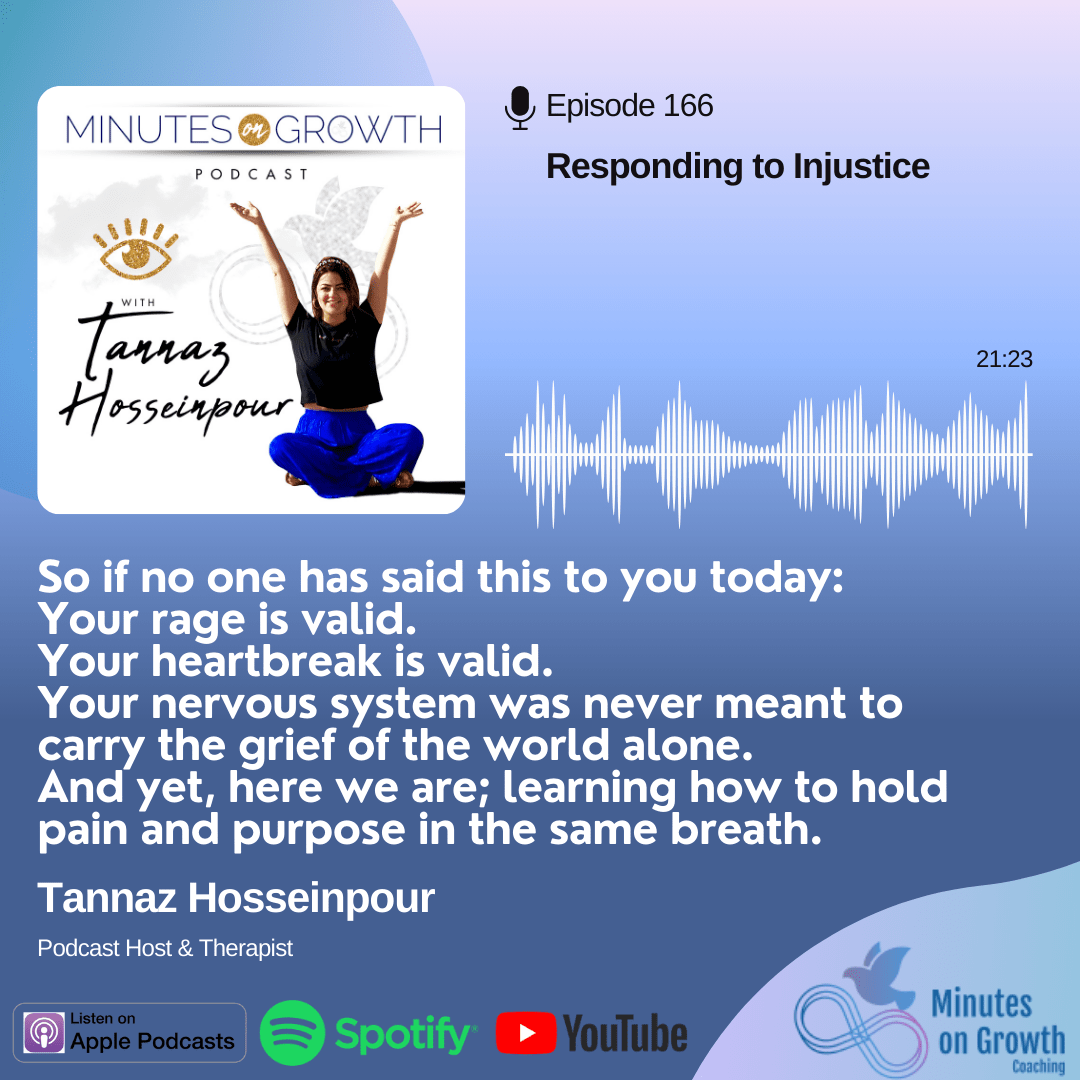
Click here to listen to Episode 166 of the Minutes on Growth Podcast on Spotify, on Apple Podcast, or watch it on Youtube
Hi soul friends,
It’s Tannaz, and welcome back to another short solo episode of the Minutes on Growth Podcast .
Today’s episode is different. It’s heavier. It’s necessary.
Because there are moments in history—and in our nervous systems—when the weight of injustice can’t be ignored.
Whether you’ve been closely following what’s happening in Iran, or you’ve recently come across the disturbing release of the Epstein files, this episode is here to hold space for your rage, your heartbreak, your numbness, and your hope.
Let’s begin with a grounding breath—
Inhale through your nose,
Exhale through your mouth with a sigh… ahhh.
You’re here. And that matters.
Let’s start by looking at what’s been happening in Iran.
So in late December of 2025, protests erupted across Iran; millions of people rising up against economic collapse, systemic repression, and 47 years of authoritarian rule.
By January 8th and 9th, 2026, those protests were met with one of the most horrific responses in modern history: a brutal massacre that left tens of thousands of civilians dead in just two days. The current unofficial numbers are 40,000+ but the reality is significantly higher.
The regime imposed a near-total communication blackout.
- Internet and phone lines were cut.
- Messaging apps like WhatsApp and Telegram went dark.
- Even emergency services were inaccessible.
For nearly two weeks, families in the diaspora couldn’t reach loved ones. It was the same situation in the country too. Even basic safety and medical needs were left unanswered.
Only fragments of truth emerged—thanks to limited Starlink access.
But even those fragments were devastating:
- The regime using military grade equipment to kill protestors in broad daylight.
- Regime bringing in foreign militia to help with their democide
- Hospitals being stormed and injured protestors being outright shot.
- Forced confessions aired on state TV.
- Families being charged exorbitant sums — or coerced into signing false statements — in order to receive the bodies of their loved ones
This wasn’t chaos. It was deliberate, premeditated cruelty.
And yet, mainstream media coverage was shockingly silent.
What many Iranians — emotionally, mentally, and spiritually — are going through right now is profound.
There isn’t just one kind of grief here. There are layers:
- Collective Grief:
For the tens of thousands murdered. For lives and dreams cut short. - Anticipatory Grief:
For those still missing, as tens of thousands of protestors were arrested or abducted — living with the unbearable uncertainty of not knowing whether our loved ones are alive, safe, or at risk of being executed without due process. - Disenfranchised Grief:
This is grief that the world doesn’t officially recognize. There’s no global holiday to mourn the massacre. There’s no state funeral. There’s no public acknowledgment in most international quarters. No UN statements. Just silence.
Speaking of Silence…
Silence is not neutral.
Silence protects perpetrators.
Silence keeps the machinery of oppression running.
When global media ignores atrocities like this, regimes are emboldened.
And victims are buried—not just in death, but in forgetting.
This is why witnessing matters.
- Sharing stories.
- Amplifying accurate information.
- Holding space for the names, the faces, the voices.
Because when the world sees, pressure builds.
And when we remember, we resist invisibility.
Already, we’ve seen the power of collective voices making an impact. Some executions have been halted, though tragically, at least 292 others have still been carried out. We’ve also seen institutions abroad begin holding the regime accountable in tangible ways — including universities and organizations distancing themselves from, or dismissing, the children of high‑ranking regime officials who live comfortably in the very countries the regime publicly condemns as “satanic,” while forcing children inside Iran to chant “death to” slogans.
Just last weekend, Toronto witnessed one of the largest political rallies in its history, with over 150,000 people gathering peacefully. The demonstration was so orderly that Toronto Police released a public statement noting there was not a single incident.
People often ask, “Why protest every week when this is happening on the other side of the world?”
Because when media coverage is limited, we become the amplifiers. And it works. Following the rally, several Canadian news outlets finally began reporting on what’s happening.
It’s important for the world to understand that Iranians are calling for regime change. It’s important for people to see the atrocities being committed so that governments stop legitimizing the current regime and instead open dialogue with the transitional leader many Iranians support — Reza Pahlavi, the son of Iran’s last monarch, who was overthrown in 1979.
But all of this advocacy… all of this witnessing… is heavy.
If you’ve felt more irritable lately, more distracted, more emotionally raw —
you’re not being “dramatic.”
You’re being human.
This is grief.
And even more than that, this is secondary trauma. When people around the world see it, feel it, and carry it in their bodies, we are witnessing suffering that our nervous systems were never designed to process passively. This isn’t academic. It isn’t abstract. It’s embodied. It’s real.
Your anger. Your sorrow. Your exhaustion.
These are valid responses to witnessing injustice unfold in real time.
It’s your nervous system trying to make sense of something unbearable..
So what can we do—when it all feels too much?
Try these gentle practices:
- Name what’s true
Whisper to yourself: “This makes sense.” You’re not weak for feeling this. - Place a hand on your heart or belly
Take a deep breath in through your nose, and gently release it through your mouth. The longer the exhale the better. Soothe your system. Be present. - Ground into the now
Use the 5-4-3-2-1 technique:
5 things you see
4 things you touch
3 things you hear
2 things you smell
1 thing you taste - Move your body
Shake. Cry. Hum. Trauma doesn’t leave through thinking—it leaves through movement. - Set a timer for grief or rage
Let yourself feel fully—for 5 minutes. Then pause. Come back later if needed.
And if you have the capacity—advocate, donate, amplify.
Not everyone can do everything. But everyone can do something.
And not just for Iran. For everywhere that injustice is present.
This past week, people are feeling waves of grief and fury in response to the new releases of the Epstein files.
Names. Cover-ups. Systems that protect abusers and silence survivors.
For many, it’s not “new” information—but having it confirmed again, seeing the impunity of power—can feel retraumatizing.
You might be asking:
How is this still happening?
Why aren’t more people talking about it?
What do I do with this fire in my chest?
That’s why this episode exists.
What connects these events is this:
A world that too often silences pain and shields power.
But you can disrupt that.
We all can.
- By witnessing.
- By validating.
- By refusing to look away.
I also want to take a moment and talk about Why Emotional Validation Is Essential (Especially Across Cultures)
When you’re triggered by injustice, your nervous system is flooded.
You may feel rage. Grief. Numbness. Fear.
And yet—especially in trauma-impacted or collectivist cultures—we’re taught to suppress.
To “be strong.”
To “move on.”
But neuroscience says otherwise.
Research by Dr. Dan Siegel and Dr. Kristin Neff shows that when our emotions are acknowledged—by ourselves or another—our brain’s threat system calms. This is called co-regulation.
And here’s the nuance:
In many cultures, emotions like anger or grief are seen as “too much.” Especially for women. Especially for those in marginalized communities.
But validation is not indulgence.
Validation is recognition.
It’s saying:
“Of course you’re feeling this way. What you’ve witnessed, what you’ve lost, what you’re carrying—makes sense.”
So if no one has said this to you today:
Your rage is valid.
Your heartbreak is valid.
Your nervous system was never meant to carry the grief of the world alone.
And yet, here we are—learning how to hold pain and purpose in the same breath.
So as you move through this week, ask yourself:
- How can I honour my body’s cues today?
- How can I validate what I’m feeling?
- And how can I be part of the collective healing, without burning out my own flame?
You are not alone.
No justice without truth.
No peace without grief.
No healing without each other.
Thank you for listening.
Thank you for feeling.
If this episode moved you, please share it.
Let’s make sure the stories being silenced are still heard.
And remember:
Your compassion is not a burden.
It is a force.
Until next time,
Stay grounded. Stay tender.
And keep showing up with love.
 Minutes on Growth