
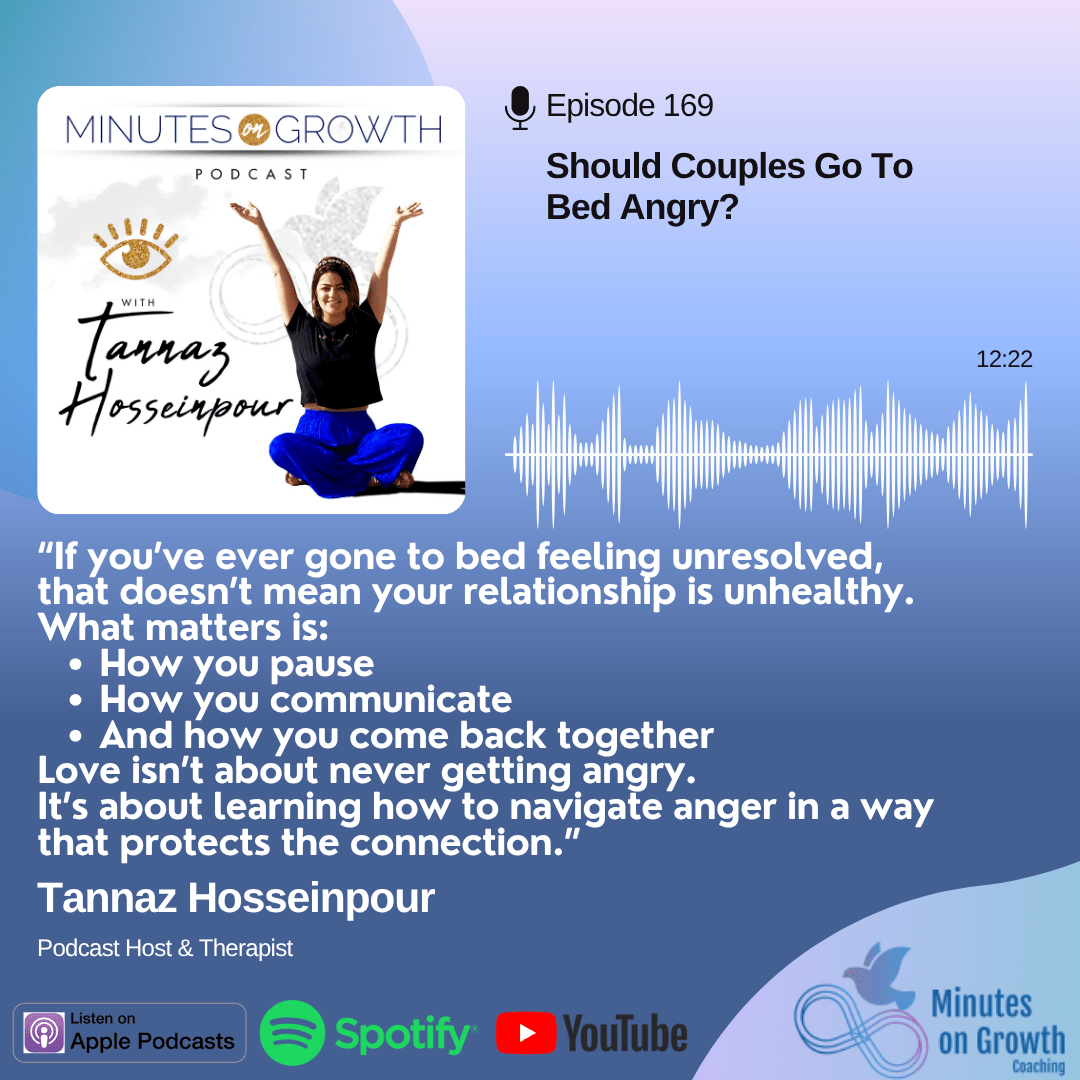
Click here to listen to Episode 169 of the Minutes on Growth Podcast on Spotify, on Apple Podcast or to watch it on Youtube.
Hi soul friends, its Tannaz Hosseinpour, and welcome back to another short solo episode of the Minutes on Growth podcast.
Today’s episode is inspired by something I recently came across on social media.
I saw a comment that said, “Good couples never go to bed angry.”
And it had so much engagement — people agreeing, reinforcing it, almost treating it like a rule for a healthy relationship.
And I left a comment gently offering a different perspective… and it really resonated with a lot of people.
So I thought — okay, we need to talk about this.
Because what if I told you… sometimes, the healthiest thing you can do in your relationship is actually to go to bed angry?
What Happens When We’re Dysregulated
Let’s start with what’s happening in your brain during conflict.
When you’re calm and regulated, your prefrontal cortex — the part of your brain responsible for logic, empathy, reasoning, and perspective-taking — is online.
This is where you can say:
“I hear you.”
“Let me understand your perspective.”
“Let’s work through this.”
But when you’re triggered, your nervous system shifts.
Your amygdala, which is your brain’s threat detector, takes over.
This is what we often call amygdala hijack.
And when that happens, your prefrontal cortex essentially goes offline.
So now you’re not responding from a grounded, thoughtful place — you’re reacting from survival.
Fight. Flight. Freeze.
And this is where things like:
- Saying things you don’t mean
- Raising your voice
- Shutting down
- Getting defensive
start to happen.
Physiological Flooding
now you might have heard me share something similar when I was discussing the 4 horsemen. In Gottman’s research, when we’re stonewalling one of the 4 horsemen, physiological flooding takes place
Your heart rate increases, your body is activated, and you are no longer in a state where productive conversation is even possible.
And this is the part that’s really important:
You cannot solve a problem when your body feels like it’s under threat.
So forcing yourself to “resolve it before bed” in that state?
It often creates more harm than good.
Speaking of the Gottman Institute, one of the maladaptive communication patterns that can show up in relationships (& cause harm) is something called stonewalling, which is one of the Four Horsemen identified by John Gottman.
Stonewalling is when someone shuts down, withdraws, or disengages — often because they’re overwhelmed.
Have you ever found yourself talking to your partner and they’re just staring back at you with a blank face? Or they’re mindlessly scrolling while you’re speaking, and you’re thinking… hello? am I talking to a wall?
And on the other side, the listener might be thinking: there’s so much I want to say, but I don’t have the words… or they just won’t come out.
That’s what we mean by stonewalling….
And here’s the nuance:
Stonewalling isn’t always intentional.
Sometimes it’s actually a nervous system response to being flooded.
But if it’s done without communication, it can feel like abandonment to the other partner.
So the goal is not to force connection when flooded…
and it’s also not to completely disconnect without repair.
The goal is a regulated pause.
Pausing is not avoidance.
Pausing is protecting the relationship from unnecessary damage.
But how you pause matters.
It might sound like:
“Hey, I can feel myself getting overwhelmed right now. I really care about this conversation, and I don’t want to say something I don’t mean. Can we take a break and come back to this in a couple of hours or tomorrow?”
Notice what’s happening there:
- You’re naming your internal state
- You’re reassuring your partner
- You’re committing to coming back
This is especially important if your partner has a more anxious attachment style, where pauses can feel like disconnection or abandonment.
So we don’t just walk away.
We communicate the pause.
btw you might be thinking—that’s a lot of talking for someone who’s experiencing emotional flooding. And you’re right. That’s why I often recommend that couples choose a simple code word that represents “pause.” So when words feel hard to access in the moment, they can use that word to let their partner know they need space, without escalating the situation.
Now back to the pause, here’s a really important piece that often gets missed.
If you say, “Let’s talk about this tomorrow,”
you need to come back to it.
And when tomorrow comes, you check in with yourself:
“Am I actually regulated enough to have this conversation?”
If yes — you initiate it.
If not — you communicate again:
“I know we said we’d talk today, and I really want to have this conversation. I’m noticing I’m still not fully regulated. Can we revisit this later today or tomorrow?”
This is how you build:
- Trust
- Reliability
- Emotional safety
Because your partner learns: we don’t avoid — we repair.
Now let’s talk about what to actually do during that pause.
Because the pause isn’t just time passing — it’s intentional regulation.
Here are a few ways you can support your nervous system:
- Take a walk and get some fresh air
- Do slow, deep breathing (long exhales help calm the body)
- Move your body — stretch, shake, or do light exercise
- Splash cold water on your face or hold something cold
- Journal what you’re feeling without filtering
- Listen to calming music
- Sit in silence and allow the emotion to move through
- Practice grounding: name 5 things you can see, 4 you can feel, 3 you can hear, 2 you can smell and 1 you can taste
The goal is to bring your body back to safety.
Because once your body feels safe… your mind can think clearly again.
So let’s come back to the original statement:
“Good couples never go to bed angry.”
I would reframe that as:
Healthy couples don’t force resolution when they’re dysregulated.
Sometimes, the most loving thing you can do is say:
“We’re both overwhelmed. Let’s rest. Let’s come back to this when we can actually hear each other.”
Because sleep itself can be regulating.
And often, things feel very different in the morning.
So if you’ve ever gone to bed feeling unresolved, that doesn’t mean your relationship is unhealthy.
What matters is:
- How you pause
- How you communicate
- And how you come back together
Love isn’t about never getting angry.
It’s about learning how to navigate anger in a way that protects the connection.
Thank you for listening,
Speak soon
 Minutes on Growth