
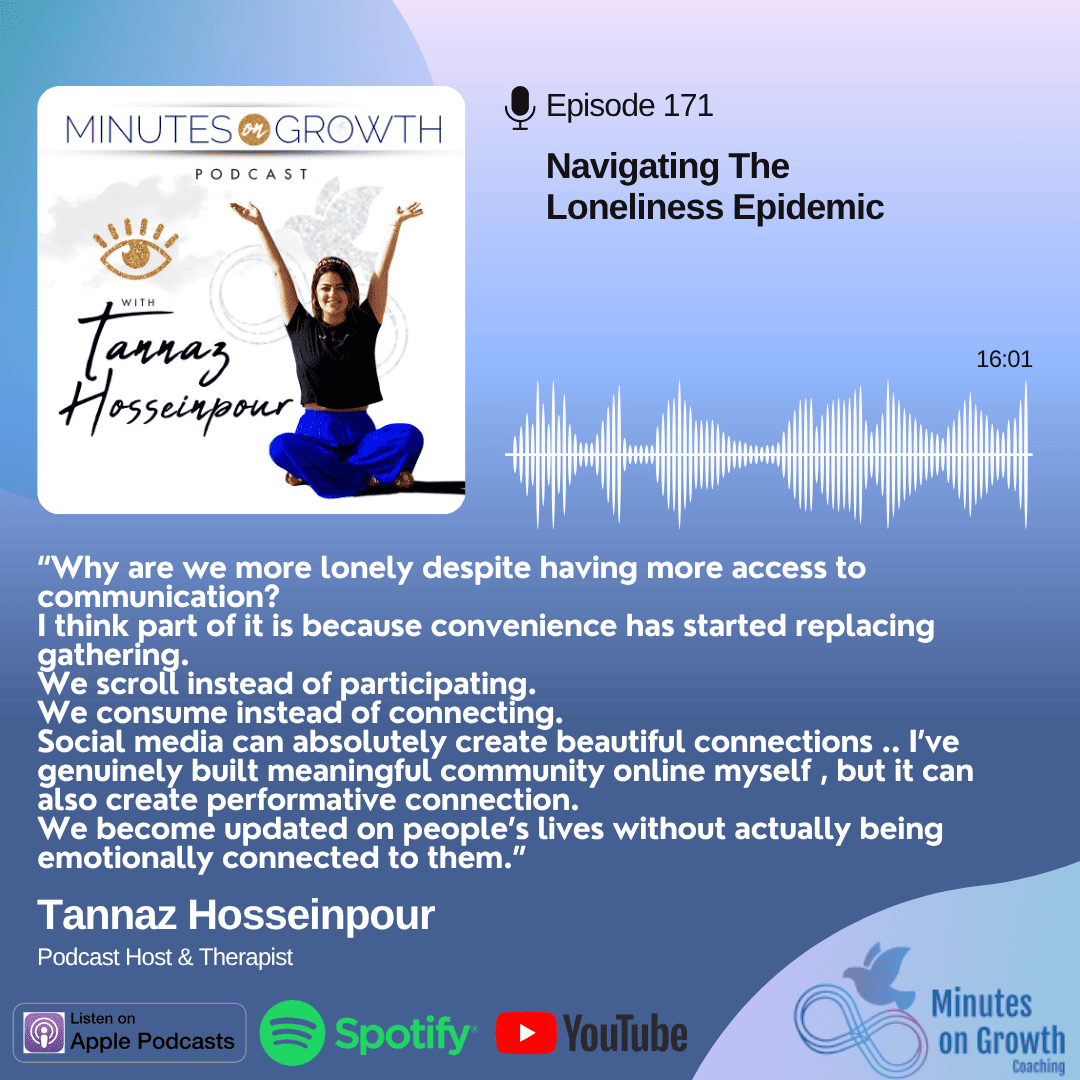
Click here to listen to Episode 171 of the Minutes on Growth Podcast on Apple Podcast, on Spotify or watch it on Youtube.
Hi soul friends, its Tannaz Hosseinpour and welcome back to another short solo episode of the Minutes on Growth podcast.
Today, I want to talk about something that I genuinely believe is one of the biggest emotional and societal issues of our time.
Loneliness.
And not just physically being alone.
But emotional loneliness.
Feeling unseen.
Feeling disconnected.
Feeling like you’re surrounded by people… yet still somehow feeling emotionally far away from everyone.
I think we’re living through a loneliness epidemic.
And what’s interesting is that this is happening during a time where we are technically more “connected” than ever before.
We can text instantly.
We can FaceTime.
We can follow hundreds or thousands of people online.
We can know what someone ate for breakfast
And yet so many people are craving deeper connection.
The Research on Loneliness
This conversation has become so significant that in 2023, the U.S. Surgeon General released a report called Our Epidemic of Loneliness and Isolation.
And the findings were honestly staggering.
The report found that chronic loneliness has health impacts comparable to smoking 15 cigarettes a day.
And chronic loneliness was associated with increased risk for:
- depression
- anxiety
- cardiovascular disease
- dementia
- and even early mortality
Which tells us something really important:
Social connection is not a luxury.
It is a biological need.
Humans are wired for connection.
Historically, we were tribal people. We survived through community, through interdependence, through belonging.
And I think modern culture has slowly convinced many people that needing others is weakness… when actually, needing connection is deeply human.
Being Alone vs Feeling Lonely
And I think it’s important to distinguish something here.
Being alone and feeling lonely are not the same thing.
Solitude can actually be beautiful.
It can be restorative. Peaceful. Creative. Self-connecting.
Loneliness, however, feels different.
Loneliness is emotional disconnection.
It’s feeling like you don’t truly belong.
Like you’re not emotionally met.
Not emotionally safe.
And I think this is important because a lot of people aren’t necessarily lacking proximity to people…
They’re lacking emotional intimacy.
They’re lacking spaces where they feel safe enough to fully be themselves.
Fitting In vs Belonging
This reminds me of something from Brené Brown that I think about often.
She talks about the difference between fitting in and belonging.
Fitting in is:
- performing
- masking
- people pleasing
- changing yourself to be accepted
But belonging is being accepted as your authentic self.
And I think many people today are surrounded by people who know the curated version of them… but not the real version.
Many people are perceived… but not truly known.
And that creates loneliness too.
Why Are We More Lonely Despite Technology?
And I think this is one of the biggest paradoxes of modern life.
Why are we more lonely despite having more access to communication?
I think part of it is because convenience has started replacing gathering.
We scroll instead of participating.
We consume instead of connecting.
Social media can absolutely create beautiful connections … I’ve genuinely built meaningful community online myself, but it can also create performative connection.
We become updated on people’s lives without actually being emotionally connected to them.
And comparison can intensify loneliness too.
You’re sitting there feeling disconnected while watching everyone else appear fulfilled, connected, thriving.
Attachment, Vulnerability & Fear of Intimacy
I also think many people deeply crave intimacy… while simultaneously fearing vulnerability.
And that paradox is huge.
A lot of people grew up learning:
- emotions are weakness
- asking for help is unsafe
- self-sufficiency equals strength
So people become hyper-independent.
Or emotionally avoidant.
Or anxious and terrified of rejection.
And then later in life, they want deep connection… but vulnerability feels unsafe.
But the reality is:
You cannot deeply connect while emotionally armored all the time.
As Brené Brown says, vulnerability is not weakness — it is the foundation of connection.
Love requires vulnerability.
Trust requires vulnerability.
Belonging requires vulnerability.
And healthy vulnerability is not trauma dumping or oversharing.
It’s honesty.
Emotional openness.
Asking for support.
Allowing yourself to be seen.
Blue Zones & The Power of Community
And this is where I want to bring in something fascinating: the Blue Zones research.
Blue Zones are regions in the world where people statistically live longer and have lower rates of chronic disease.
Places like:
- Okinawa in Japan
- Sardinia in Italy
- Ikaria in Greece
- Nicoya Peninsula in Costa Rica
- and Loma Linda in California
And what’s interesting is that many people think Blue Zones are only about diet.
But one of the strongest themes researchers repeatedly found across all of them… was community.
Strong family systems.
Daily social interaction.
Intergenerational living.
Shared rituals.
Purpose.
Belonging.
In Okinawa, there’s something called a Moai ;a lifelong social support group where people emotionally support one another throughout life.
And honestly… community is almost treated like preventative healthcare.
People eat together.
Walk together.
Pray together.
Celebrate together.
Care for elders together.
And I think one of the biggest differences between many Blue Zone cultures and modern Western culture is this:
Belonging is woven into everyday life instead of treated like an extra task.
The Nervous System & Co-Regulation
And this connects so deeply to nervous system health.
Humans regulate through safe connection.
This is called co-regulation.
Things like:
- eye contact
- touch
- laughter
- shared meals
- synchronized experiences
- safe conversations
all help regulate the nervous system.
And this is why healing often happens in relationship, not isolation.
Have you ever noticed how different your body feels around certain people?
Around some people, your nervous system tightens.
You monitor yourself.
You feel anxious.
And around others… your body softens.
You breathe deeper.
You feel safer.
More like yourself.
That matters.
Belonging is not just emotional.
It’s physiological.
The Loss of Third Spaces
There’s also a sociological concept called third spaces.
These are places outside of home and work where connection naturally happens.
Places like:
- cafés
- gyms
- churches or temples
- book clubs
- volunteering spaces
- community centers
Modern life has dramatically reduced many of these spaces.
People are overworked.
Burnt out.
Remote working.
Moving frequently.
And I think our nervous systems feel that loss.
Because humans were never designed to live in chronic isolation.
Healing the Loneliness Epidemic
So what do we do about this?
I think healing loneliness starts smaller than people realize.
Not through grand gestures.
But through small, consistent acts of connection.
Things like:
- joining a class
- sending the text first
- voice notes
- weekly dinners
- volunteering
- participating instead of only consuming
- deepening existing relationships
- allowing yourself to be emotionally honest
And this part is important:
Belonging doesn’t usually come before participation.
A lot of people think:
“When I feel confident, I’ll go.”
“When I stop feeling awkward, I’ll reach out.”
“When I feel accepted, I’ll speak.”
But often it works the other way around.
You take the small step while awkwardness is still in the room.
You say hello while your mind predicts rejection.
You allow yourself to slowly build evidence that connection is possible.
Closing
So if you’ve been feeling lonely lately…
I hope this episode reminds you that you are not broken.
Longing for connection is deeply human.
And I genuinely believe people today are starving not just for connection… but for authentic connection.
For spaces where they can be real.
Where they feel emotionally safe.
Where they feel seen beyond performance.
Connection is medicine.
And healing often happens in safe relationships.
I’m really grateful you’re here, soul friends.
And if this episode resonated with you, feel free to share it with someone who might need this reminder too.
I’ll see you in the next episode 💛

