
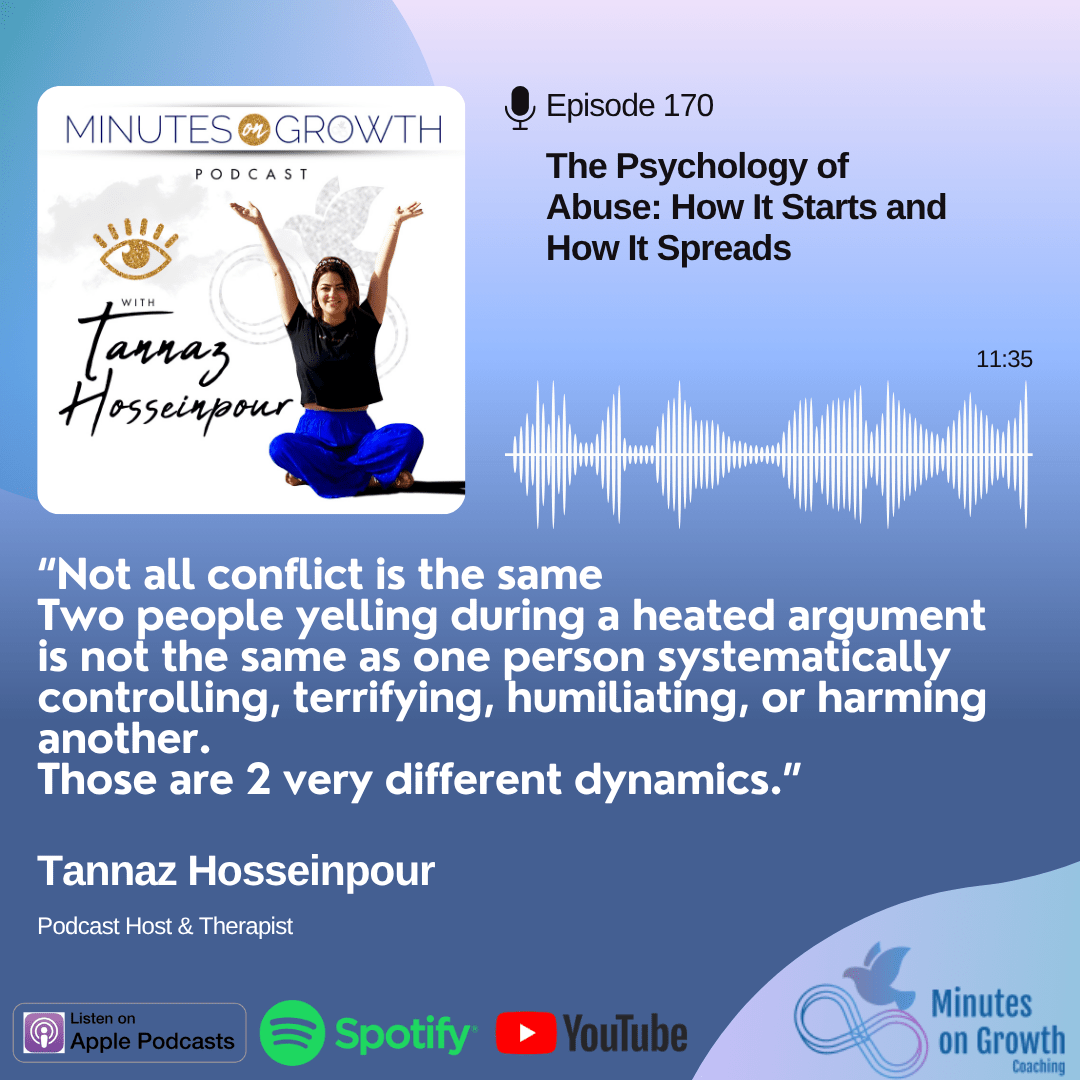
Click here to listen to Episode 170 of the Minutes on Growth Podcast on Spotify, on Apple Podcast or watch it on Youtube.
Hi soul friends, its Tannaz and welcome back to another short solo episode of the Minutes on Growth Podcast.
Today I want to talk about a difficult but deeply important topic: abuse.
Not all harmful conflict is the same. Not all aggression comes from the same place. And if we fail to understand the difference, we risk giving the wrong advice, staying in dangerous situations, or normalizing patterns that can scale from the home… all the way to governments and institutions.
Today we’re going to talk about two different patterns often discussed in relationship research and clinical work:
- Situational violence or situational abuse
- Characterological abuse, often linked with coercive control, domination, and chronic intimidation.
We’ll talk about what the research says, how childhood shapes these patterns, what healing can look like, and why understanding abuse in the home can help us understand abuse in society.
Let me start with this: not all conflict is the same
Two people yelling during a heated argument is not the same as one person systematically controlling, terrifying, humiliating, or harming another.
Those are very different dynamics.
Researchers often differentiate between:
1. Situational Couple Violence
This tends to arise during conflict escalation.
It can happen when both people lack emotional regulation skills, communication tools, trauma awareness, or conflict repair strategies.
It may include yelling, pushing, reactive behavior, threats, or emotional harm during intense moments.
This does not make it okay.
But the key distinction is that the violence is not rooted in an ongoing strategy of domination.
It is rooted in dysregulation, poor conflict management, unresolved wounds, and destructive patterns.
2. Characterological Abuse
This is different.
This pattern is about power and control.
It can include:
- intimidation
- fear tactics
- isolation
- surveillance
- blame shifting
- humiliation
- financial control
- coercion
- threats
- repeated physical or emotional harm
- lack of remorse
- punishment when the victim asserts themselves
This is not “we both need communication skills.”
This is one person using power to dominate another.
That distinction matters.
So let’s look at what the Gottmans Say About Situational Conflict
John Gottman and Julie Gottman have spent decades studying couples.
Their work shows that many distressed couples are not evil people. They are flooded people.
They get triggered.
They become defensive.
They criticize instead of expressing needs.
They shut down instead of repairing.
They repeat painful cycles.
In their work, including themes explored in Fight Right, they emphasize that successful couples are not couples who never fight.
They are couples who know how to repair.
That means:
- taking breaks when flooded
- softening start-ups
- validating each other
- expressing needs without contempt
- returning after conflict
- apologizing
- making small bids for connection
Many situationally aggressive couples can improve significantly when they learn these tools, trauma regulation, and accountability.
That’s hopeful.
Because sometimes what people need are skills, healing, boundaries, and support.
But this only applies when both people are willing to take responsibility and safety is present.
But what about when It’s Not a Skills Problem
If one person says:
- “You made me do this.”
- “If you didn’t talk back, I wouldn’t hit you.”
- “Look what you made me become.”
- “You’re crazy.”
- “No one will believe you.”
- “If you leave, I’ll ruin your life.”
That is not a communication problem.
That is abuse.
And this is where many people lose years of their life trying to “communicate better” with someone whose real goal is control.
You cannot use healthy communication to heal someone committed to domination.
So let’s dive deeper into it. Where Does Characterological Abuse Begin?
Often, it starts in childhood.
Imagine a child hearing:
“Don’t make daddy mad or he’ll hit you.”
“Be quiet so mommy doesn’t explode.”
“Just listen, or this will happen.”
What is the child learning?
Not:
“Violence is wrong.”
They are learning:
- if I get hurt, it’s my fault
- power has the right to punish
- anger excuses cruelty
- the victim causes the abuse
- silence keeps me safe
These beliefs can go underground and become subconscious truths.
Then later in life:
The child may tolerate abuse.
Or become abusive.
Or excuse abusive leaders.
Or fear speaking truth.
& that Abuse can manifest on the Macro Level
What happens in homes can happen in nations.
The same psychology scales upward.
In abusive relationships, someone says:
“If you didn’t challenge me, I wouldn’t hurt you.”
In abusive systems, governments say:
“If you protest, we will punish you.”
“If you speak up, we’ll do worse next time.”
“If you don’t want to be harmed, stay silent.”
That is the same logic.
Victim blaming.
Power avoiding accountability.
Fear used as control.
We see these dynamics in many places throughout history and in modern societies, including the pain many people reference regarding Iran and the treatment of protesters.
When a state says obedience is the only path to safety, it mirrors abusive dynamics.
So if You Are in a Characterologically Abusive Relationship
Please hear me clearly:
This is not about trying harder.
This is not about being more patient.
This is not about saying it the perfect way.
Priority becomes:
Safety.
- Document incidents if safe to do so
- Reach out to trusted supports
- Speak with a therapist trained in abuse dynamics
- Contact a domestic violence hotline or shelter
- Create a safety plan
- Protect finances and documents
- Do not announce exits if danger may escalate
- Trust patterns, not promises
Many abusive people apologize after consequences.
Watch behavior, not speeches.
I’d like to make space for this Public Service Announcement
If someone controls your movement, isolates you, threatens you, monitors you, degrades you, scares you, or hurts you physically or emotionally—you do not need bruises to call it abuse.
If you are afraid of your partner’s reactions, that matters.
If your nervous system is always on edge, that matters.
If you keep shrinking to stay safe, that matters.
Please reach out for help.
Domestic violence resources, shelters, crisis lines, trusted family, therapists, and community organizations exist for a reason.
You deserve safety.
You deserve dignity.
You deserve a life where love does not require fear.
& here are my Final Thoughts
Conflict can be healed.
Abuse must be named.
Some relationships need skills.
Some relationships need distance.
Some systems need reform.
Some systems need resistance.
And healing begins when we stop asking victims to be quieter… and start asking power to be accountable.
If this episode spoke to you, please share it with someone who may need these words.
As always thank you for listening and speak soon.
 Minutes on Growth