
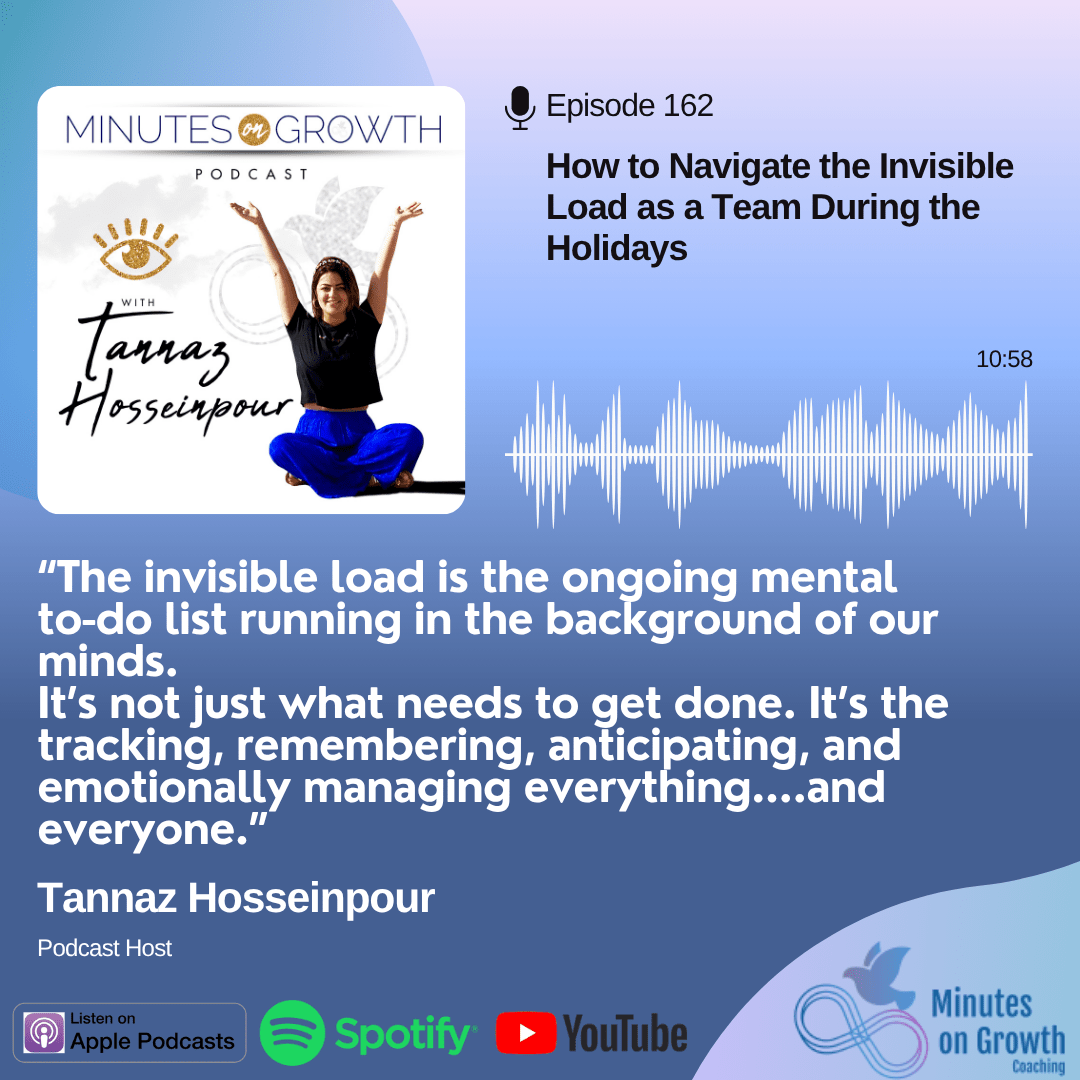
Click here to listen to Episode 162 of the Minutes on Growth Podcast on Spotify, on Apple Podcast or to watch it on Youtube.
Hi Soul friends,
It’s Tannaz Hosseinpour & Welcome back to another short solo episode of the Minutes on Growth podcast. Today I want to talk about something that’s coming up a lot in client sessions lately and something I think many of us are quietly feeling as we head into the holiday season.
And that is: the invisible mental load.
This episode is here to shed light on what it actually is, how it shows up, especially during the holidays, and most importantly, how we can start navigating it together with our partners, without blame, shame, or frustration.
So, let’s dive in.
What is the invisible load?
The invisible load is the ongoing mental to-do list running in the background of our minds.
It’s not just what needs to get done. It’s the tracking, remembering, anticipating, and emotionally managing everything….and everyone.
It’s thinking about the dentist appointment your partner forgot, remembering your niece’s allergy when buying snacks, making a note to pick up wrapping paper after work, and mentally preparing for how Aunt Linda might comment on your life choices at dinner.
None of these are “urgent,” but all of them are essential. And for many, especially women, the burden of this invisible load gets heavier during the holidays.
Let’s start by breaking It Down and looking at the different Categories of Mental Load
When I work with clients, we often list out the different domains of the invisible load:
- Scheduling: doctor’s appointments, RSVPs, pick-ups and drop-offs
- Social planning: gifts, parties, family traditions
- Household management: groceries, cleaning, decorations
- Health: managing medications, mental health check-ins, kids’ sniffles
- Finances: holiday spending, budgeting, tracking receipts
- Emotional tracking: who’s okay, who’s upset, who needs cheering up
- Future thinking: “What are we forgetting?” “What could go wrong?” “What if someone’s feelings get hurt?”
Yes. It’s a lot, and most of it isn’t written down anywhere. It’s held.
That’s why we call it invisible. Because it’s often not seen until it’s dropped.
Let’s look at Why this invisible load tends to Fall on Women (Often Without Intention)
This isn’t to say all women carry the load or all men don’t. But statistically and culturally, women are conditioned from a young age to anticipate needs and carry emotional labor.
Even in egalitarian relationships, this can show up subtly; one partner does the task, the other tracks it. One buys the gift, the other figures out who needs a gift, and when, and what they’d like.
So many couples I work with aren’t in conflict because they don’t love each other but because they’re swimming in silent resentment.
& now that we’re approaching the holiday season, that resentment can grow if we don’t get proactive with it.
Because the holidays layer on:
- More social obligations
- More spending
- More expectations (internal and external)
- More emotional labor (managing family dynamics, tradition, kids’ excitement, etc.)
And if we’re not talking about it, the partner carrying the invisible load becomes overwhelmed, often silently until they snap or shut down.
But it doesn’t have to be that way.
If you’ve been following my work you know that I love to turn the theory into practice so let’s take a look at what Partners Can Practically Do
Let’s get actionable. Here are some ways to be a better teammate this season:
- Ask this simple question:
“Is there anything you’re keeping track of mentally that I can take off your plate completely?” - Take ownership, not just help.
Instead of saying “Tell me what to do,” choose a category and fully manage it. For example: “I’ll handle all the gift planning for your side of the family.” - Create a shared doc or checklist.
Write down the categories I mentioned earlier—and split them up. Adjust weekly. Check in. Be flexible. - Plan a money talk early.
Discuss how much you want to spend, where the money’s coming from, and what really matters. - Make space for boundaries.
If your calendar is feeling too full, sit down and ask: “What’s a must-do? What can we let go of this year?”
I can’t stress enough how impactful these suggestions are. I see it not only in my own relationship but with my clients too.. Something shifts when couples start to acknowledge and address the invisible load together.
So here are a few grounding questions you can use with your partner this week:
- “What’s been feeling mentally heavy for you lately?”
- “What would help you feel more supported this month?”
- “What’s one thing you’d love to not do this holiday season?”
- “How can we make this season feel joyful—not just busy?”
Remember soul friends, We all carry invisible things. But we don’t have to carry them alone.
The goal here isn’t to point fingers. It’s to build awareness, trust, and true partnership especially during busy seasons.
If this resonated, share it with your partner or someone in your life who might need to hear it. And take 5 minutes today to check in with yourself and with each other.
You deserve ease, support, and softness. Not just for the holidays, but always.
Thanks for being here.
Speak soon
 Minutes on Growth