Episode 130 – Relationship Vs. Career

Click here to listen to Episode 130 of the Minutes on Growth Podcast on Apple Podcast, on Spotify and on Youtube.

Hi Soul Friends, it’s Tannaz Hosseinpour, and welcome back to another short solo episode of the Minutes On Growth Podcast.  Today, I want to talk about prioritizing your relationship versus your career. This conversation was inspired by a chat I recently had with my uncle, where we talked about how work culture in North America differs so much from other parts of the world, particularly the Middle East, where I spent a lot of my childhood summers.

In North America, there’s this constant hustle—a 9-to-5 grind, often extending far beyond that, with busyness almost worn as a badge of honor. In contrast, cultures like the Middle East incorporate rest and connection into daily life. For example, in Iran, it’s common to take an extended break after lunch—almost like the Spanish siesta. Growing up, when I’d visit my grandparents in the summers, I’d notice how my grandfather would close his shop and come home to have lunch with my grandmother. This wasn’t just a quick bite; it was a daily ritual. They would sit together, eat, and talk about their day. It might have only lasted 30 minutes, but it created a sense of connection that grounded their relationship.

Looking back, I realize how those small, intentional moments made a big difference. My uncle shared something that really stuck with me: he’s heard from friends that many couples he knows are separating, not because they don’t love each other, but because they feel disconnected. This disconnection often stems from one or both partners focusing so heavily on their careers that the relationship gets pushed to the side.

Now, I’m not here to say that your career isn’t important. It absolutely is. But what I want to explore today is the idea that prioritizing your career doesn’t mean your relationship has to take a backseat. In fact, when we give our relationships the attention and care they require, they can actually fuel our success in other areas of life, including our careers.

Research has shown that the quality of our relationships directly impacts the quality of our health and life. When we feel supported, connected, and loved, it has a ripple effect on everything else. Personally, I notice such a difference when Ash and I are connected. After spending quality time together, I feel more grounded, creative, and focused. And when I say quality time, I don’t mean spending endless hours together. It’s not about the quantity—it’s about the quality. Even 30 minutes of intentional connection can make a huge difference.

For my grandparents, it was their daily lunch ritual. They didn’t have cell phones or distractions during that time. They simply talked, shared their thoughts, and reconnected. And while they may not have realized it then, those moments strengthened their bond and provided the emotional grounding they needed to face life’s challenges together.

This idea of rituals of connection is something the Gottman Institute emphasizes in their research. Small, consistent habits—like having coffee together in the morning, checking in at the end of the day, or even just sharing a meal—create a sense of stability and closeness in a relationship. These rituals don’t have to be grand; they just have to be intentional.

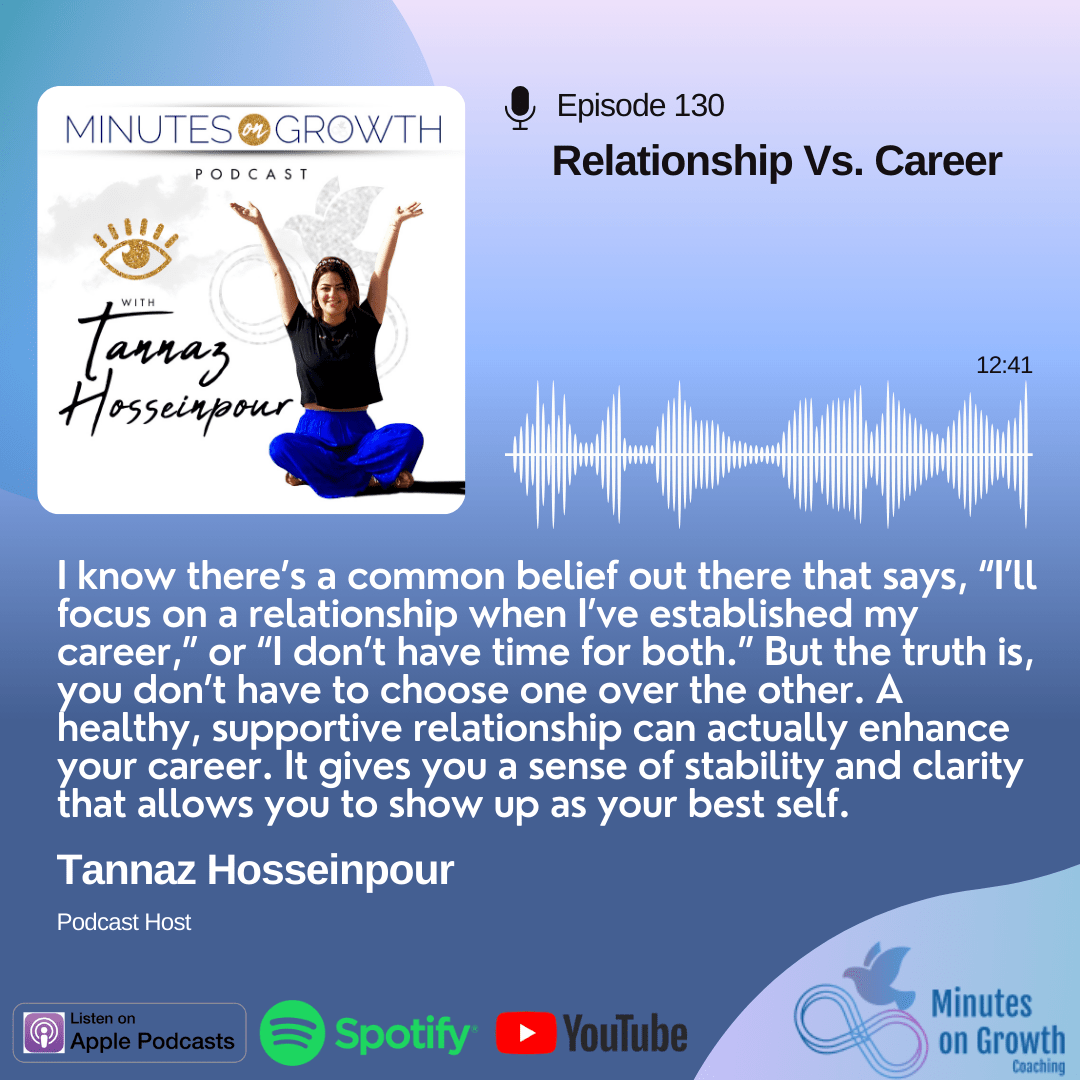
I know there’s a common belief out there that says, “I’ll focus on a relationship when I’ve established my career,” or “I don’t have time for both.” But the truth is, you don’t have to choose one over the other. A healthy, supportive relationship can actually enhance your career. It gives you a sense of stability and clarity that allows you to show up as your best self.

On the flip side, I understand how an unhealthy relationship can be draining. If there’s constant conflict or unmet needs, it can take up so much mental energy that it becomes hard to focus on anything else. But that’s why it’s so important to invest time and effort into cultivating a healthy relationship. When both partners are committed to supporting each other, it creates a foundation that benefits every aspect of life.

Now, let’s talk about what prioritizing a relationship can look like in practical terms. 

First, it’s important to recognize that everyone’s dynamic is different. Some people thrive in traditional setups, where one partner works while the other manages the household. Others prefer a more balanced approach, where both partners contribute financially and share responsibilities. The key is to have open conversations about what works for you and your partner.

Next off, One of the most powerful ways to do this is by setting up rituals of connection. These don’t have to be elaborate or time-consuming. It could be as simple as:

  • Having a phone-free dinner together.
  • Taking a 10-minute walk in the evening.
  • Sending each other a thoughtful text during the day.

The idea is to create moments where you’re fully present with each other, even if it’s just for a few minutes.

Another important aspect is understanding your own money mindset and how it impacts your relationship. In my uncle’s story, we also talked about how financial stress often adds to relationship strain. If one partner feels pressured to work longer hours to provide, or if societal expectations create unrealistic comparisons—like what we see on social media—it can lead to feelings of inadequacy or resentment. That’s why it’s so important to communicate openly about finances and create shared goals that align with your values. And if you want help in navigating these conversations, check out my couples and money workbook, where I provide prompts and guidance on navigating financial expectations, beliefs, patterns, shared dreams, and so much more. 

Finally, I want to emphasize that success isn’t just about achieving career milestones. It’s about living a life that feels meaningful and fulfilling—and relationships play a huge role in that. At the end of the day, what’s the point of career success if you don’t have someone to share it with?

So, if you’re feeling like your relationship has been taking a backseat to your career, I encourage you to take a step back and reflect. What small, intentional actions can you take to reconnect with your partner? It doesn’t have to be complicated—sometimes, the simplest things have the biggest impact.

Thank you for joining me for this episode. Speak soon

Episode 129 – Navigating Finances in Your Relationship

Click here to listen to Episode 129 of the Minutes on Growth Podcast on Apple Podcast, Spotify

Welcome back, soul friends. I’m Tannaz Hosseinpour, your host of the Minutes on Growth podcast, and I’d like to begin by offering a delayed happy new year message. I unfortunately lost my voice and was unable to record sooner but I am so excited to have it back and to be able to present the first short solo episode of 2025!

As we step into this new year, I want to dive into a topic that came up frequently during the holidays—finances in a relationship and how to navigate them. This is such an important conversation because it touches every part of our lives, whether you’re in a relationship, dating, or considering long-term commitments.

Today, we’ll explore this topic from both a macro and micro perspective, diving into cultural, legal, economic, and personal beliefs and boundaries.

At a macro level, let’s acknowledge how much financial dynamics in relationships have shifted over time. Two generations ago—or even just one—it was much more common for households to thrive on a single income. of course there’s many reasons for this. one is cultural, the other is there were less women in the workforce, and less women getting a post secondary education. I know for me, it was heavily influenced by culture, Coming from a Middle Eastern background, I grew up in a family where my grandfather was the sole provider while my grandmother was a stay-at-home mom even though she had many skills that she could generate income from. The same applied to my parents: my father was the breadwinner, and my mom took care of the household and children, despite being educated.

However, when we moved to Canada, I began noticing a shift. Dual-income households were much more common, and being in that environment, and noticing the cultural differences, my mom developed a desire for financial independence. She eventually started her own business and became financially independent.

In a previous podcast episode, I interviewed Monica Parikh, a NY based dating coach, who shared that one of the most important elements in dating is for women to have financial independence. She explained that financial independence allows women to want to be in a relationship rather than need to be in one because of financial constraints. This independence gives women the freedom to navigate relationships better and leave unhealthy dynamics if necessary. I definitely witnessed this in the Middle East. I conversed with many who expressed their desire to leave their unfulfilling marriage, but weren’t able to because of finances so I understood her stance on it.

This highlights how cultural values, economic realities, and even legal frameworks intersect. For example, in Canada, the laws around common-law relationships can significantly impact finances. In British Columbia, after two years of living together, common-law couples automatically take on the same financial obligations as married couples, including property, debt, and retirement savings. In contrast, in Middle Eastern countries, this concept doesn’t exist. The laws where you live will dictate certain financial responsibilities, so it’s important to factor these into your conversations.

Social media has added another layer to this conversation. The displays of wealth we see—luxury vacations, extravagant gifts, and influencers promoting an idealized version of relationships—can create unrealistic expectations. I’ve had men share with me during private sessions that they feel immense pressure to provide based on what they see on social media. This pressure often leads to feelings of inadequacy, but many don’t discuss it with their partners because of the shame and taboo surrounding finances.

It’s also crucial to remember that everyone’s expectations are different. Some men want a partner who contributes financially, while others prefer a stay-at-home partner. If a partner is staying at home, how are non-monetary contributions valued, seen and appreciated? Similarly, some women prioritize financial independence, while others prefer a more traditional setup. The key is finding alignment with your partner and crafting a system that works for both of you.

On a more personal level, our money beliefs are deeply influenced by our upbringing and life experiences. For instance, even though my brother and I grew up in the same household, we have very different money beliefs. The version of our parents we experienced was not the same. I had a different relationship with money growing up than my brother did because the circumstances surrounding money evolved over time.

Our individual money stories can show up in relationships in unexpected ways. For example, think about how money was discussed in your family of origin. Was it even discussed? Did you grow up hearing things like, “Money doesn’t grow on trees,” or was money readily available? How did your parents approach spending—on themselves, on you, or on others? These patterns shape our money mindset and influence how we view and manage finances in adulthood.

Another way to better understand your money beliefs is to notice what triggers you. For instance, if you go on social media and feel triggered by posts of men gifting women extravagant gifts, ask yourself: What is the root cause of this trigger? Is it because you believe that financial displays equal love? Is it because you feel your partner should provide more, or is it because you want to be able to afford similar luxuries for yourself? Taking the time to reflect on these triggers can provide valuable insight into your money mindset.

As we start to examine our beliefs, it’s important to ask: Are these truly my beliefs, or are they beliefs I’ve been conditioned to have? For instance, someone might believe that financial stability means owning a home, while their partner might define it as having six months’ worth of savings. These differences need to be explored and discussed openly.

Another key aspect of this conversation is setting financial boundaries. Boundaries around finances can look different for every couple. For instance, one partner might prioritize saving, while the other values spending on experiences or material items. Without clear communication, these differences can lead to misunderstandings or resentment.

I worked with one couple who contributed equally to household expenses and also divided household chores equally, but the husband also covered the cost of his wife’s self-care. This made her feel taken care of, and it worked beautifully for their dynamic. This is a perfect example of how financial systems can be tailored to fit the unique needs of each relationship.

I’ve also worked with couples where one partner is the primary breadwinner however due to unforeseen circumstances, they had to temporarily change the dynamics and both financially contribute to be able to navigate the challenges. The ability to have honest conversations respectfully, and work as a team is key when discussing finances.

Couples often ask me, “What is the right way to handle finances in a relationship?” The truth is, there’s no one-size-fits-all approach. The “right way” is the way that feels fair and aligned for both partners. For some, that might mean splitting expenses equally. For others, it could mean one partner contributes more financially while the other takes on a different role in the household. The key is finding a balance that honors your individual values and relational goals.

To help you navigate these conversations, I’ve created a super useful resource: an 18 page guide filled with prompting questions specifically designed to help you and your partner explore your financial beliefs, boundaries, and expectations. each question is meticulously crafted based on research or on my own experience with my clients and even in my own relationship.

This activity is especially powerful at the start of the year as we’re setting and committing to our New Years resolutions. With clarity comes a reduction in misunderstandings, a stronger sense of alignment, and an opportunity for growth—both individually and as a couple.

Navigating finances in a relationship is a complex but deeply rewarding process. It requires open communication, a willingness to compromise, and the courage to explore your own beliefs. Finances are not just about numbers—they’re about values, trust, and the life you want to build together, the shared dreams you’re both working towards.

Thank you for joining me for this first episode of 2025. If you’re ready to dive deeper, download the resource linked in the show notes. Wishing you a year filled with clarity, growth, and meaningful connections. Until next time, take care and keep growing!

Episode 127 – Nervous System Regulation

Click here to listen to Episode127 of the Minutes on Growth Podcast on Apple Podcast, Spotify or Amazon Music.

Hi soul friends, it’s Tannaz Hosseinpour, and welcome back to another short solo episode of the Minutes on Growthpodcast.

As some of you know, this past month was filled with excitement as I planned for my engagement weekend which was so much fun, but once it finished, I had a realization that I feel is so important to share with you all today. It’s a topic that’s gaining some attention on social media, but I still believe it’s not getting the recognition it truly deserves. This topic is at the very core of how we show up in our lives—how we handle stress, how we interact with others, and how we navigate through our challenges. And that topic is nervous system regulation.

So leading up to my engagement weekend, so many people asked me if I was stressed out, or if Ash and I were fighting over the planning, and my answer was honestly no. I wasn’t feeling stressed, primarily because I genuinely love hosting and organizing events. Yes, this one was significantly larger than anything I’d ever planned before, but I approached it with the same principles of organization and discipline that I always use. So I thought I had everything under control… until

about a week before the actual engagement, I started to notice something shifting. Before I talk about the shift, I think it’s important to let you know when I was planning out the dates, I had from the beginning decided to take a week off work prior to the engagement so that week that I noticed the shift in my body, I was off of work. During that week, my processing was that its perhaps nerves, excitement, or a mix of both. I could feel the quality of my sleep declining, my patience wearing thin, and this underlying sense of being on edge that I couldn’t quite shake. There were even moments where I’d be so overwhelmed that I just froze – I would be starting at me white board filled with informations and tasks, but unable to move or process what I needed to do next. As someone who prides herself on staying composed and organized, it was so confusing since time wise, I did have time, I mean my schedule was cleared out so I couldn’t understand why I was feeling overwhelmed.

Once all the festivities were over, and our loved ones had returned home, I took a moment to sit with myself and reflect on what had happened. Why….Why was my body reacting this way, despite my best efforts to stay on top of everything? That’s when it hit me: even though I had all my organizational tools and structures in place, my nervous system wasn’t regulated.My body didn’t feel safe or grounded in those moments, which made it difficult to process everything with clarity and peace. No matter how much we prepare mentally, if our nervous system isn’t on our side, it can be nearly impossible to stay balanced and present. Mind-body connection is real!

But you might be wondering why my nervous system was disregulated..well… it’s all because I had cleared my calendar…it sounds odd, but when I am working full-time, I am very intentional with making time for nervous system regulation tools in between my sessions with my clients because it’s super important that I take a grounded energy with me into sessions. So I usually go on walks in the middle of the day, I do balance breathing before an after every session, I do some shaking and movement at the end of my working day. So I’m constantly regulating my nervous system throughout the day. But because I had cleared my schedule for that week, I have completely blanked out and forgot about all these small simple yet profound daily regulation tools so all the stressors pertaining to planning the weekend were there but there was no outlet or medium of regulation present. So prior to that week off, yes I was getting stressed out I was getting triggered but I was balancing it out with these tools. No remove the tools, all you have left is stressors.

I realized that I was so caught up in my to-do list that I completely neglected my own needs. I wasn’t giving myself the time and space to breathe, to ground, to regulate. I really wasn’t doing the things that usually help me stay centered, like going for walks or dancing. It’s no wonder that my mind and body were all over the place.

Do use the analogy of a cup, and whenever there is a stressor come off the cupcakes for, and whenever we engage in regulation tools, the cup is empty. If we’re not emptying out the stressors, it will lead to overflow.

This experience brought me back to the importance of nervous system regulation, and I want to take a moment to explain what that actually means from a scientific perspective. So at the heart of our ability to regulate lies the autonomic nervous system (ANS), which is like the control center for how our body responds to stress and relaxation. The ANS has two main branches: the sympathetic nervous system and the parasympathetic nervous system.

The sympathetic nervous system is what we often refer to as the “fight or flight” response. It’s what kicks in when we sense danger or when we’re under stress, getting our body ready to take action. On the other hand, the parasympathetic nervous system is responsible for the “rest and digest” response, where our body slows down, calms, and restores itself. Both systems are essential, and they each have their place. There are times when we need to be alert and active, but there are also times when we need to allow ourselves to relax and recover.

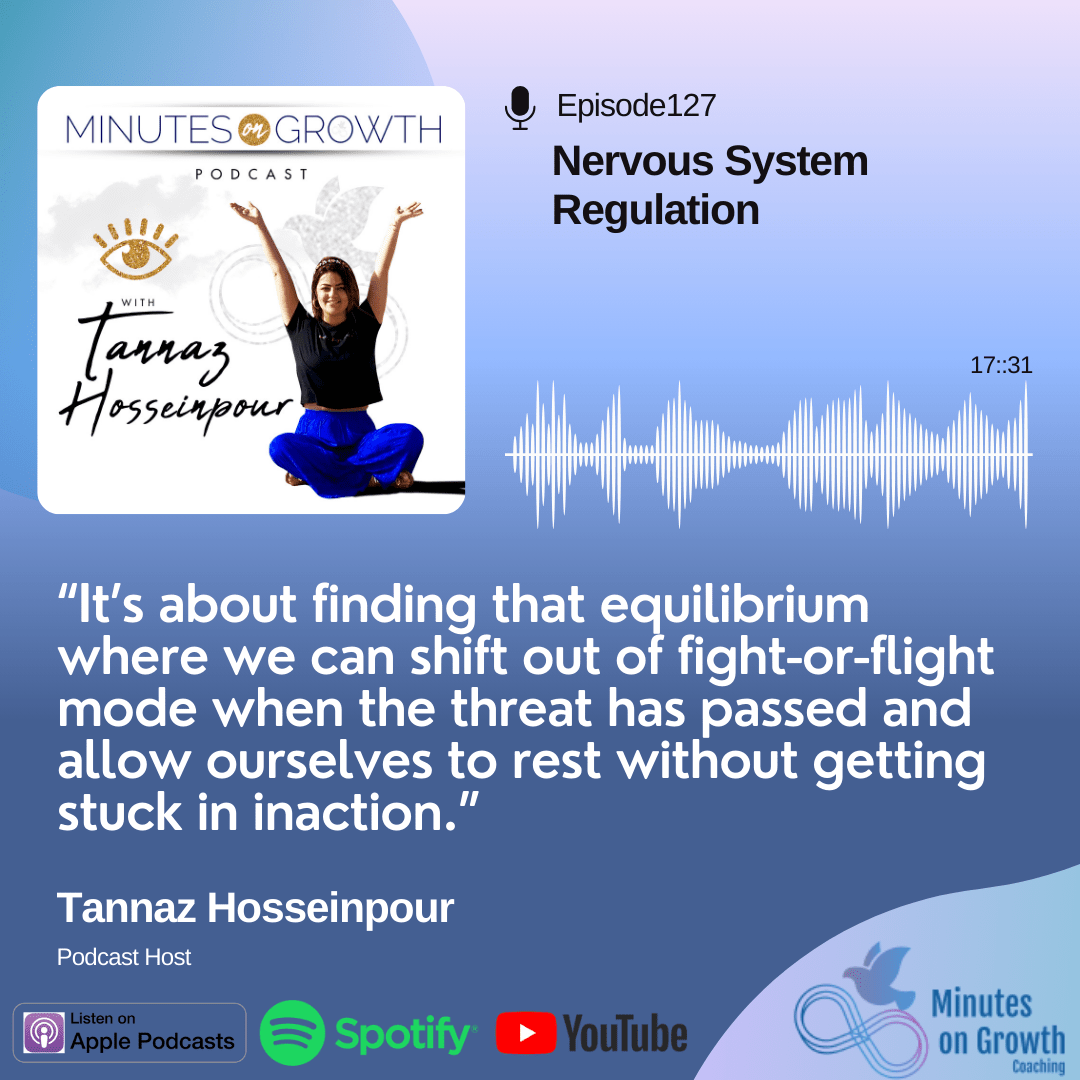
The key is knowing when to activate each state and, more importantly, how to bring ourselves back to that state of calm when we need it most. It’s about finding that equilibrium where we can shift out of fight-or-flight mode when the threat has passed and allow ourselves to rest without getting stuck in inaction. This balance helps us approach our relationships, our work, and our daily challenges with a sense of clarity.

The truth is, we can’t always control what happens around us, the unexpected stressors, the challenges, the curveballs life throws our way. But what we can control is how we respond to those situations. When our nervous system is regulated, we’re able to respond rather than react. We can pause, take a breath, and choose how to engage with whatever comes our way. This ability to stay grounded, even when things get chaotic on the outside, is what allows us to navigate life’s ups and downs with resilience and grace.

Let’s talk about what happens when we’re in the wrong state. When we’re stuck in a heightened sympathetic state, or ‘fight or flight’ mode, which I was that week, it’s like our body is constantly on alert, ready to face a threat. This state is essential in genuinely dangerous situations—it gives us the energy to act quickly. But if we stay in this state for too long or trigger it unnecessarily, it can take a toll on our mental and physical health. We might find ourselves feeling constantly anxious, irritable, and unable to relax. Our thoughts can become scattered, our decision-making abilities get clouded, and we tend to react impulsively rather than respond thoughtfully. This is when communication breaks down because we’re so on edge that even a small misunderstanding can escalate into a bigger conflict.

I see this often in my work with couples. They come to me feeling stressed out, saying they want to learn better communication skills or techniques to navigate their conflicts more effectively. But what they really want—what they truly need—is to feel calmer and more regulated in their nervous systems. Because when we’re in a dysregulated state, it’s almost impossible to communicate calmly and openly. We become defensive, on edge, and reactive, which only deepens misunderstandings and creates distance between us and the people we care about.

On the other hand, if we get stuck in a parasympathetic state, or ‘rest and digest’ mode, when we actually need to be alert and active, we can end up feeling unmotivated, lethargic, and unable to take action. This can make us feel like we’re in a fog, lacking the energy and drive to accomplish our goals, which ultimately leads to frustration and self-doubt.

When we prioritize nervous system regulation, we give ourselves the ability to empty the cup when it gets full, and engage with life from a place of presence. It’s about finding that equilibrium where we can shift out of fight-or-flight mode when the threat has passed and allow ourselves to rest without getting stuck in inaction. This balance helps us approach our relationships, our work, and our daily challenges with a sense of clarity.

This whole experience inspired me to create a free resource for you: an ebook with 11 simple yet profound nervous system regulation tools that you can incorporate into your daily routine. I created this ebook not just for all of you, but as a reminder to myself to make time for these small yet powerful practices that keep us centered and grounded. So, soul-friends, I hope it serves you and empowers you to step into a state of regulation.

By the way I feel like I need to share this because it relates so much to the topic and it was the universe’s way of saying practice what you preach it but I first recorded this episode right after I had finished my sessions of the day yesterday and after I finished recording I realized, wait a second my voice sounds a little bit angsty, I was speaking too fast, and my hands are fidgety. So I told myself get up go for a walk, ground yourself and come back and re-record this and I’m so glad I did because I brought a whole different energy to this episode.

So thank you so much for tuning in today.

I hope this episode serves as a gentle nudge to listen to your body and to give it the attention it deserves.

Until next time, take care, stay grounded, and I’ll speak to you soon

Episode 126 – Embracing Life’s Transitions: Soul Growth, Relationships, and the Power of Spirit with Kim Colella

Please click here to listen to Episode 126 of the Minutes on Growth Podcast on Apple Podcast, Spotify or watch the video on Youtube.

Episode 124 – Transform Your Relationship With These 5 Daily Habits

Click here to listen to Episode 124 of the Minutes on Growth Podcast on Apple Podcast.

Hi Soul-Friends,

It’s Tannaz Hosseinpour and welcome back to another short solo episode of the minutes on growth podcast. I just realized that its been a month since my last episode. time truly flies! I will definitely set an intention to release more episodes this summer but honestly a lot has happened this past month with Ash and I getting engaged which I’ll definitely talk more about in upcoming episodes, but today I wanted to briefly share 5 habits that we’ve been intentionally engaging in everyday these past couple of months that has truly elevated our relational experience, and they’re honestly so simple and basic that they don’t feel significant enough to cause such a grand transformation but I really want you all to try it out and to experience firsthand how powerful they can be,

So I want to begin with gratitude, and we’ve talked a lot about it it before, whether its pertaining to conscious manifestation or just elevating our own experience of reality, gratitude can be extremely transformational in relationships too. a lot of the time, we appreciate who our partner is and how they show up but we don’t vocalize it and so the secret here is to vocalize it as much as possible. it’s the best feeling in the world, when people acknowledge our efforts, and they truly see and hear us. so when we express to our partners, they feel like all the effort that they’re putting into the dynamic is being recognized and that itself becomes motivation to continue doing all the great things. it also gives the person the feeling that I am good enough which is a game changer because we’re living In a society that is constantly trying to convince us that we’re not enough, not pretty enough, not rich enough, not going enough, not having enough time.. so to be in a relationship where we feel enough.. thats sacred. so the simple “thank you for helping me out with my errands”, “thank you for grabbing me coffee”, “thank you for checking in with me today when you knew I was nervous about my appointment”, “thank you for listening to me” .. goes a long way in our relationships.

Next off we have the power of active listening. Often times, we’re with our partners, and they’re speaking to us but we’re not really present with them. Our mind is processing a conversation we had earlier at work, or we’re thinking about our to do list for tomorrow, and in those moments, when we’re not fully present, the other party might take it personally and might start to feel overlooked, not important enough, not heard… which can cause disconnection. not only that, part of active listening is the ability to hear what the other person isn’t saying…picking up on the other person’s body language.. do they look nervous.. are they fidgety.. I have eczema and when I’m stressed out my skin becomes super dry… so it means the world to me when Ash notices is and asks me if anything wrong, but sometimes, up until the moment that he asks me that question, I’m not even aware that I’m experiencing disconnection and disregulation… so it really creates space for me to become aware of my feelings and to ultimately feel and process them, so the art of active listening is so powerful, and side note, this is especially for the men, don’t try to fix your partner’s emotions unless they’ve asked you for that. most of the time, we’re just looking for someone to hold space for us in a safe, non judgmental way. hear us out… let us vent.. hold us tight… emotions don’t need fixing, they just need to be heard.

which brings us to my third point, which is making time for each other. we need to be putting in effort to spend quality time together, even if its just 5 minutes a day. 5 minutes of uninterrupted time, tech free time, where we can just check in with one another and see how the other person is feeling, and how we can stay informed of one another and ultimately how to support each there. so maybe in the morning asking each other what their day is going to look like, and at the end of the day, asking them how it went so they know that you cared to listen (previous point). some people mistake quality time with spending 24/7 together. I have couples who watch 5 hours of tv overnight only to complain in sessions that they don’t feel connected. its not about the hours, but the quality of the connection. now this doesn’t mean that 5 minute connections are all you need. it is important for us to plan date nights every now and then, but don’t overlook and underestimate the power of these few intentional minutes of connection everyday.

and if you’re running low on time, then definitely do this 4th point as much as you can: 6 second kisses and hugs. Why? well research shows that after a six second hug , oxytocin flows through us which lowers blood pressure and helps with anxiety; it lowers cortisol (the stress hormone); and it increases your social connections and sense of belonging. how amazing is that? so the next time you hug your partner, hold on for a little bit longer. when you’re parting ways in the morning, sneak in that 6 second kiss. be intentional with these 2 physical experiences and see how they transform your relationship.

Last but not least, Compliment each other as much as you can. be your partner’s biggest cheerleader. highlight their strengths over and over again. notice the small details. every time you notice and vocalize their strength, that strength grows. let your time together and ultimately your home be a safe space where love grows, where you grow. this ties in a lot with gratitude and the two are just the secret ingredients of deep emotional intimacy.

Outside of my own relationship, I’ve seen complimenting and gratitude transform many relationships. in fact, I recently had a couple. the wife kept complaining that her husband didn’t help around the house, and the husband complained that nothing he did was enough for her and he never felt appreciated. part of the homework that I gave them was to recognize each other’s efforts and to express gratitude for it. at first, she said it felt fake and forced, but after a while, she realized that he was doing a lot for her that she didn’t notice before, and the shocking part was that he felt like he could be doing more than what he was doing before. the more she expressed gratitude, the more he wanted to do. the more she complimented him on his efforts, the more he wanted to put in effort. WIN-WIN.

honestly, Ash and I have always been intentional with these 5 habits, but over the past month, I’ve woken up every morning asking the universe with support to embody and practice all 5 everyday, and I can vouch for how powerful they can be. I know this might be a bit TMI, but in the past, when I was in a very loving mood, ash would ask me “are you ovulating”. he’s been asking that question almost every other day these past few months! so he’s noticing the energy of love expanding in our relationship and so have I!

So soul-friends, write them down and remind yourself of them every single day until they become part of your daily routine and habit. until it becomes part of your auto pilot. I can’t wait for you all to experience powerful relational shifts. you deserve to be in the most loving healthy relationship and I hope these 5 habits help cultivate that!

Sending you lots of love,

speak soon!

Episode 123 – Taking Ownership of Your Life with Jocelyn Sandstrom

Please click here to listen to Episode 123 of the Minutes on Growth Podcast on Apple Podcast and on Spotify

Episode 122 – Fighting Fair

Please click here to listen to Episode 122 of the Minutes on Growth Podcast

Hi soul friends

Its Tannaz hosseinpour and welcome back to another short solo episode of the minutes on growth podcast. I recently created a series of reels on instagram on the importance of fighting fair when navigating conflict which resulted in many DMs asking me to dive deeper into it so here we are.

First of all, let me begin by saying that the presence of conflict is never an issue. In fact, when couples tell me that they never fight … it’s rarely a good sign. it means that perhaps someone has been abandoning their needs and not speaking their truth because disagreements are normal… seeing the world differently is normal. siblings in the same household have differences let alone two individuals coming together with two completely different families of origin, experiences and worldviews.

so conflict is never the issue.. but how we fight and ultimately how we repair is what matters.

the goal is to fight fair.. but what does fighting fair look like? when we’re talking about conflict resolution , respect needs to be present and we show respect by making sure that we avoid name calling or attacking our partner’s character.. this is what happens when we shift gears into criticism, one of the deadly four horsemen as outlined by Dr John Gottman… for example, the problem shifts from the unwashed dishes to now your partner being labelled as messy and inconsiderate. When we are attacking our partner’s character, naturally the other person is going to get defensive.

we also want to avoid bringing up the past.. this can side track us from the issue at hand so I always remind my clients to tackle one issue at a time… it’s also important to avoid over generalizing terms like “always” and “never”. for example, “you never show up on time” or “you always take the other person’s side”. in that moment, instead of your partner being able to recognize the meaning behind your complaint, they’ll focus on the times they did show up and or they take your side. this will lead them into defensiveness, another one of the 4 horsemen

When we’re fighting fair, it’s important to not make assumptions about the other person’s intentions… “you didn’t answer the phone on purpose to punish me for our morning argument…” or “you were late because you don’t respect my time”… it’s easy for our inner critic to make these deductions and thats why it’s important that we do 2 things.. one is to practice curiosity and the other is to give the person the benefit of the doubt… practicing curiosity allows us to ask questions instead of making assumptions… can you let me know what you didn’t answer the phone or why you were late to our date. curiosity brings clarity… assumptions create ruptures because when we make an assumption there’s 2 scenarios.. one we vocalize it and the other person gets defensive… or we don’t vocalize it and our behavior towards the other person shifts which can create a domino effect.

when we’re practicing curiosity and the other person is sharing their experience with us and the feelings they’ve felt, it’s important that we don’t dismiss or minimize their feelings…everyone’s feelings are always valid for them… it might not be how you feel or how you would feel in their shoes but that doesn’t mean that they can’t feel that way… so making sure we refrain from making comments such as “you’re being too sensitive”… or “you’re wrong for feeling that way…”

another element of fighting fair is the tone we use. we want to make sure we’re not speaking in a condescending tone… and we’re actually allowing them to speak without us interrupting them with our counter arguments. I call this lawyering up. Sometimes I notice in sessions that instead of the client listening to what their partner is saying so that they can better understand them, they’re coming up with their responses in their head so that they can quote on quote win the argument — we’re not in court, and you’re both on the same team. its always us vs the problem, and not me vs you. this perspective shift can help us be more present and actually hear the other person. On the topic of tone, language matters too. avoiding belittling language such as “didn’t you learn better from your parents..” or “where were you raised…” when we use sarcasm and start to belittle our partner, we’re entering the realm of contempt .. which is technically, criticism on steroids. research conducted by the gottman institute showed that the presence of contempt was the number of predictor of divorce.

speaking of divorce, another element of fighting fair is not threatening to leave the relationship… if we threaten to end the relationship during every conflict, this ruptures the relational safety present… the other person will no longer feel safe in that relationship.. which can lead to other issues.

Lastly, the ability to take accountability for the impact of our actions. I outlined 10 examples of this on my instagram so definitely check it out.

So soul-friends, please remember that the presence of conflict is not a red flag – but how we fight can be. Educating and reminding ourselves of these elements can help us master the skill of fighting fair, and through this process, allowing ourselves to grow and evolve both as individuals and as a couple. Btw all of this even applies to friendship.

I hope this episode has served you and has given you the insights you need to handle conflict better.

Thank you for listening,

Speak soon

Episode 121 – Trusting Our Intuition

Please click here to listen to Episode 121 of the Minutes on Growth Podcast on Apple Podcast

Hi Soul-friends

It’s Tannaz hosseinpour and welcome back to another short solo episode of the minutes on growth podcast. this month in my book club we read a wonderful book named trust your vibes by Sonia Choquette. the book reminded me of the importance of trusting our intuition, gut, vibes, however you feel comfortable calling it and how different our lives can look when we choose to dismiss or ignore its voice which got me reflecting on my own life.

Recently, ashkan and I have been planning a trip to europe in the summer for one of my dear friends weddings but something within me held back from booking the tickets when I first received the save the date. even though I intuitively knew I was going hence why I RSVPed, I had this feeling within me to hold back on booking the tickets. A few days ago, I woke up in the morning, and instead of grabbing my phone, I recited one of my favorite morning prayers ” universe tell me where to go, what to say and who to say it too”. honestly, the quality of my days significantly alter when I recite these words first thing, instead of going into autopilot mode and grabbing my emails. when we’re intentional with the universe, the universe reciprocates that energy.

Anyways, that day after my prayer, I had this voice inside of me telling me that today is the day to book the tickets. As I came downstairs into the kitchen, ashkan looked at me and said “do you remember my friend named x from many years ago – he just called and invited us to his wedding which is a few days after your friends wedding – do you think we’ll be able to make it?”

I couldn’t help but laugh… the universe grand 6D vision… no wonder I was hesitant to buy our tickets… we were meant to be at this wedding too which meant that our return ticket would be from another airport.

This is just a small example of how our intuition is connected to the universe’s wisdom. The question is… how often do we listen to our intuition? because our gut, vibes, spirit guides are always speaking to us … but more often than not, we’re so deeply immersed in our auto pilot mode or our ego has hijacked the driver’s seat that we don’t allow ourselves to pause, and actually hear what its telling us.

The wonderful part is that our intuition is always trying to protect us and keep us safe. I remember Oct 2nd 2020 like it was just yesterday.. I was in Dubai with my ex, and that night as I was sitting in our bedroom, a voice inside of me said I would never see him again and I burst into tears. I was flying to Toronto the next day for my brother’s birthday, something I did every single year… but this time it felt different. even though my return ticket was for Oct 24th, there was this knowing within me that something would happen on this trip, and I wouldn’t return to my house in Dubai and my relationship would somehow end. My ex held me tight and told me that I was wrong, and that logically it made absolutely no sense. We had been together for over 5 years and it was a stable relationship. I had a return ticket. I was even hosting a Halloween party on the 31st. But like the ticket situation.. our intuition always knows.. always one step ahead of us…I couldn’t explain it but I just knew.

Fast forward to Oct 15th as I was in Toronto, something traumatic beyond my wildest imagination took place, and to this day, May 9th 2024, I haven’t returned to that house or seen my ex.

Wild

Everyone keeps telling me that my angels and spirit guides protected me from that incident and it wasn’t a coincidence that I decided to uphold my yearly tradition of attending my brother’s birthday even though it was in the middle of covid and my 3 week trip consisted of me staying in quarantine for 2 weeks. Honestly, I didn’t even want to come to Toronto that year because of all the travel restrictions, but a voice inside of my head kept saying… go. and I’m glad I listened to it because it really did protect me.

There’s been many more incidents where listening to my intuition saved me and paved a new path for my life such as when my intuition told me to do a uturn from law to coaching and psychology.. and many incidents where ignoring my intuition led me to pain (for example staying in relationships and friendships for too long, making the wrong financial decisions (Decisions that were ego based) and more. Nevertheless, all these instances were filled with lessons and I love our ability to look back, to pause, to reflect and to ask ourselves how can I learn from this. every challenge is an opportunity to grow…

a side note here… our ego thinks it knows everything … it usually responds to “I know I know” when someone shares their opinions, or insights into something… our ego is the voice that thinks she knows best and knows it all (I know better than you and my way is the right way mentality)… our ego isn’t willing to learn or grow because well our ego thinks its perfect and perfect doesn’t need to grow… and it is precisely this ego that can prevent us from listening to our intuition…

so if you notice yourself saying “I know, I know”..pause. take a deep breath, and allow yourself to take a step back to make space for your intuition to enter the conversation…

After everything I’ve experienced, I now trust that my gut houses a mini version of the universe within it – my gut, my intuition is linked to the universe source of wisdom and insights. when I’m connected to my gut, I’m connected to the energy of creativity, to the energy of love, to the energy of understanding and patience. and when I’m in an agitated state, in a state of judgment, me vs you or us vs them mentality , I’m disconnected from myself, which means that I’ve disconnected myself from the universe.

I like to visualize a lampshade for this.. I am the lampshade.. the socket is the universe’s flow.. always available… it’s up to me to plug myself in or not.. that is the beauty of free will.. the universe’s insights are always available to us but never pushed upon us because we have the free will to choose…

so soul-friends, I will leave you with this… will you exercise your free will to plug yourself in? to listen to your soul’s voice? to hear what your intuition is trying to tell you? or will you allow disconnect yourself from it all?

Thank you for listening

Speak soon