
Click here to listen to Episode of 139 of the Minutes on Growth podcast on Apple Podcast, on Spotify or watch it on Youtube.
Episode 138 – Change the Story, Change Your Life
Click here to listen to the Episode on Apple Podcast, on Spotify
Hi Soul Friends, it’s Tannaz Hosseinpour, and welcome back to another short solo episode of the Minutes on Growthpodcast.
Today, I want to talk about something that can completely shift the way you experience life:
The power of storytelling and meaning-making.
Because here’s the truth: It’s not always the problem that’s the problem—it’s the story we’ve created about the problem that holds us back.
Everything we experience is filtered through the meaning we assign to it—and that meaning is shaped by our past, our conditioning, and our subconscious beliefs.
In this episode, we’re going to:
- Explore how narrative therapy helps us separate ourselves from our problems.
- Understand the power of meaning-making and how it shapes our reality.
- Learn how to identify the limiting stories we’re telling ourselves.
- Discover practical tools to rewrite our inner narrative in a way that empowers and expands us.
So let’s begin.
We are all natural storytellers. From the moment we wake up to the moment we fall asleep, we are constantly making meaning out of the events in our lives.
But the question is: Is the meaning we assign to things empowering us or limiting us?
Let’s take an example.
Imagine two people lose their job on the same day.
Person A says:
“I got fired. This is proof that I’m not good enough, I’ll never be successful, and I should just settle for less.”
Person B says:
“I got fired. This is the universe redirecting me toward something better. This is an opportunity to realign with a career that truly excites me.”
Same event. Two completely different meanings.
And because of those different meanings, these two people will experience the same event in completely different ways.
Person A might spiral into self-doubt, hesitate to apply for new opportunities, and ultimately prove their limiting story to be true.
Person B might take inspired action, network, and find a career path even more aligned with their purpose.
This is how powerful the meaning we assign to things is.
So ask yourself:
- What meaning am I attaching to the things that happen in my life?
- Am I framing my experiences in a way that limits me or expands me?
Narrative Therapy: You Are Not Your Story
Narrative therapy is based on the idea that we are separate from our problems.
It helps us realize that we have the power to rewrite our experiences by changing the story we tell ourselves.
Here’s a simple way to start practicing narrative therapy in your own life:
- Externalize the problem
- Instead of saying “I am an anxious person”, say “I am experiencing anxiety, but I am not anxiety.”
- Instead of saying “I am stuck”, say “I am feeling stuck in this moment, but I am capable of movement.”
When we separate ourselves from the issue, we give ourselves the power to change it.
- Question the story
- Where did this story come from?
- Is this my belief, or was it conditioned into me by society, family, or past experiences?
- Is this the only possible story, or is there another way to see this?
- Rewrite the meaning
- What is a more empowering meaning I can assign to this situation?
- How can I reframe this experience in a way that serves me?
Shifting Your Story in Real Time
Let me share another real-life example.
I once had a client who was struggling with rejection. Anytime she wasn’t chosen for a promotion she would tell herself:
“This always happens to me. I’m not worthy. I’ll never be enough.”
She had built an entire narrative around rejection—one that reinforced self-doubt and unworthiness.
So we got curious with it – what was another way to look at the rejection?
What if we reframed it to mean that she wasn’t being “rejected.” She was being redirected.
The meaning she had assigned to rejection was: “I’m not good enough.”
But she could just as easily shift that to: “This is not meant for me. The right opportunity is still on its way.”
We spent time and energy embedding this new belief in her subconscious mind
And the moment she started rewriting the meaning of her experiences, everything shifted.
And you can do this too.
Practical Steps to Rewrite Your Story
- Become aware of the dominant story you’re telling yourself.
- What is the common theme in your inner dialogue?
- If your life was a book, what would the title of your story be?
- Is this story limiting you or empowering you?
- Find the origin of the story.
- Who taught you this?
- Was this belief passed down to you by parents, culture, or past experiences?
- Does this belief still serve the person you are today?
- Create a new, empowering meaning.
- What is another way to look at this situation?
- If your best friend had this experience, what advice would you give them?
- What new belief will allow you to feel more at peace and in alignment?
- Reinforce the new story through action.
- Your subconscious will need proof that this new story is true.
- Start looking for evidence that supports your new belief.
- Surround yourself with people, books, and experiences that reinforce this new narrative.
At the end of the day, we are not just experiencers of life—we are storytellers of life.
The meaning we assign to events shapes our emotions, our actions, and ultimately, our future.
So today, I invite you to ask yourself:
- What story have I been telling myself about who I am?
- What new meaning can I give to my experiences that will empower me?
- How can I rewrite my narrative into one of growth, resilience, and self-trust?
Because you are not your past. You are not your fears.
You are the author of your own story. And you can turn the page at any moment.
Thank you for being here today. If this episode resonated with you, let me know—I’d love to hear the story you’re rewriting. Until next time, take care and keep growing.
Episode 137 – Navigating Burnout and Wellness with Hope Pedraza

Click here to listen to Episode 137 of the Minutes on Growth Podcast on Apple Podcast, on Spotify or to watch on Youtube.
Episode 136 – Spring Cleaning for the Mind, Body, and Soul
Click here to listen to Episode 136 of the Minutes on Growth Podcast on Spotify, on Apple Podcast or to watch it on Youtube
Hi Soul Friends, it’s Tannaz Hosseinpour, and welcome back to another short solo episode of the Minutes on Growth podcast. Today, we’re talking about spring cleaning—but not just in the way we usually think about it. Yes, we’re going to talk about clearing out the clutter in our homes, but we’re also going to go deeper. Because spring isn’t just about refreshing our physical spaces—it’s about detoxing our minds, beliefs, and relationships as well.
Spring is a season of renewal, and the spring equinox is the perfect time to step into a new version of ourselves by letting go of what no longer serves us. Today, we’re going to explore:
- How decluttering our physical space impacts our energy
- How to detox limiting beliefs that are keeping us stagnant
- How to take inventory of our relationships and create space for more reciprocal, aligned connections
So let’s begin.
Decluttering Your Physical Space = Clearing Energetic Blockages
Look around your home right now. What are you holding on to that it’s time to let go of?
Maybe it’s clothes that don’t fit anymore—not just physically, but energetically. Maybe it’s items from your past self, from a version of you that no longer exists. Maybe you’re holding on to things “just in case,” but in reality, they’re just anchoring you to an old identity.
Spring cleaning isn’t just about organizing—it’s about making space for expansion. When we let go of what no longer aligns with who we are today, we create room for new energy to flow in. And I know this can be hard, especially when we attach meaning to objects.
For example, if you’re holding on to clothes that don’t fit anymore in the hopes that one day you’ll wear them again, I invite you to ask yourself:
- Am I holding on to an old version of myself?
- Am I resisting accepting myself as I am today?
Because true transformation doesn’t come from shame or judgment. We don’t change by criticizing ourselves into a new version—we change by accepting where we are and moving forward with love.
Trust that if and when the time comes, you can always call new things into your life. But for now, release the old and create space for something new.
Detoxing Your Limiting Beliefs
Now, let’s go deeper.
We declutter our homes, but how often do we declutter our minds?
Take a moment to reflect: What limiting beliefs are you still carrying into this new season?
- Are you telling yourself I should be doing this or I can’t do that?
- Are you looking for evidence against yourself instead of evidence for your potential?
- Where are these beliefs coming from? Are they truly yours, or were they conditioned into you by family, society, or past experiences?
One of my friends recently got out of a bad relationship, and she kept sending me videos with titles like “All men are narcissists” and “All men cheat.” It became a constant cycle—she was consuming this content, sharing it, and reinforcing the belief that healthy love wasn’t possible.
I told her, “You need to stop entertaining this content, because your algorithm is going to flood you with more of it.”
Then I asked her, “How does watching these videos actually make you feel?”
She paused for a moment and admitted, “It makes me feel worse.”
So I asked her, “And what do you ultimately want? What’s your desire?”
She said, “I want to be in a healthy relationship.”
So I told her, “Then is it serving you to keep consuming content that reinforces the belief that healthy relationships don’t exist?”
She thought about it and said, “No.”
So I asked, “What would actually help you feel more empowered? What would bring more hope into your life?”
She said, “If I saw more examples of healthy couples.”
And I said, “Exactly. Train your algorithm to show you that. Seek out evidence that what you want is possible.”
This isn’t just about social media—it’s about how our brains work. Let me share the science behind it.
So the Reticular Activating System (RAS) is a network in our brainstem that acts as a filter—it prioritizes what we pay attention to based on what we already believe.
If you tell yourself, “All men are cheaters,” your brain will subconsciously seek out evidence to support that belief. It will notice stories of infidelity, reinforce the idea, and ignore counter-evidence of healthy relationships.
This is confirmation bias—our brain actively looks for proof that aligns with our preexisting beliefs, while discarding anything that contradicts it.
Now let’s talk about Neuroplasticity , the brain’s ability to rewire and form new neural pathways based on repeated thoughts, behaviors, and experiences.If you repeatedly consume negative relationship content, you’re strengthening neural pathways that associate love with betrayal, toxicity, and fear.
But if you intentionally consume content about secure, evolving relationships, your brain will literally rewire itself to believe in healthy love.
Don’t just take my word for it – Studies show that what we consume online affects our emotional state. Research from the Journal of Cyberpsychology, Behavior, and Social Networking found that exposure to negative content online increases anxiety, stress, and hopelessness.
Conversely, studies from positive psychology research show that consuming uplifting content can increase feelings of optimism, motivation, and even impact our actions.
you know as a relationship coach—and as someone who wants to experience deep, fulfilling love—I make a conscious effort to engage with content that supports my belief in healthy relationships.
I follow therapists, neuroscientists, and couples who share research-backed tools for building love. I study neuroplasticity, relational intelligence, and communication techniques. And because I only interact with content that reflects healthy relationships, my algorithm has adjusted—I don’t even see that limiting content anymore.
And the same is true for life beyond social media.
What we choose to focus on, believe in, and repeatedly expose ourselves to shapes our subconscious mind, our expectations, and ultimately, our lived experience.
So if you want to shift your beliefs and rewire your brain for something more expansive, start by curating your inputs:
- Audit Your Content Consumption
- Take a look at your social media, books, conversations—what themes are dominating?
- Are you consuming content that reinforces hope and possibility or fear and limitation?
- Start Seeking Out the Opposite Evidence
- If you believe healthy relationships don’t exist, start searching for stories of couples who have done the work and built beautiful partnerships.
- If you believe financial abundance isn’t possible for you, follow people who have transformed their financial reality through mindset shifts and action.
- Engage With What You Want to Believe
- Every like, comment, and share teaches the algorithm (and your subconscious) what to prioritize.
- Want to believe in healthy relationships? Follow accounts that highlight secure attachment, growth, and love that evolves over time.
- Want to believe in abundance? Read stories of people who have shifted their financial narrative.
- Be Conscious of the Story You’re Feeding Yourself
- Just like your social media algorithm, your mind is also running on an algorithm—it prioritizes what you repeatedly give attention to.
- What are you training your mind to expect?
- What “mental feed” are you scrolling through every day?
So if you’re stepping into this new season with doubts, ask yourself:
- How is my life a reflection of my beliefs?
- Where am I looking for evidence against myself instead of for myself?
- How can I shift my perspective to align with the reality I want to create?
Taking Inventory of Your Relationships
Now, let’s move on to something even deeper—our relationships.
Spring is the perfect time to take inventory of the people in our lives.
Ask yourself:
- Are my relationships reciprocal? Do the people in my life pour into me as much as I pour into them?
- Which relationships feel expansive, and which feel draining?
- Are there conversations I’ve been avoiding that need to happen?
And let’s take this even further—because self-awareness isn’t just about evaluating others. It’s about reflecting on how we show up in our relationships, too.
- Am I being a good friend, partner, or family member?
- Am I showing up for the people I love in a way that aligns with my values?
- In my romantic relationship, am I bringing the energy I want to receive?
One of my best friends, Alex, is in a relationship, and we often talk about growth within relationships. Because the truth is, relationships aren’t just about what we get—they’re about what we contribute.
If we want to experience deep, fulfilling, soul-nourishing relationships, we have to be willing to do the work—to reflect, to adjust, to communicate, and to show up as the highest version of ourselves.
So as we step into spring, let’s not just clean out our closets—let’s clean out our energy, our minds, and our connections.
So soul-friends, spring is a season of rebirth and renewal. It’s the ideal time to:
- Release what no longer serves us physically, mentally, and emotionally
- Create space for new, aligned energy to enter
- Shift our mindset and subconscious patterns to support our growth
So as you go about your day, I invite you to ask yourself:
- What am I ready to let go of?
- What new beliefs, habits, or relationships am I ready to step into?
Because just like nature, we are always evolving. And true transformation begins when we clear the space for something new to emerge.
Thank you for joining me today. If this episode resonated with you, let me know—I’d love to hear what you’re releasing this season. Until next time, take care and keep growing.
Episode 135 – Mind Training: Unlocking Self-Empowerment Through Beliefs and Practices with Ravinder Taylor
Click here to listen to Episode 135 of the Minutes on Growth Podcast on Spotify, on Apple Podcast and to watch it on Youtube
Episode 134 – Nothing Is A Coincidence
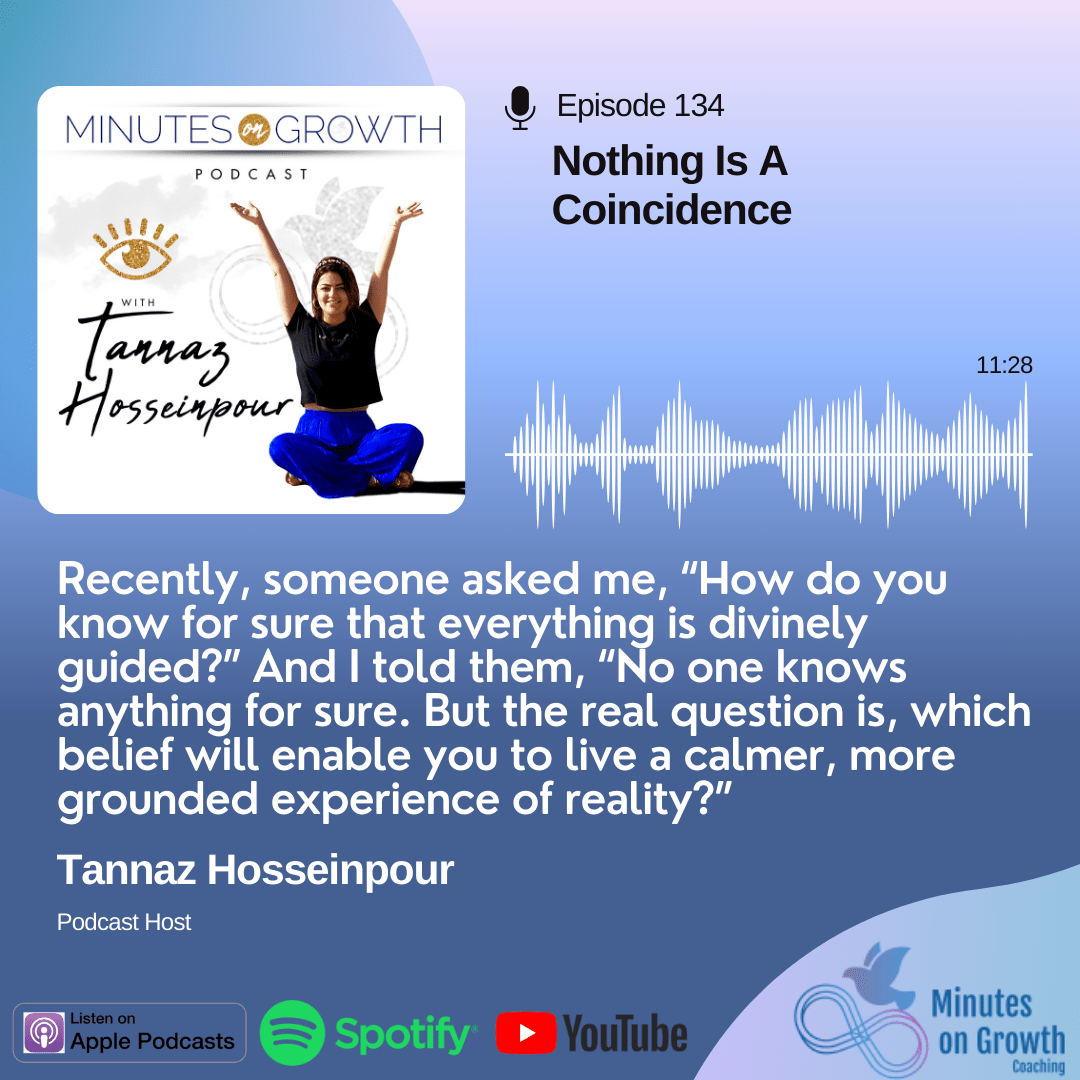
To listen to Episode 134 of the Minutes on Growth Podcast, click here for Apple Podcast, click here for Spotify, or click here to watch on Youtube.
Hi Soul Friends, it’s Tannaz Hosseinpour and welcome back to another short solo episode of the Minutes on Growth podcast. Today, we’re going to talk about something that has truly transformed the way I experience life: the belief that nothing is a coincidence and that everything is happening for us, not to us.
When we start to see the universe as a supportive entity—one that’s divinely guiding us through every challenge, every delay, and every redirection—it brings a sense of calm and trust that completely shifts our experience of reality. Today, I want to share some personal stories that highlight how this belief has shown up in my life and invite you to reflect on the beliefs you’re holding and how they’re impacting your nervous system.
Recently, someone asked me, “How do you know for sure that everything is divinely guided?” And I told them, “No one knows anything for sure. But the real question is, which belief will enable you to live a calmer, more grounded experience of reality?”
For me, choosing to trust that everything is unfolding exactly as it should has allowed me to navigate challenges and delays with a sense of ease. This doesn’t mean we let go and do nothing; it means we take inspired action from a regulated, grounded state. Let me share an example that perfectly illustrates this.
Ash and I were recently in Thailand, and we had rented a bike to visit some beautiful waterfalls. To get to the waterfalls, we had to park the bike and take a small bus. After enjoying the waterfalls, we returned to the motorbike, and that’s when Ash realized he didn’t have the keys.
Immediately, he started to panic, saying things like, “Oh my god, what are we going to do now?!” And in that moment, I could see how the belief you hold changes everything. I took a deep breath and told him, “Let’s stay calm. We’ll figure this out together.”
At this stage of my life, I’ve come to trust that when something like this happens—whether it’s losing something, facing a delay, or even a major challenge—it’s happening for a reason. In Farsi, we have a beautiful word for this: khayr, meaning there’s a blessing behind it.
As Ash panicked, I stayed grounded. He thought he might have dropped the keys in the waterfall, but I told him, “That’s unlikely. Let’s retrace our steps.” I went to the bike, checked around, and then asked the management to call the bus driver. They kindly agreed, and as we were driving to the waterfall to look for the keys, we saw the bus driver.
The moment I saw him, I told Ash, “Pull out 100 and give it to him.” He asked me how I knew the driver had the keys, and I just said, “Trust me.” And sure enough, when we reached him, the driver had found the keys at the bottom of the bus.
Here’s the amazing part: the management staff also told us, “You need to give him 100.” It was such a powerful moment. I told Ash, “You became the vessel for this driver to receive this 100 today. That’s why this happened.” Nothing about this was random—it was all divinely guided.
Later that day, something else happened. After grabbing a bite to eat at KFC, we drove back to the hotel, only for me to realize I had left my bag behind. My bag had my medicine, wallet, and credit cards—everything. Normally, I never forget things like this.
Ash was concerned about the time because I had a session scheduled soon. He said, “If we go back, we’ll barely make it.”But I told him, “There’s a reason we’re not meant to be at the hotel right now. Let’s trust this.”
We went back, and the staff at the restaurant were so kind. They had kept my bag safe and asked me to check that everything was still inside. In that moment, I felt an overwhelming sense of safety and trust—not just in the people around me, but in the universe as a whole.
Whether the purpose of this delay was to reaffirm my feeling of safety or to prevent us from being at the hotel at a certain time, I’ll never know. But that’s the beauty of trusting that everything is happening for us, even when it doesn’t make immediate sense.
In both of these situations, I could have panicked. I could have spiraled into “Why is this happening to me?” But instead, I chose to trust that there was a reason—and that belief completely changed my experience.
Ash, on the other hand, was holding a different belief. His panic created a sense of urgency and stress that affected how he approached the situation. This is why it’s so important to ask yourself: What beliefs am I entertaining, and how are they impacting my nervous system?
When we hold the belief that the universe is working for us, it allows us to stay calm and take inspired action from a grounded place. It’s not about passivity; it’s about trusting that you’re capable of handling whatever comes your way.
So, the next time life throws you a curveball, I invite you to pause and ask yourself:
- What is this moment teaching me?
- What belief will allow me to experience this situation with calm and trust?
When we see life as divinely guided, we open ourselves up to a more grounded, peaceful way of being. We realize that every delay, every challenge, is an opportunity for growth and alignment.
Thank you so much for joining me today. If this resonated with you, I’d love to hear your thoughts. Share this episode with someone who might need this reminder. Until next time, take care, stay grounded, and trust that the universe has your back.
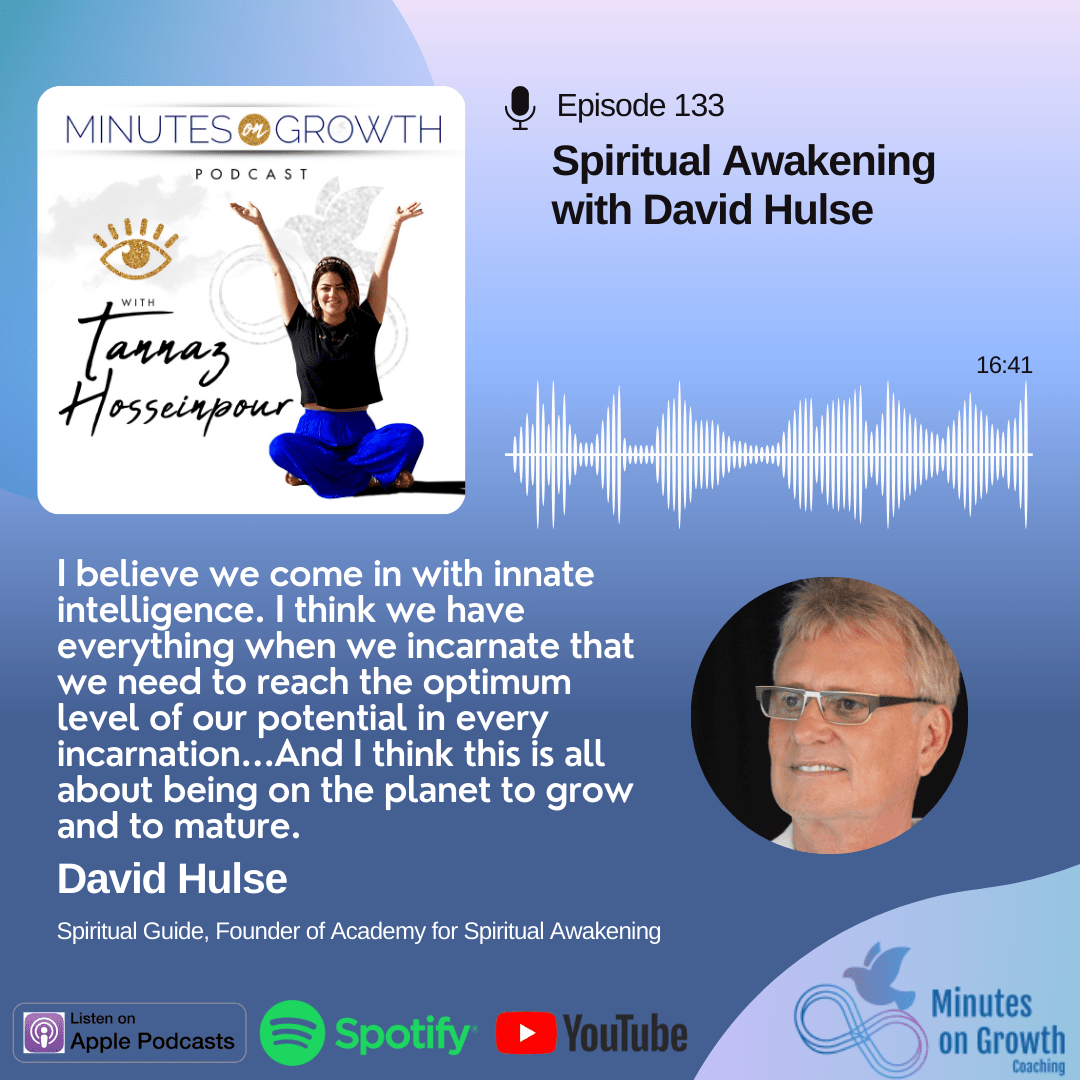
Episode 133 – Spiritual Awakening with David Hulse
Episode 132- Am I The Problem?
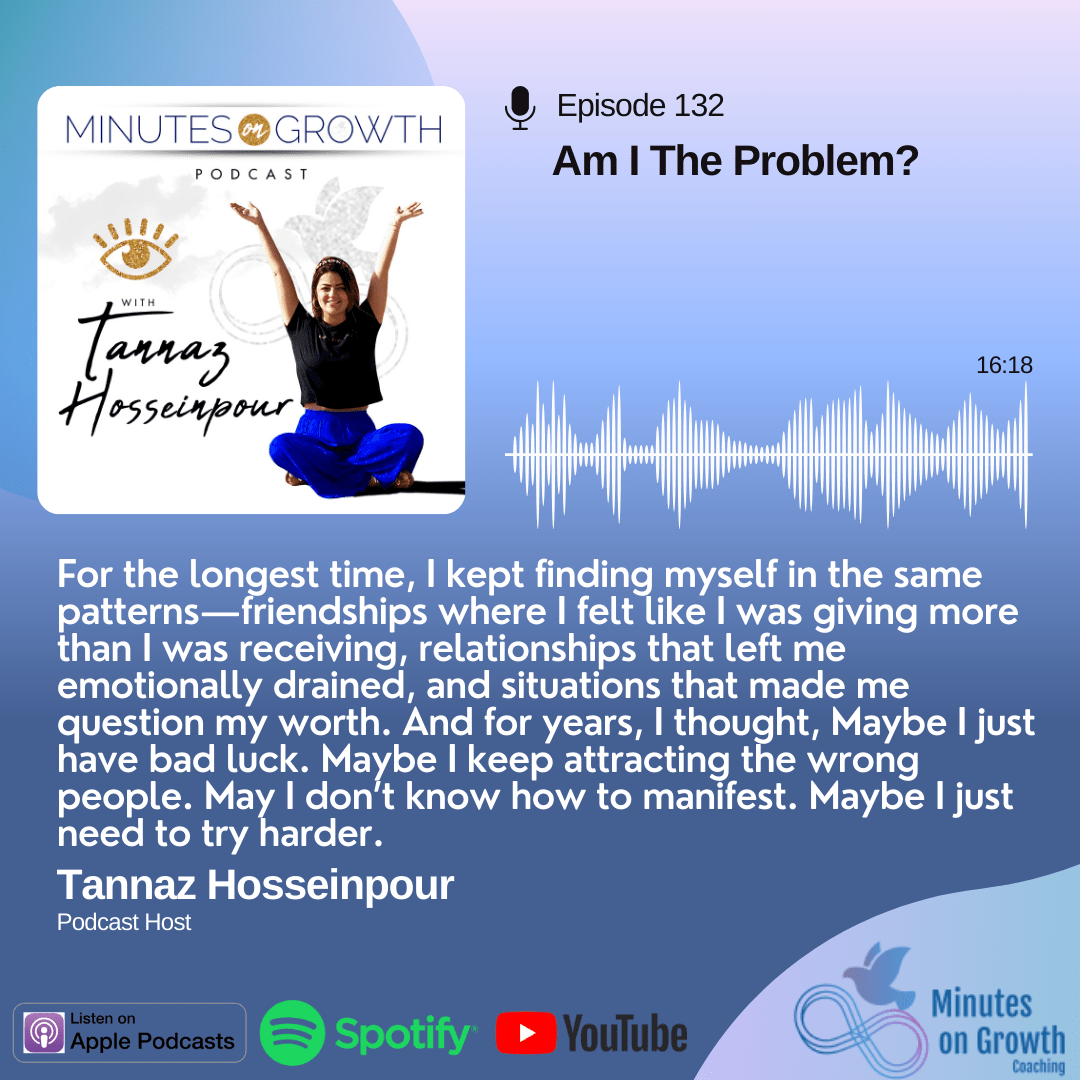
Click here to listen to Episode 132 of the Minutes on Growth Podcast on Apple Podcast, on Spotify
Hi Soul Friends,
It’s Tannaz Hosseinpour, and welcome to another short solo episode of The Minutes on Growth podcast. Before we begin, I wanted to begin by saying happy valentines day! may you all know that you are worthy of love, and feel the energetic frequency of love with yourself, with your friends, with your family, co-workers, strangers and with your romantic partner if you’re in a relationship. today as I woke up next to Ash, I couldn’t help but reflect on how I ended up here… the journey of getting to a place where I’m comfortable showing up as my true quirky self and experiencing life with an emotionally safe partner. Healthy relationships weren’t modelled to me growing up so to be able to change that narrative for myself is one I’m deeply grateful for. So I decided to dedicate today’s episode to the journey of getting here. Today, I want to share something deeply personal—an experience that shaped the way I showed up in relationships for years, without me even realizing it. And I want to talk about a question that changed my life and ultimately helped me get to where I am today:
“Am I the problem?”
For the longest time, I kept finding myself in the same patterns—friendships where I felt like I was giving more than I was receiving, relationships that left me emotionally drained, and situations that made me question my worth. And for years, I thought, Maybe I just have bad luck. Maybe I keep attracting the wrong people. Maybe I just need to try harder.
But then, I had a realization that hit me hard. The only constant in all these experiences was me.
And while that could have felt like a devastating truth, it actually became an opportunity—an invitation to go within and see what needed to change.
The Middle School Moment That Changed Everything
I want to take you back to seventh grade.
At the time, I had a best friend who felt like my other half. We did everything together—passing notes in class, sleepovers, whispering secrets over the phone, planning our futures like we were going to be inseparable forever. You know that kind of friendship where you feel like nothing could break it? That was us.
Until one day, she handed me a letter.
A letter telling me that she couldn’t be my friend anymore.
I remember my hands shaking as I unfolded it, my stomach dropping as I read the words. And the reason?
Because my dad didn’t allow me to wear short skirts to the mall. Because I had a stricter curfew than she did.
That moment shattered something inside me. I didn’t just feel abandoned—I felt like I wasn’t enough. That somehow, because I had different family values, different boundaries, I was less worthy of love and connection.
And here’s the thing—I didn’t realize it at the time, but that single moment planted a belief deep in my subconscious. A belief that said:
“If I want to keep people close, I need to make sure I don’t make them uncomfortable.”
“I need to fit in, adjust, and make myself more accommodating so I don’t lose them.”
And from that moment on, without even realizing it, I started over-giving.
I became the friend who would drop everything for people, the one who always said yes, the one who was always there—sometimes at the expense of myself. I thought that love and friendship had to be earned.
Then, a few years later, something happened that reinforced this belief even further.
That same best friend and I found out that we were dating the same boy.
He was cheating on both of us.
And when I found out, I wish I could say I was angry, that I immediately walked away with my self-respect intact. But the truth? I questioned myself.
Instead of blaming him, I thought:
“Why wasn’t I enough for him to choose me?”
“What does she have that I don’t?”
“Maybe if I was prettier, cooler, more fun—he would have loved me more.”
And that’s when it hit me.
The patterns I was experiencing weren’t just coincidences. They were reflections of the way I viewed myself.
And at the root of it all, there was a belief:
“Who I am isn’t enough to be fully chosen.”
The Wounded Feminine & Masculine: Why This Happens
I didn’t know it at the time, but what I was operating from was wounded feminine energy.
Let me explain.
We all have both feminine and masculine energy within us—this is the concept of yin and yang.
The feminine is the energy of flow, intuition, nurturing, softness, and receiving. It’s the part of us that feels deeply, connects, and embraces emotions.
The masculine is the energy of structure, action, logic, and protection. It’s the part of us that sets boundaries, takes decisive steps, and provides stability.
When these energies are balanced, life feels expansive—not draining. Love flows more freely, boundaries feel natural, and we show up in our relationships from a place of confidence rather than fear.
But when these energies become wounded, they lead to patterns that keep us stuck.
Wounded Feminine Energy Looks Like:
- Over-giving in relationships, hoping it will make people stay
- Having no boundaries, fearing that saying no will push people away
- Seeking validation outside of yourself—feeling like your worth depends on someone choosing you
- Suppressing your needs to accommodate others
On the other hand…
Wounded Masculine Energy Looks Like:
- Being emotionally shut down or avoiding vulnerability
- Overworking, trying to prove yourself through achievement
- Feeling the need to control everything because deep down, you don’t feel safe
- Rejecting help or support because you see it as weakness
When we operate from wounded feminine energy, we attract relationships that reflect that wounding.
And that’s exactly what I had been doing.
Healing & The Inner Work That Changed Everything
The real turning point for me was when I stopped looking outward for validation and started looking inward for healing.
I started asking myself:
- Where am I over-giving, and why do I feel the need to?
- What part of me is still trying to prove my worth?
- What would change if I truly believed I was enough, without having to earn it?
And when I started healing these wounds, everything shifted.
I started setting boundaries—not out of anger, but out of self-respect.
I stopped chasing people, validation, or love.
I realized that the right people would never require me to overextend myself to be loved.
And this is the work we do inside Manifesting Love: Self-Love Edition.
Because healing the wounded feminine isn’t just about thinking differently—it requires deep subconscious healing, nervous system work, and unlearning years of conditioning.
Inside this 5-week program, we go beyond mindset shifts. We work on:
✨ Healing the subconscious beliefs that make us over-give and people-please
✨ Balancing masculine & feminine energy, so love feels expansive—not draining
✨ Somatic practices that help us feel safe in our worth, without external validation
✨ Breaking cycles of self-doubt, over-giving, and proving our worth
This is the work that changed everything for me.
If this episode resonates with you, I invite you to join me inside Manifesting Love: Self-Love Edition—our 5-week journey of transformation starting March 2nd.
You don’t have to keep repeating the same painful cycles to learn the same lesson.
📍Click here to learn more.
And remember—your worth isn’t something you have to prove. It’s something you embody.
Sending you all my love, and I’ll see you in the next episode. 💖
Episode 131 – Guided Meditation on Self Love and Confidence
Episode 130 – Relationship Vs. Career
Click here to listen to Episode 130 of the Minutes on Growth Podcast on Apple Podcast, on Spotify and on Youtube.
Hi Soul Friends, it’s Tannaz Hosseinpour, and welcome back to another short solo episode of the Minutes On Growth Podcast. Today, I want to talk about prioritizing your relationship versus your career. This conversation was inspired by a chat I recently had with my uncle, where we talked about how work culture in North America differs so much from other parts of the world, particularly the Middle East, where I spent a lot of my childhood summers.
In North America, there’s this constant hustle—a 9-to-5 grind, often extending far beyond that, with busyness almost worn as a badge of honor. In contrast, cultures like the Middle East incorporate rest and connection into daily life. For example, in Iran, it’s common to take an extended break after lunch—almost like the Spanish siesta. Growing up, when I’d visit my grandparents in the summers, I’d notice how my grandfather would close his shop and come home to have lunch with my grandmother. This wasn’t just a quick bite; it was a daily ritual. They would sit together, eat, and talk about their day. It might have only lasted 30 minutes, but it created a sense of connection that grounded their relationship.
Looking back, I realize how those small, intentional moments made a big difference. My uncle shared something that really stuck with me: he’s heard from friends that many couples he knows are separating, not because they don’t love each other, but because they feel disconnected. This disconnection often stems from one or both partners focusing so heavily on their careers that the relationship gets pushed to the side.
Now, I’m not here to say that your career isn’t important. It absolutely is. But what I want to explore today is the idea that prioritizing your career doesn’t mean your relationship has to take a backseat. In fact, when we give our relationships the attention and care they require, they can actually fuel our success in other areas of life, including our careers.
Research has shown that the quality of our relationships directly impacts the quality of our health and life. When we feel supported, connected, and loved, it has a ripple effect on everything else. Personally, I notice such a difference when Ash and I are connected. After spending quality time together, I feel more grounded, creative, and focused. And when I say quality time, I don’t mean spending endless hours together. It’s not about the quantity—it’s about the quality. Even 30 minutes of intentional connection can make a huge difference.
For my grandparents, it was their daily lunch ritual. They didn’t have cell phones or distractions during that time. They simply talked, shared their thoughts, and reconnected. And while they may not have realized it then, those moments strengthened their bond and provided the emotional grounding they needed to face life’s challenges together.
This idea of rituals of connection is something the Gottman Institute emphasizes in their research. Small, consistent habits—like having coffee together in the morning, checking in at the end of the day, or even just sharing a meal—create a sense of stability and closeness in a relationship. These rituals don’t have to be grand; they just have to be intentional.
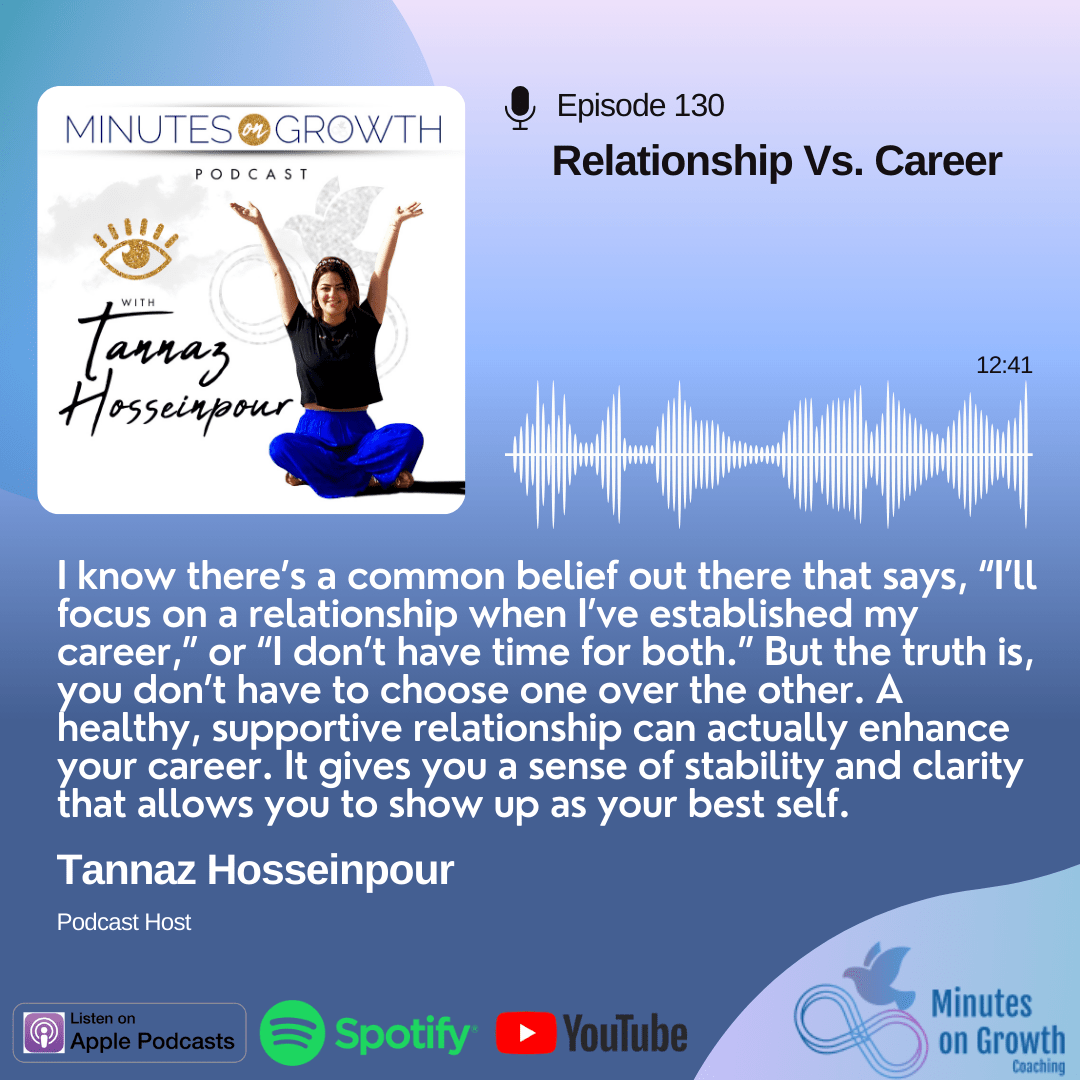
I know there’s a common belief out there that says, “I’ll focus on a relationship when I’ve established my career,” or “I don’t have time for both.” But the truth is, you don’t have to choose one over the other. A healthy, supportive relationship can actually enhance your career. It gives you a sense of stability and clarity that allows you to show up as your best self.
On the flip side, I understand how an unhealthy relationship can be draining. If there’s constant conflict or unmet needs, it can take up so much mental energy that it becomes hard to focus on anything else. But that’s why it’s so important to invest time and effort into cultivating a healthy relationship. When both partners are committed to supporting each other, it creates a foundation that benefits every aspect of life.
Now, let’s talk about what prioritizing a relationship can look like in practical terms.
First, it’s important to recognize that everyone’s dynamic is different. Some people thrive in traditional setups, where one partner works while the other manages the household. Others prefer a more balanced approach, where both partners contribute financially and share responsibilities. The key is to have open conversations about what works for you and your partner.
Next off, One of the most powerful ways to do this is by setting up rituals of connection. These don’t have to be elaborate or time-consuming. It could be as simple as:
- Having a phone-free dinner together.
- Taking a 10-minute walk in the evening.
- Sending each other a thoughtful text during the day.
The idea is to create moments where you’re fully present with each other, even if it’s just for a few minutes.
Another important aspect is understanding your own money mindset and how it impacts your relationship. In my uncle’s story, we also talked about how financial stress often adds to relationship strain. If one partner feels pressured to work longer hours to provide, or if societal expectations create unrealistic comparisons—like what we see on social media—it can lead to feelings of inadequacy or resentment. That’s why it’s so important to communicate openly about finances and create shared goals that align with your values. And if you want help in navigating these conversations, check out my couples and money workbook, where I provide prompts and guidance on navigating financial expectations, beliefs, patterns, shared dreams, and so much more.
Finally, I want to emphasize that success isn’t just about achieving career milestones. It’s about living a life that feels meaningful and fulfilling—and relationships play a huge role in that. At the end of the day, what’s the point of career success if you don’t have someone to share it with?
So, if you’re feeling like your relationship has been taking a backseat to your career, I encourage you to take a step back and reflect. What small, intentional actions can you take to reconnect with your partner? It doesn’t have to be complicated—sometimes, the simplest things have the biggest impact.
Thank you for joining me for this episode. Speak soon
 Minutes on Growth