Episode 161 – Love Lessons from Divorce Attorney Sarah Intelligator

Click here to listen to Episode 161 of the Minutes on Growth Podcast on Apple Podcast, on Spotify, or watch it on Youtube.

In this episode I sit with Sarah Intelligator — a divorce attorney, long-time yoga teacher, and author of Live, Laugh, Find True Love — to explore her approach to ‘holistic divorce’ and how bringing mindfulness, compassion, and practical tools to family law can change how people navigate separation.

Sarah explains why caring for the whole person matters in legal work, how divorce impacts children (and adult children), and the red flags and early patterns she sees in relationships that lead to separation.

We dig into her ‘six F’s’ framework; fundamental values, fear, foundation, fairy tale, family, and fixing, and learn how to choose a partner intentionally, avoid settling, and protect your future self.

To connect with Sarah: https://livelaughfindtruelove.com

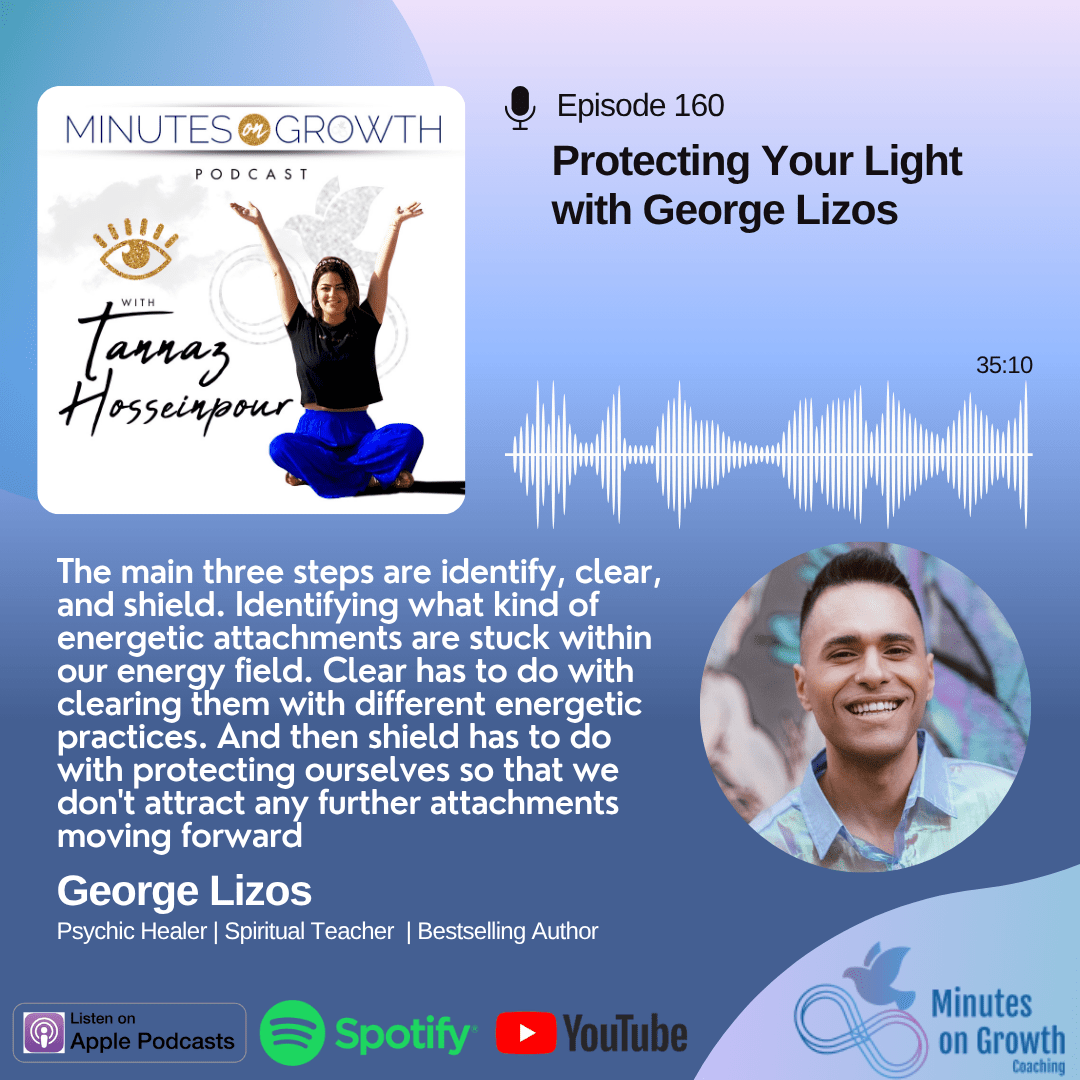
Episode 160 – Protecting Your Light with George Lizos

Click here to listen to Episode 160 of the Minutes on Growth Podcast on Spotify, on Apple Podcast or watch the episode on Youtube.

In this episode I sit with George Lizos — spiritual teacher, energy healer, and award‑winning author — to explore how we can protect our energy, live more authentically, and integrate healing across the body, mind, and spirit.

George shares his personal story of coming out and reclaiming his truth, then breaks down a simple but powerful framework for energetic wellbeing: identify, clear, and shield. We cover practical, everyday techniques, how to layer shields for empaths and healers, and concrete guidelines for protecting your presence online without disconnecting.

He also explains why energy work often opens the door to deeper shadow work and why healing must be holistic; blending energy practices with psychological and somatic approaches.

Episode 159: The Obstacle Is The Way

Click here to listen to Episode 159 of the Minutes on Growth podcast on Apple Podcast, on Spotify, or watch it on Youtube.

Hi soul friends, it’s Tannaz Hosseinpour and welcome back to another short solo episode of the Minutes on Growth podcast. Today’s solo episode is inspired by a moment that really stayed with me; something I heard in a conversation between Madonna, Jay Shetty, and Eitan Yardeni, a phenomenal Kabbalah teacher

He shared a powerful analogy that resonated with me so deeply, I knew I had to bring it here and expand on it not just spiritually, but also through the lens of psychology and personal growth.


Let’s start with the inner critic..

We’ve all heard the voice in our head … the one that doubts, fears, criticizes. And if you’ve been on this journey of healing and growth for a while, you’ve probably also asked yourself:
“How do I overcome this voice? How do I silence the inner critic? How do I stop the chatter?”

But I want to go deeper than just asking how.
I want to ask: Why is it even there in the first place? What’s its purpose?

Because I truly believe — and what Kabbalah also teaches — is that everything has purpose. Even that annoying, persistent internal chatter. Even the self-doubt. Even the fear.


In that interview, Eitan offered a sport analogy, a football or soccer nlogyif you’re in North America, that I’ll never forget. He said:

“What feels better — scoring into an empty net, or scoring against an opponent?”

And that hit home, because I grew up playing soccer. I remember those childhood practices so clearly — it’s one thing to shoot into an open goal. But when there’s a goalie? When there’s a defender coming at you? That’s when you really learn. You dribble better. You move quicker. You develop skill, strategy, strength.

The opponent makes you better.
The opponent is the reason you grow.
The obstacle isn’t in the way — it is the way.


Not going to lie.. When I first started embarking on the personal development journey, I thought that the goal was to fight my inner critic. Like, shut it down, override it, silence it. But over the years, that understanding has shifted.

The more I studied psychology and spirituality, the more I realized that what you fight fights back. What you resist, persists. So instead, I learned to turn toward it… to get curious.

When the chatter gets loud, I ask:

  • What are you afraid of?
  • What are you trying to protect me from?
  • What skill do I need to strengthen here? What do I need to learn right now?

Because just like in parts work in psychology for example IFS or schema therapy — every part of us, even the ones that feel like enemies, are actually trying to help us. Their methods might be outdated. Their voices might sound harsh. But underneath it all, there’s a protective intention.

Sometimes that voice says: “You’re not ready.”
And maybe underneath, it’s scared you’ll fail and be humiliated.
Or maybe it says: “It’s not safe.”
Because a part of you was once deeply hurt or betrayed, and doesn’t want to feel that pain again.

So what if we listened?
What if we stopped resisting, and started understanding?


For me, my healing work became infinitely deeper when I integrated both spirituality and psychology.

Studying Kabbalah for over 12 years grounded me spiritually. But adding in somatic work, nervous system regulation, polyvagal theory, parts work — that gave me the language to understand what was happening inside my body, not just my soul.

And I want to say this:
There is no single path to healing. But for me, the most expansive growth has come from pulling from different lineages and weaving them together. Finding what resonates.


So today, if you’re facing internal resistance, fear, doubt — I want to leave you with this reminder:

That voice is not your enemy. It’s your opponent.
And just like on the soccer field, the opponent is what sharpens your skill.
It reveals where you still need to grow.
It shows you the next layer of your healing.
It’s not trying to destroy you — it’s trying to evolve you.

We can’t control the existence of challenges.
But we can choose how we meet them.
We can choose to let them birth a higher version of us or we can choose to entertain the victim narrative that life is happening to me instead of FOR me.

Because the goal isn’t to have a challenge-free life.
It’s to be able to meet life’s challenges with grace, with tools, with devotion to our growth.


Thank you for spending these minutes with me today.
If this episode resonated, I’d love for you to share it with someone who needs a reminder that their inner chatter has meaning. And as always, keep growing, keep feeling, keep choosing your healing.

Until next time

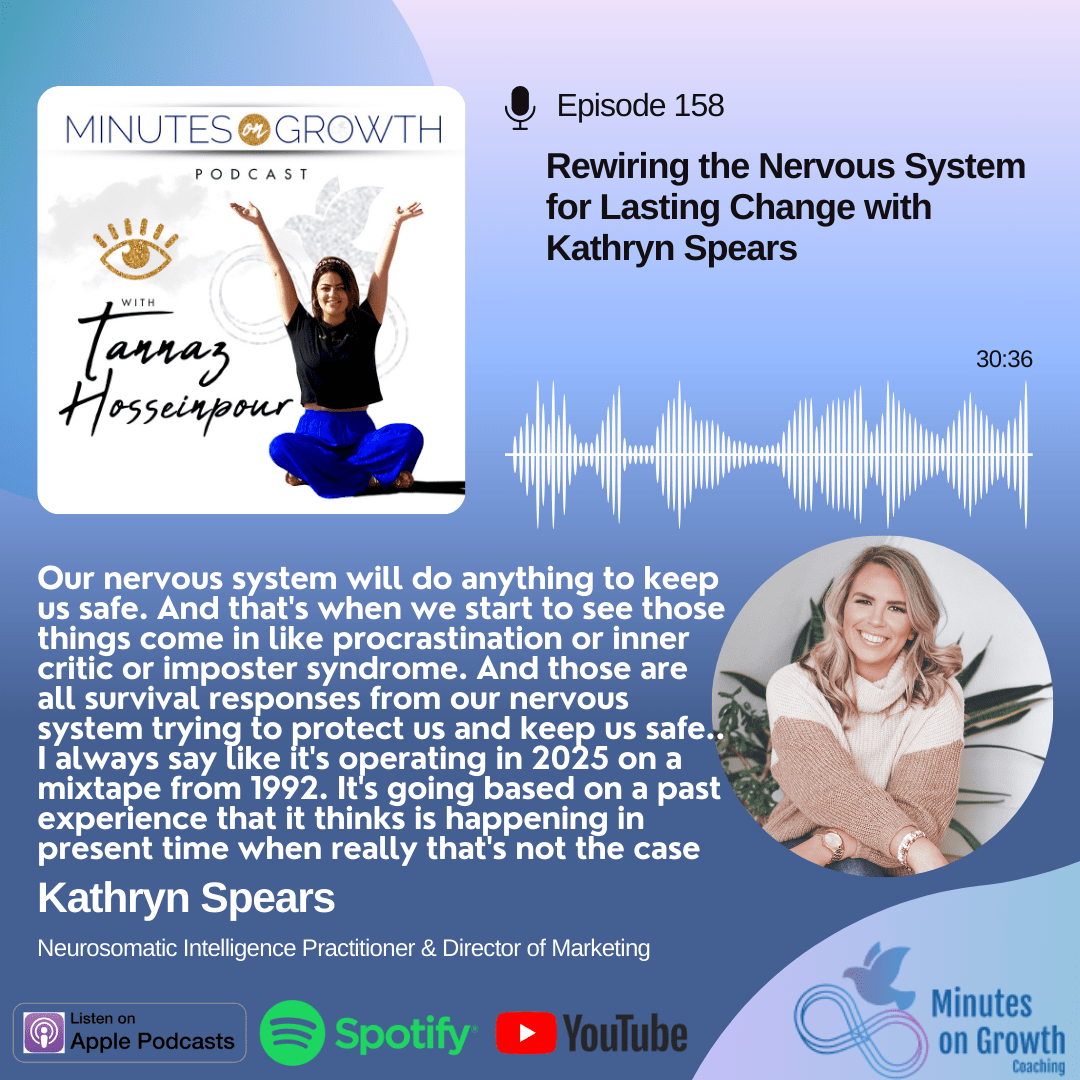
Episode 158 – Rewiring the Nervous System for Lasting Change with Kathryn Spears

Click here to listen to Episode 158 of the Minutes on Growth Podcast on Spotify, on Apple Podcast or to watch the episode on Youtube.

In this episode, I sit with Kathryn Spears, a Neurosomatic Intelligence Practitioner and Director of Marketing at the leading global institute of neurosomatics.

We explore the vital role of nervous system regulation in healing, sustainable change, and leadership.

Kathryn shares her personal journey overcoming childhood trauma, late-diagnosed ADHD, and breaking free from limiting patterns using uniquely personalized somatic tools.

Together, we uncover why mindset work alone isn’t enough and how signaling safety to the nervous system unlocks profound, sustainable transformation.

Whether you’re a high-achieving woman feeling stuck or someone looking to deepen their understanding of mind-body healing, this conversation offers hope, practical insights, and empowerment.

To connect with Kathryn: https://kathrynspears.co

Episode 157 – Stop Picking Up The Sock

Click here to listen to Episode 157 of the Minutes on Growth Podcast on Spotify, on Apple Podcast or to watch it on Youtube.

Hi Soul-friends, it’s Tannaz Hosseinpour and welcome back to another short solo episode of the Minutes on Growth Podcast.

Today, I want to share a simple phrase that completely changed the way I show up in my relationship, and one that I think many of you will resonate with

A few years ago, I was venting to my therapist about all the little things I was constantly doing to “keep the peace” … handling the chores, managing the schedules, remembering all the to-dos, and constantly having to clean the house….

When she looked at me, and after a long pause, gently said:
“Stop picking up the sock.”

Now, she wasn’t just talking about a literal sock on the floor.
It was a metaphor … for all the invisible labor I was carrying that wasn’t mine to hold.

The emotional labor.
The mental load.
The tiny, unseen ways I was over-functioning every day.

Doing things just to get them done, or so he wouldn’t have to, or because I didn’t want to feel the discomfort of waiting.

But here’s the truth:
Every time you pick up a sock that isn’t yours, you create a dynamic that becomes hard to unwind.


This is deeply connected to our nervous system.
Sometimes we over-function — we manage, fix, anticipate — because that keeps us regulated.

Because letting things drop or leaving space for someone else to take responsibility?
That can feel really uncomfortable.

But if you keep doing everything, your partner never has the chance to show up.
And you never get to experience the relationship you actually want ; the one where the labor is shared, and love is a co-creation.


Picking up the sock becomes a slippery slope — because soon, one partner becomes the parent, and the other becomes the child.

You start feeling like the manager.
They start acting like the dependent.
And suddenly, the intimacy shifts — because nobody wants to feel romantic toward their manager.

You start keeping score.
You start feeling unseen.
And instead of collaboration, it becomes quiet resentment.


so let’s look at where this comes from…

Most of us learned this pattern early on.
Maybe you were the eldest child that was the responsible child.
Maybe love was modeled to you as self-sacrifice.
Maybe you thought being “good” meant being accommodating.

But love doesn’t mean doing everything.
Love means doing your part — and trusting your partner to do theirs.


& so that day, my therapist started to teach me ways to break the cycle

Here’s what helped me break free…

  1. Notice the impulse.
    Catch yourself when you’re about to “just do it” again.
    Ask: Is this something I need to take on? Or something I’m choosing out of habit?
  2. Allow space.
    Can the sock stay on the floor for a bit?
    Can you let someone else notice it and decide to act?
  3. Regulate the discomfort.
    It might feel so hard to leave things undone.
    But sit with that discomfort. That’s the real work.
  4. Trust their capacity.
    Your partner isn’t helpless.
    Let them rise — or let them take accountability if they don’t.
  5. Let Natural Consequences Happen
    If they forget something, let them feel it.
    That’s how accountability and growth happen.
  6. Talk about it openly.
    Let your partner know you’re stepping back from doing everything — and why.
    Invite collaboration, not confrontation.

💡 Final Thoughts

So the next time you feel the urge to pick up the sock, to jump in and fix it,
to make the call, to clean the thing, to remember the birthday —
pause and ask yourself:
Is picking this up serving the relationship — or is it silently eroding it?

“Is picking this up an act of love… or is it an act of fear?”

Let this be your reminder:
You don’t have to hold everything.
You get to share the weight.
And that soul-friends is what builds real intimacy.


Sending you love,
Until next time,

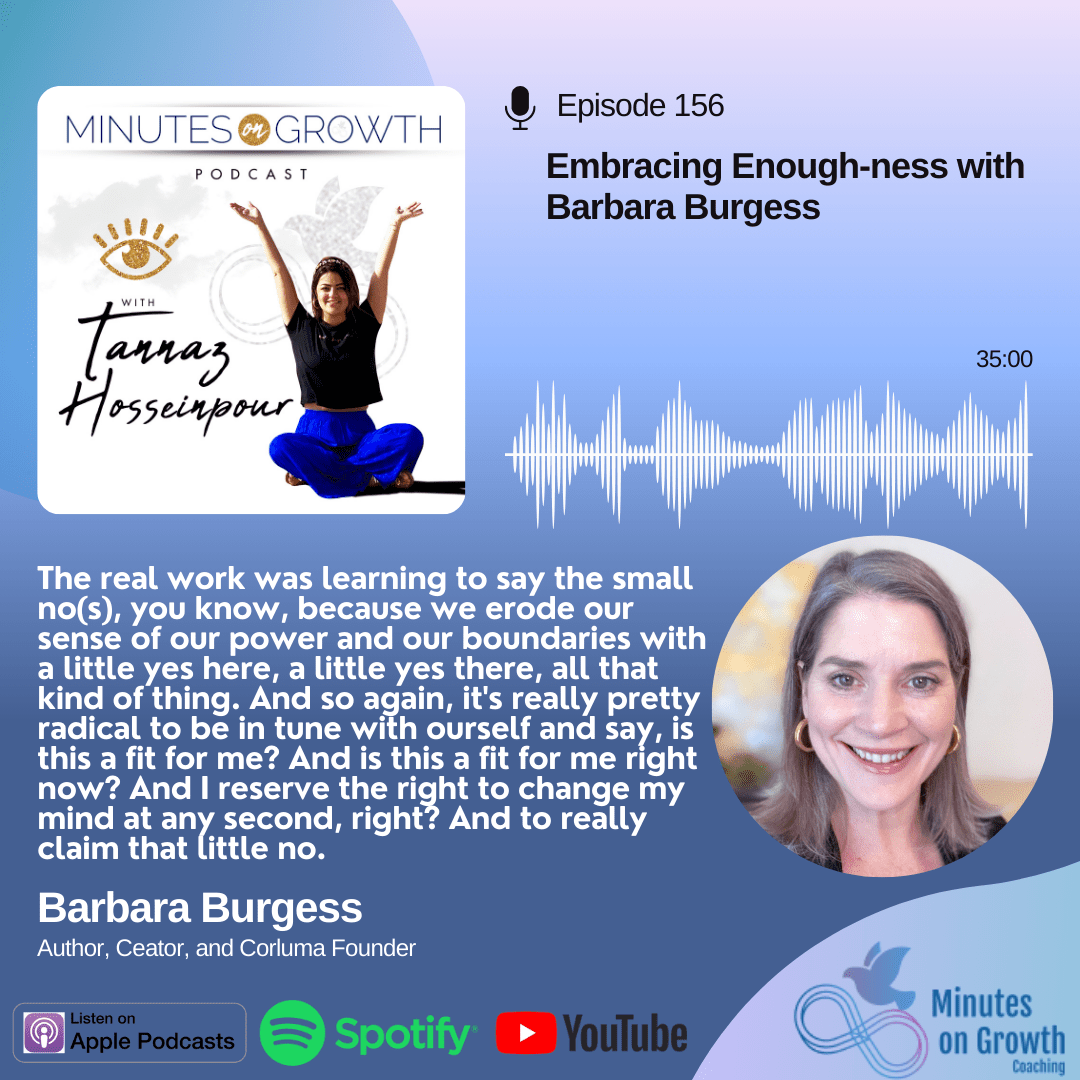
Episode 156 – Embracing Enough-ness with Barbara Burgess

Click here to watch Episode 156 of the Minutes on Growth Podcast on Youtube, or to listen to it on Spotify or on Apple Podcast

In this 35 minute episode, I sit down with Barbara Burgess, author, founder, and executive, to explore the transformative power of embracing “enough” in a world obsessed with lack.

We dive into Barbara’s personal journey of overcoming feelings of not enoughness, the importance of setting both big and small boundaries unapologetically, and the beautiful interplay of spirituality and practical action in business and life.

Barbara shares how showing up authentically opens doors to creativity, connection, and fulfillment, offering powerful insights on following intuition, surrendering control, and living a life rich with presence and playfulness.

Whether you’re wrestling with self-worth or curious about integrating spirituality into your daily hustle, this conversation brings a wholesome perspective to help you feel more grounded, empowered, and enough.

Episode 155 – Kabbalistic Wisdom with Monica Berg

Click here to watch Episode 155 of the Minutes on Growth podcast on Youtube, or to listen to it on Apple Podcast or on Spotify.

In this transformative episode of the Minutes on Growth podcast, I sit down with Monica Berg, co-director of the Kabbalah Center and author of Rethink Love, to explore profound Kabbalistic tools that have the power to change lives.

Monica shares her insights on embracing change, cultivating certainty amidst uncertainty, and nurturing meaningful relationships.

We dive into practical wisdom on active appreciation, the art of pausing, and the deep spiritual work needed to truly “earn the light” in our relationships.

If you’ve ever wondered how to navigate love, life, and soul growth through the lens of ancient Kabbalistic teachings, this conversation is a must-listen.

To learn more: http://www.kabbalah.com

To listen to the Spiritually Hungry Podcast: https://www.spirituallyhungrypodcast.com

Episode 154 – Embracing Uncertainty as the Path to Purpose with Christian Ray Flores

Click here to listen to Episode 154 of the Minutes on Growth Podcast on Spotify, or Apple Podcast

Episode 153- Are You Mothering Your Partner?

Click here to listen to Episode 153 of the Minutes on Growth podcast on Spotify or on Apple Podcast

Hi soul friends, its Tannaz Hosseinpour, and welcome back to another solo episode of Minutes on Growth.

In this episode, we’re diving into something I see so often in sessions and hear in sisterhood spaces … the pattern of stepping into the mothering role in romantic relationships.

This episode is not about blame or shame … it’s about awareness, emotional safety, and reclaiming our feminine power in relationships. Because here’s the truth:

When you mother your partner, the role of girlfriend, lover, or wife becomes vacant.

And while it often comes from a good place ( wanting to support, help, or nurture ) this dynamic can slowly erode emotional intimacy, sexual polarity, and mutual respect.

Let’s explore how this happenswhy it’s harmful, and what to do instead.


Let’s start with some honesty … many of us were conditioned to over-function.
Especially if you’re a people-pleaser, an eldest daughter, or someone who grew up in a home where emotional labor was your love language.

You might have learned that love looks like:

  • Reminding him of his appointments
  • Repacking his gym bag
  • Cleaning up after him
  • Doing his emotional processing for him

But here’s the thing:

That’s not partnership. That’s parenting.

According to relationship researcher Dr. John Gottman, imbalance of responsibility   can lead to resentment, conflict, and feelings of being undervalued. The Gottman Institute emphasizes that it’s not necessarily about dividing tasks 50/50, but rather about each partner feeling that their contributions are recognized and appreciated and mothering (constantly correcting, controlling, or over-managing your partner ) can breed resentment on both sides,  and resentment can lead to contempt, which is a major predictor of divorce (their research shows 93% likelihood). so why on both sides?

  • You feel exhausted, underappreciated, and touch-starved.
  • He feels belittled, emasculated, and pulled away from his own agency.

And when sexual polarity disappears… the romantic connection fades.
I read a beautiful quote once which I think is attributed to Esther perel (not fully sure) but it says

“We want to have sex with someone who excites us, not someone who exhausts us.”


Now let’s look at it from a different perspective

From a nervous system lens, stepping into the mothering role often feels “safe.”
It gives us a sense of control … especially if we fear being abandoned or disappointed. It’s the “If I don’t do it, no one will” wound.
But when we’re always doing ( planning, fixing, managing ) we move into hyper-vigilance, not intimacy.

True partnership thrives in interdependence, not caretaking.


If this is resonating, I don’t want you to panic … its not a death sentence… like always, awareness is the first step

Once we are aware of it, here are some ways to step out of the mothering dynamic and back into your role as a partner:

  1. Notice the Pattern Without Shame:
    Ask yourself: “Am I over-functioning in areas where he can step up?”
  2. Stop Reminding & Start Releasing:
    Let him hold the consequences of forgetting or messing up.
    Trust that discomfort can be a teacher.
  3. Use “I” Statements to Reclaim Energy:
    Try: “I’ve noticed I’ve been feeling more like your manager than your partner, and it’s affecting how connected I feel.”
  4. Invite, Don’t Instruct:
    Instead of directing (“You should…”), invite collaboration.
    Ask, “How can we both support the home/relationship better?” or “I’m deeply craving date nights and feeling connected to you without the kids or any other distractions, can you schedule a night out for us?”
  5. Reignite Polarity:
    Step back into your feminine … the energy if softness, trust, receptivity … instead of constantly being in the doing, fixing energy. Remember balancing the yin and yang is key. so allow yourself to flirt. Receive. Express. Be.

So soul-friends, f you’ve been in this pattern, I want you to know:
You are not wrong for being nurturing.
But love doesn’t mean over-responsibility.
Devotion does not mean depletion.

You deserve to be loved as a woman, not just appreciated as a caregiver.

If this episode resonated , feel free to share it with your loved ones – thank you for listening and speak soon

Episode 152 – Navigating Difficult Mother-Daughter Relationships with Katherine Fabrizio

Click here to listen to Episode 152 of the Minutes on Growth Podcast on Spotify, on Apple Podcast or to watch the episode on Youtube