
Click here to listen to Episode 149 of the Minutes on Growth Podcast on Spotify, on Apple Podcast or watch on Youtube.
Episode 148 – Honouring Your Capacity
Click here to listen to Episode 148 of the Minutes on Growth Podcast on Spotify, on Apple Podcast
Hi Soul Friends, it’s Tannaz Hosseinpour, and welcome back to another short solo episode of the Minutes on Growth podcast.
You might’ve noticed—it’s been a couple of weeks since our last episode.
And I want to start today by being honest with you.
With everything that was going on in the world, particularly in the Middle East—I found myself needing to pause.
Not because I didn’t have anything to say. But because my nervous system didn’t have the capacity to hold space for one more thing.
And that’s something I’ve really been learning to honor.
So instead of pushing through, instead of producing just to produce, I gave myself permission to take something off my plate.
I extended grace to myself.
And that’s what today’s episode is really about:
How do we learn to honor our capacity and extend ourselves grace, especially when the world around us keeps demanding more?
So often, especially for those of us who are recovering people pleasers, or perfectionists, the idea of pausing feels… wrong.
We fear letting others down.
We fear not being enough.not doing enough.
We fear slowing down might make us seem lazy, unmotivated, or weak.
But here’s a reframe I want to offer:
Pausing isn’t weakness.
It’s wisdom.
Your nervous system knows when it’s reached its threshold (you know those moments when everything you see and hear gets on your nerves… thats when you know you’ve crossed your internal limits)
So one of the most healing things we can do for ourselves is to listen when that whisper shows up telling us to pause.
Because regulation doesn’t happen in constant motion.
It happens in rest.
It happens in space.
It happens in the exhale.
One of the phrases I’ve found myself repeating lately is:
“This is what I have capacity for today, and that is enough.”
Say it with me:
This is what I have capacity for today, and that is enough.
Whether that’s sending one email.
Or feeding yourself.
Or just waking up and being with what is.
Your worth isn’t measured by how much you accomplish.
Your worth is not earned. It is remembered. It is innate.
The relationship you have with yourself is heavily influenced by how tenderly you respond to yourself in those tender moments.
I also want to speak to that very specific discomfort that can arise when you do start honoring your capacity.
Especially for people pleasers.
Especially for those of us who grew up learning to be hyper-aware of everyone else’s needs but our own.
Because let’s be honest; sometimes, putting your well-being first feels… selfish.
But it’s not.
It’s actually a radical act of self-responsibility.
You can’t pour into others when your own cup is bone dry.
You can’t truly serve when your own nervous system is in survival mode.
So when you say, “I need to rest,”
or “I can’t hold that conversation right now,”
or “I need space to feel,”
you are not abandoning others.
You are simply choosing not to abandon yourself.
And I promise you…when you learn to do that, you show up for others more honestly, more sustainably, and more compassionately.
And if no one’s told you this recently:
You’re allowed to take a break.
You’re allowed to reset.
You’re allowed to choose rest over hustle.
🌿
Before we close, I want to gently remind you that our Tuscany Self-Worth, Self-Care & Sisterhood Retreat is just around the corner.
There are only a few spots left, and if you’ve been feeling the pull to recharge, reset, and reconnect in a deeply nourishing way—this might be for you.
Because part of reclaiming our capacity also means surrounding ourselves with spaces that honor who we are becoming.
Spaces that feel safe.
That feel expansive.
That encourage you to be, rather than to perform.
So whether it’s through a retreat, a pause, a breath, or a boundary—
May you keep choosing you.
May you keep honoring what you need.
And may you keep extending grace, even when it feels unfamiliar.
You are not behind.
You are right on time.
Until next time, be gentle with yourself.
You’re doing better than you think.
Episode 147 – From Stress to Connection with Elizabeth Earnshaw
Click here to listen to Episode 147 of the Minutes on Growth Podcast on Spotify, on Apple Podcast or to watch the episode on Youtube
Episode 146 – Healing Shame & Honoring the Body We’re In
Click here to listen to Episode 146 of the Minutes on Growth Podcast on Spotify, on Apple Podcast or to watch the Episode on Youtube
Hi Soul Friends, it’s Tannaz Hosseinpour, and welcome back to another solo episode of Minutes on Growth.
Today’s conversation is one that’s been unfolding in sessions, in my friendships, and in my own reflections. It’s about our bodies.
More specifically—the comments made about our bodies, the shame we carry because of them, and the deep, often invisible wounds they leave behind.
Before we dive deeper, I want to clarify something: I’m not a nutritionist or a medical doctor. I don’t offer dietary or medical advice. My expertise lies in mental health, and that’s the lens through which I approach these topics. My focus is on how our relationship with our bodies, food, and societal narratives impacts our emotional and psychological well-being.
Research has shown that body image concerns are a global mental health issue. A study published by Cambridge University press highlights that dissatisfaction with one’s body appearance, including shape and weight, is prevalent worldwide and is associated with poor mental and physical health outcomes. These concerns are influenced by cultural contexts but are universally linked to mental health challenges . That’s why it’s crucial to foster open dialogues about these issues. By understanding the psychological aspects of body image and the societal pressures that contribute to them, we can begin to heal and support one another. Remember, it’s not about fitting into a mold but embracing and honoring our unique selves.
so lets begin…
For many women, our bodies have been a topic of conversation since childhood.
We grew up watching our mothers criticize their bodies.
Our grandmothers did the same.
And somewhere along the line, we learned that our bodies and the way we look were always up for discussion.
“Wow, you’ve lost weight.”
“You’ve gained some.”
“Your arms look big.”
“That outfit is too tight on you. You shouldn’t be wearing that with your body type.”
And for the longest time, this wasn’t questioned—it was normalized.
It was almost expected that our bodies be available for commentary, and that we should either take it as a compliment or see it as motivation.
But isn’t it time for us to change the narrative… for us to set a new normal… that our bodies are not public property to be reviewed or critiqued.
And comments—even the seemingly innocent ones—can hit wounds we’ve carried for decades.
I’ve had conversations with my fiancé about this, too.
And I explained to him:
You didn’t go to school and hear, “Bro, your hips look bigger today.”
This simply isn’t something that’s been up for discussion for most men… I say most and not all because I saw first hand how my brother was subject to these comments too growing up which I’ll discuss in a bit…
anyways, because many haven’t had these experience they don’t realize that for example..when a male partner makes a comment about our body—even with good intention—it often lands in a wound that’s been conditioned into us since we were girls.
That’s why we feel triggered.
Not because of necessarily what they said in that one moment—but because of everything that came before it.
The years of scrutiny.
The beauty industry constantly telling us we’re never enough.
The social media filters.
The shifting trends—one minute it’s heroin chic, the next it’s curves.
And so many of us begin to feel like our worth is constantly tied to whether or not we fit whatever mold is trending.
As if our body is a fashion statement that needs to be constantly adjusted.
But it goes deeper than body image.
I mean—think about it—for the longest time, we didn’t even consider our menstrual cycles when it came to fitness or nutrition…
Most of the research done in health and wellness? It was done on men—and simply applied to women, without accounting for our unique biology.
I recently read a study showing that women actually need more sleep, and yet up until now, that was never part of the conversation.
Our bodies weren’t factored in. We were expected to perform and operate just like men.
And one thing I deeply appreciate—something I rarely saw growing up in the Middle East—is my dad’s policy at work.
He created space for women to take the first day of their cycle off—no questions asked.
It wasn’t seen as a weakness.
It was acknowledging biology, honoring the body, and creating space for rest.
And yet, for so many of the women I work with, that kind of openness around menstruation has been completely absentfrom their homes.
They tell me they never talked about it.
That when they first got their period, it was filled with shame, secrecy, embarrassment.
That when their bodies began to change during puberty—developing breasts, gaining curves—they felt they had to hide.
And that shame? It doesn’t just vanish. It sits quietly in the background, influencing our relationship with our bodies—and it resurfaces again later during perimenopause and menopause.
And here’s the thing—we don’t talk about that enough either.
Perimenopause especially is something I hear so little about, even though it affects our mood, sleep, energy, hormones, weight, relationships, and nervous system.
We’re not educated about it. We’re not prepared for it.
And most of the time, the men in our lives don’t know about it either—which makes it harder to ask for support when we don’t even have the language for what we’re experiencing.
This is why these conversations matter.
This is why body literacy matters.
Because when we’re informed, we stop feeling like we’re broken.
We stop fighting biology.
And we start working with our bodies instead of against them.
Here’s what I want us to begin shifting:
The body was never the problem.
The story we inherited about our bodies is.
As I mentioned… shame is a heavy story.
And we cannot shame ourselves into changing.
We cannot judge ourselves into love.
But we can begin to reclaim.
To rewrite the narrative.
To come home to the body—not to control it, but to honor it.
My Brother’s Story: From Shame to Strength
And I want to share an example of this reclamation from someone very close to me that I mentioned earlier—my brother.
He once weighed 220 kilos.
He had his fair share of getting bullied…
Doctors labeled him obese. He was on thyroid and cholesterol medication
He was only 19, and every specialist told him:
“This is impossible to do naturally.”
“You need surgery.”
“You’ll never make it without medical intervention.”
He had tried for years to lose the weight through yo-yo diets, signing up to different gyms but stopping after a few sessions…
But after the last doctor appointment where the doctor was adamant on scheduling him in for surgery…
I remember him saying something powerful:
“Just give me one last chance to try and connect with my body.”
and try he did…
He embarked on the most profound sustainable journey I have ever seen … and I think it had a lot to do with intention… it no longer was to please my mom who was worried about him.. it no longer was to look like the people he saw on social media… but it was to genuinely reconnect with his body… to reconnect with the parts of himself that he had shamed and suppressed over the years…
He didn’t starve himself.
He didn’t take Ozempic, even though it was available to him for free.
He didn’t torture his body into transformation.
Instead—though baby steps…he changed his relationship with it.
He began treating his body like a temple.. verbatim.. his own words.
He went from ordering Uber Eats 3x a week including for breakfast to cooking real food…
He nourished himself with protein, veggies, rice—simple, grounded meals.
He moved his body not as punishment, but as celebration.
He kept saying… “I want to feel strong. I want to feel alive in this body.”
Over two years, he went from 220 to 90 kilos. His liver healed. He was taken off all the medication.
But more importantly—he became someone who actually felt connected to the body he lived in.
That’s not a weight-loss story.
That’s a story of autonomy.. of agency.. over his own body.. his own story.
Healing Through Safe Community
And we don’t do this kind of healing in isolation.
We need safe spaces.
At our Mykonos Retreat, one of the most beautiful transformations we witnessed was a woman healing her relationship with food.
Not because she was given a meal plan or a lecture.
But because she felt seen.
Held.
Supported.
When you’re surrounded by sisterhood—not comparison—you soften.
You release the shame.
You start to reclaim your body, not as an enemy, but as an ally.
This is why, whenever we have an in person program for example, at our upcoming Tuscany Retreat, we’re intentionally weaving in healing around our bodies, our food, and our feminine rhythms.
Whether it’s in our pizza and pasta making classes, where we engage with food joyfully and mindfully…
Or in our shared meals, where we bless our food, hold hands, and eat together…
We’re healing the layers—
The relationship with food.
With body image.
With sisterhood.
And there’s actual research that shows that eating with loved ones improves digestion, reduces stress, and increases overall satisfaction with meals.
It’s not just emotional—it’s physiological.
You’re Allowed to Be at Peace in Your Body
So here’s my invitation to you today:
You are allowed to be at peace in your body.
You’re allowed to move it, love it, feed it, honor it—without apology or explanation.
You’re allowed to speak up when someone crosses a boundary.
You’re allowed to rewrite the narrative.
And if you’re in partnership—share this episode with your partner.
Help them understand that this isn’t about one comment.
It’s about everything that came before it.
And together, we can start creating relationships and communities where bodies are respected, not reviewed.
Where healing is possible.
And where we can each learn to feel safe—in the skin we’re in.
If this episode resonated with you, I’d love for you to share it with a friend, leave a quick review, and don’t forget to check the show notes for Tuscany retreat details.
Until next time, be gentle with your body. It’s been through a lot—and it’s still showing up for you.
Episode 145 – Art as a Medium for Emotional Healing with Courtney Pearl
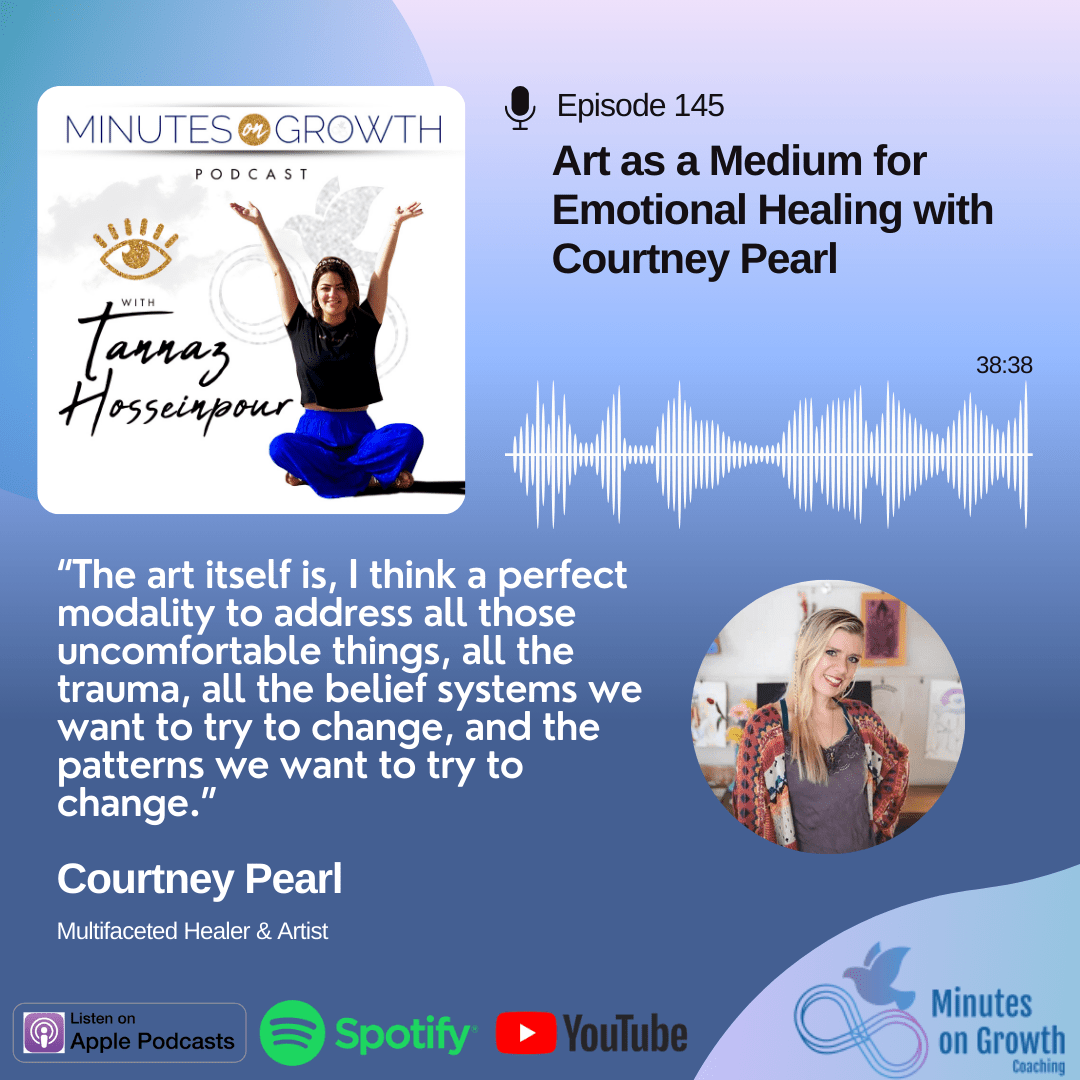
Click here to listen to Episode 145 of the Minutes on Growth podcast on Apple Podcast, Spotify ,Spreaker, or to watch it on Youtube.
In this 38 minute episode, I sit down with Courtney Pearl, a multifaceted healer and artist, dedicated to guiding individuals through emotional processing and energy healing. Courtney shares her transformative journey from a structured upbringing in the LDS community to embracing a path of creativity and healing after facing personal challenges, including infertility and her husband’s struggles with addiction.
We explore the profound role of art in healing, discussing how color and creativity can serve as powerful tools for introspection and emotional regulation. Courtney introduces the Integrative Processing Technique (IPT), which combines energy healing with emotional exploration, allowing individuals to visualize and express their feelings through art.
Additionally, we delve into the importance of understanding the mind-body connection, the impact of trauma stored in the body, and how energy modalities like Reiki and chakra balancing contribute to our overall well-being. Courtney emphasizes the significance of reconnecting with nature and respecting the land, drawing parallels between ancient practices and contemporary life.
This episode is a rich tapestry of insights, offering practical guidance for anyone seeking to harness their creativity for healing and self-discovery. Join us for a conversation that will inspire you to embrace your unique journey toward emotional wellness and connection with the world around you.
To connect with Courtney: https://www.prism-healing.com
Episode 144 – The Courage to Be Fully You
Click here to listen to Episode 144 of the Minutes on Growth Podcast on Spotify, or on Apple Podcast.
Hi Soul Friends, it’s Tannaz Hosseinpour, and welcome back to another short solo episode of Minutes on Growth.
Before we begin, I just want to share a quick announcement.
The Self-Worth, Self-Care, and Sisterhood Retreat in Tuscany is officially live—and we now have only 4 spots left!
It’s happening August 18–23, and it’s going to be a truly sacred experience for those looking to embody their Divine Feminine, heal in safe sisterhood, and reconnect with their inner wisdom through practices like yoga, breathwork, nervous system regulation, and energy healing.
If this is calling to you, check out the link in the show notes. It really is first come, first served—and I would love to hold space with you there.
Now let’s shift gears to our topic of the week. Today, I want to talk about something that’s been coming up a lot lately—in client sessions, in my personal reflections, and in collective energy—
Authenticity.
Not the curated, aesthetic version of authenticity.
But the real, raw kind.
The kind that asks us to be seen as we are.
To stop editing.
To stop shrinking.
To stop performing for a life we don’t actually want.
There’s a powerful quote in the Bhagavad Gita that says:
“It is better to live your own destiny imperfectly than to live an imitation of somebody else’s life with perfection.”
Just let that sink in.
We live in a world that’s constantly telling us who we should be.
And if we’re not deeply rooted in who we are, it becomes way too easy to start living for someone else’s expectations.
Society’s expectations.
Our parents’.
And sometimes, we’re not even aware of the parts of us that are doing this.
There’s often a part of us that’s been conditioned to fulfill the unmet desires of our parents—to live a life that gives them peace, pride, or protection.
And I want to be clear: so much of this comes from love.
Parents want the best for their kids. They want to protect them from the pain they went through.
So they give in to societal standards, hoping it’ll provide safety and success.
But somewhere along the way, that well-intentioned conditioning can interfere with the unique song that lives inside us.
And without realizing it, we start suppressing parts of ourselves—
Parts that, if brought to the surface, would actually guide us toward the highest version of our destiny.
The Parts Within Us (IFS Perspective)
This is why I love working with Internal Family Systems—or IFS.
IFS teaches us that we’re not just one single identity—we are made up of many parts.
We have parts that want to be liked.
Parts that want to protect us.
Parts that are scared.
Parts that still carry the wounds of our past.
None of these parts are bad.
They all exist for a reason.
They helped us survive.
But authenticity means learning how to see these parts.
To listen to them.
To integrate them—not to exile or shame them.
And when we lead from Self—with a capital S—we lead from a place that is calm, curious, confident, connected, and compassionate.
That Self lives beneath all the noise. And it’s always been there.
Your work is simply to return to it.
Your Unique Blueprint
And here’s the thing—you were never meant to look or sound like anyone else.
You came into this world with a unique blueprint.
Your birth chart, your human design, your lived experiences, your gifts—none of it is a coincidence.
Nothing about you was random.
So trying to squeeze yourself into someone else’s version of success or happiness will always leave you feeling disconnected.
You weren’t meant to imitate.
You were meant to express.
Why It’s Hard—and Why It’s Worth It
Now, showing up like that? That takes courage.
Because it’s asking us to step out of our comfort zone.
And our comfort zone is where our brain feels safest.
Your brain isn’t trying to sabotage you—it’s trying to protect you.
It says, “Let’s stay where it’s familiar. Let’s not be too visible. Let’s not take up too much space.”
But the truth is—when we choose authenticity…
When we say yes to our full expression, to our truth, to our gifts…
That’s when life starts to feel nourishing and expansive.
That’s when the people, opportunities, and experiences that are truly meant for us begin to align.
You Don’t Need to Be Perfect
And as cliché as it sounds:
You don’t need to be perfect.
You just need to step out of your own way and allow yourself to be… you.
One of my favorite quotes is from Sophia Bush:
“You are allowed to be both a masterpiece and a work in progress, simultaneously.”
Let that be your reminder today.
You can love who you are now and still be evolving.
You can be proud of where you are and still want more.
You can hold the both/and with grace.
Your Invitation
So I’ll leave you with this:
What part of yourself have you been hiding?
What would happen if you let it be seen?
Your authentic self—the real you—isn’t something you need to become.
It’s something you return to.
Again and again and again.
Thank you for spending this moment with me.
If this episode resonated, please share it with someone who needs a reminder that they’re allowed to take up space and be fully, beautifully themselves.
And don’t forget to hit subscribe, leave a quick review, and check the show notes for more tools on this journey.
Until next time, keep choosing you.
Episode 143 – Personalizing Your Healing Journey with Kate Champion
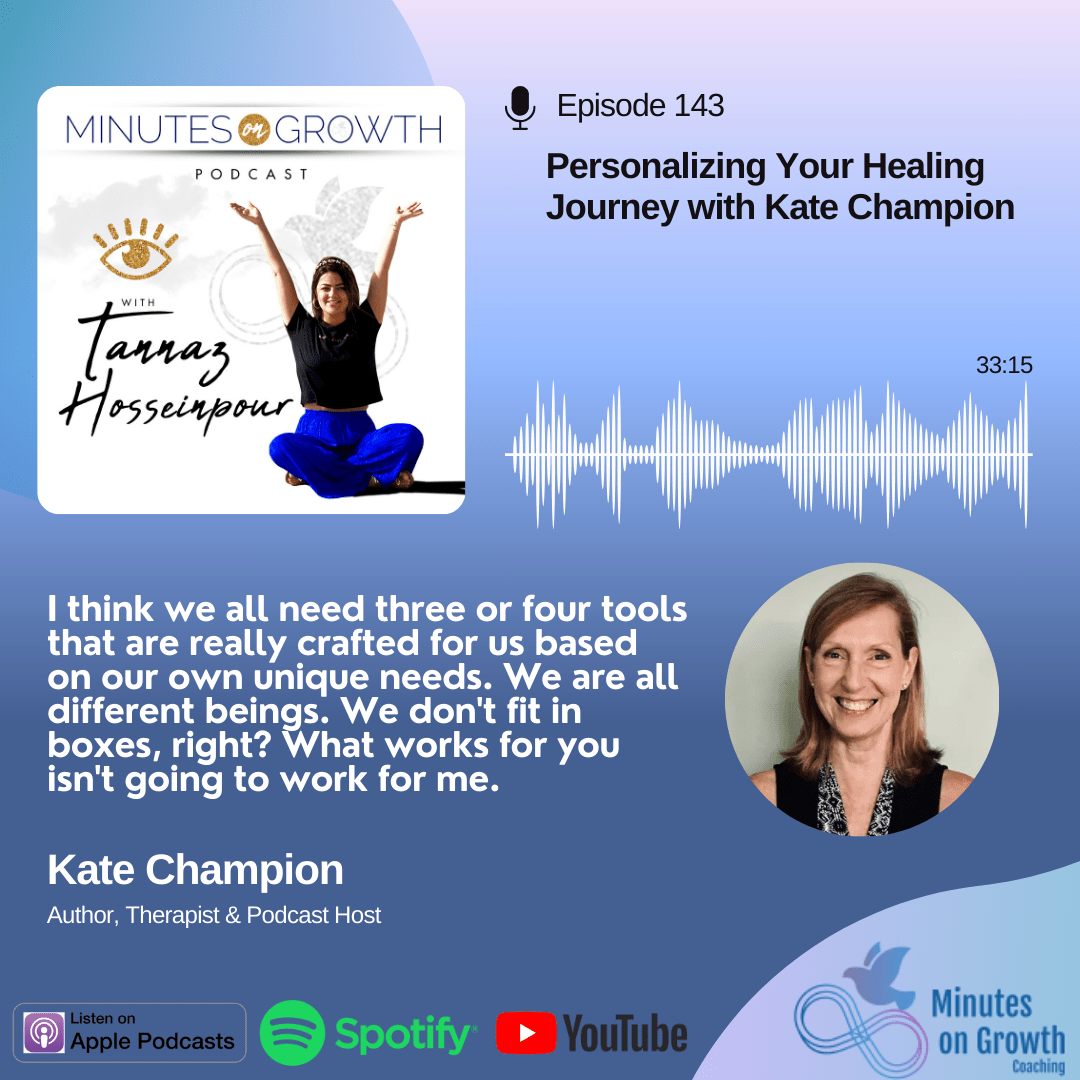
Click here to listen to Episode 143 of the Minutes on Growth podcast on Spotify, on Apple Podcast or to watch it on Youtube
Episode 142 – Building Your Support System

Click here to listen to Episode 142 of the Minutes on Growth podcast on Apple Podcast or on Spotify
Hi Soul Friends, it’s Tannaz Hosseinpour, and welcome back to another solo episode of Minutes on Growth.
Before we dive in, I have a really exciting announcement to share with you! this ones for the ladies…
The Self-Worth, Self-Care, and Sisterhood Retreat in Tuscany is officially launched, and early bird pricing is active until May 5th! You can check out all the details in the show notes below.
We’ve already had quite a few inquiries coming in, so if this is something you’d like to experience this summer, don’t wait too long. This retreat is going to be such a beautiful opportunity to tap into your Divine Feminine, to deepen your self-esteem, self-worth, and nervous system regulation. We’re going to dive into powerful work around trauma processing, balancing energies, and embodying your most authentic self—all in a safe, supportive, sacred space.
If this is resonating then I highly recommend checking it out because i would absolutely love to have you there with us
Okay, now let’s get into today’s topic: the importance of safe communities.
The Science of Connection
Did you know that the longest-running study on happiness—the Harvard Study of Adult Development, which has been going for over 80 years now—found that the quality of our relationships is the strongest predictor of our happiness and health?
Not our income.
Not our career success.
Not our achievements.
Our relationships.
Strong, safe, supportive relationships are what nourish us. They protect our nervous systems. They expand our resilience.
And this makes so much sense—because we are tribal people by nature. We are wired for connection. We thrive when we feel seen, supported, and valued within a community.
Research on Friendship and Support Systems
And it’s not just Harvard’s findings.
Research published by William Chopik in his article “Associations among relational values, support, health, and well-being across the adult lifespan” found that friendships become even more important to well-being as we age, even sometimes more than family relationships.
Friendships are the relationships we choose. They’re based on shared trust, values, and emotional reciprocity.
Another study by Julianne Holt-Lunstad in a 2010 meta-analysis of Social Relationships and Mortality Risk showed that having strong social connections boosts longevity and even strengthens immune function. Meanwhile, a lack of strong relationships can have a health impact equivalent to smoking 15 cigarettes a day.
So if you’ve been feeling the pull to seek out deeper connections or to nurture your existing friendships—you’re not imagining it. Your soul and your nervous system are craving it.
In fact, loneliness today has become such a widespread issue that it’s being called an epidemic.When I was living in Japan, I witnessed firsthand how culturally, many people experienced loneliness very differently than we might in the West—it was often quieter, more internalized.And during the pandemic, this loneliness skyrocketed across the country.There’s a study I want to mention—it was conducted among over 27,000 Japanese workers during COVID-19, published by Yusuke Konno and colleagues.They found a powerful link between loneliness and psychological distress.Even after adjusting for factors like family time, friendships, and social media interaction, people who reported feeling lonely had a 29 to 36 times greater risk of experiencing psychological distress.Think about that for a moment: 29 to 36 times higher risk.And the researchers emphasized that intervention was urgently needed—because loneliness wasn’t just a feeling; it was impacting mental health, stress levels, and even overall functioning.Even simple factors—like having no friends to call, no one to ask for help, eating meals alone—were all linked to higher levels of distress.Loneliness is heavy on the nervous system. It’s not just an emotional experience—it becomes a physiological one.
I’ve also had so many conversations lately—especially with new parents—who are feeling isolated. They tell me,
“Where’s the village? Where is the support system we were supposed to have?”
And it’s heartbreaking, but it’s also a reflection of the way our modern world has evolved.
Where once we naturally had built-in communities, today we have to be intentional about creating them.
We have to be deliberate about building the villages we need.
So now, the question becomes:
How can we intentionally create the village we need?
How can we become that village for each other?
How to Be a Better Friend as an Adult
And this is where we move from wishing for it to becoming it.
Because when we embody what we want to receive, we naturally attract it.
I recently shared a post about this—simple but powerful ways to put effort into adult friendships:
- Send check-in messages: “Hey, I was thinking about you. How have you been?”
- Schedule catch-up calls: “I miss our chats. When can we catch up?”
- Plan intentional meet-ups: Coffee, a walk, a quick dinner—it doesn’t have to be complicated.
- Send thoughtful articles, notes, or memes when something reminds you of them.
- Celebrate their milestones: Big or small.
- Be present during conversations: Not just physically, but emotionally.
- Share your own updates too: Vulnerability builds connection.
- Support their passions: Show interest in what lights them up.
When we do these small things, we create an energy of reciprocity and trust.
We build safe communities one interaction at a time.
And if your current circle doesn’t reflect the depth you’re craving?
That’s okay.
It just means it’s time to courageously look outside your usual spaces. To meet people who are aligned with the values, visions, and energies you want to cultivate.
This is exactly why we host retreats like the Tuscany Self-Worth, Self-Care, and Sisterhood Retreat.
Because sometimes, the connections your soul is seeking aren’t found in your hometown or your usual circles—they’re found in sacred spaces, with people who are also saying yes to their growth, to their expansion, to their higher selves.
Closing Reflection
So today, my invitation for you is this:
- Where can you start being the kind of friend you wish you had?
- Where can you start building your village?
- Where can you show up more fully, more intentionally, and more lovingly—for yourself and others?
Because safe community isn’t something we stumble into.
It’s something we create—with every small, loving action.
Thank you for joining me today. If this episode resonated with you, please share it with someone who might be longing for deeper connection too.
And don’t forget to subscribe so you don’t miss next week’s episode—and check out the show notes for all the details on the Tuscany retreat.
Until next time, keep nurturing your growth, and keep building your village.
Episode 141 – Healing Through Energy with Natasha Joy Price
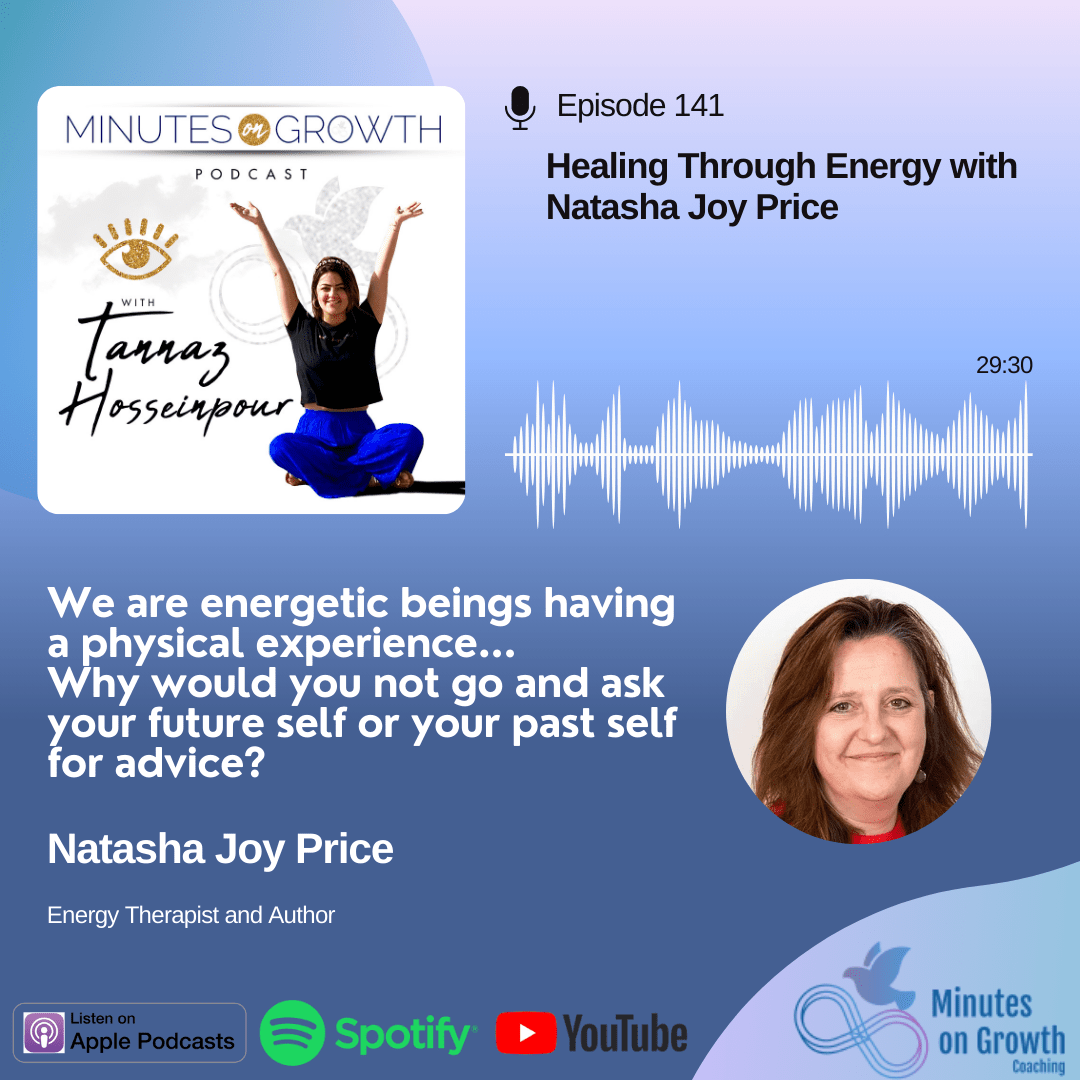
In this 29-minute episode, I sit down with Natasha Joy Price, former property lawyer turned energy healer, Reiki master, and past life regression practitioner. After a life-changing spiritual awakening post-childbirth, Natasha found her calling in the world of energy work.
We explore how passion is a powerful antidote to burnout, how her legal and spiritual worlds harmoniously coexist, and why understanding past lives can unlock your fullest potential.
Natasha also shares insights from her new book, The Red Magus, a mystical journey through past life healing and soul purpose.If you’ve ever felt torn between logic and intuition, this episode will speak to both sides of your soul.
Click here to listen to Episode 141 of the Minutes on Growth Podcast on Spotify, on Apple Podcast or to watch on Youtube
Episode 140 – Stop Waiting, Start Becoming
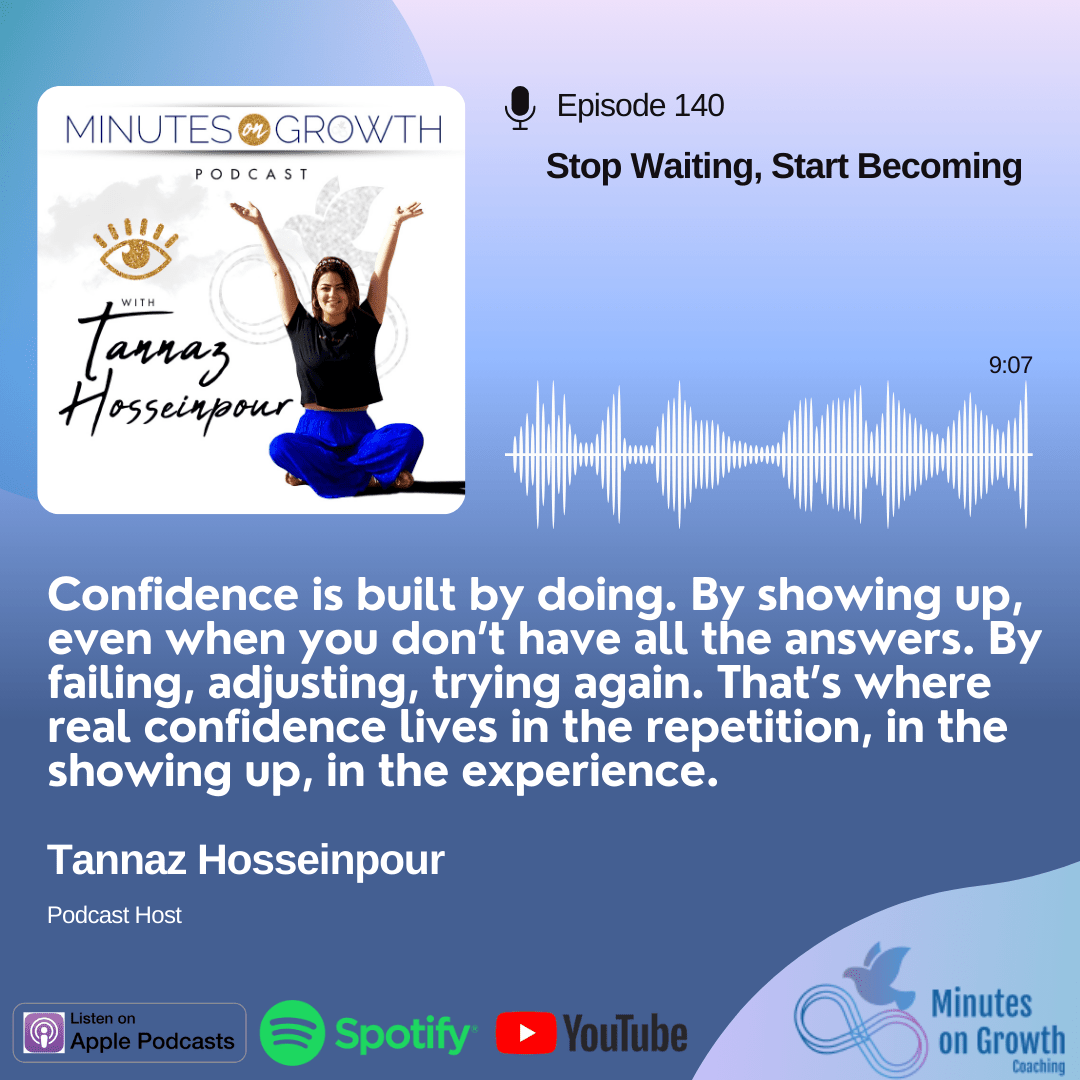
Click here to listen to Episode 140 of the Minutes on Growth Podcast on Apple Podcast or on Spotify
Hi soul friends, it’s Tannaz Hosseinpour, and welcome back to another solo episode of Minutes on Growth.
So, we’re in Aries season right now, which, astrologically, is all about bold action, initiation, and fire energy. And I’ve been feeling it. I’ve also been seeing it come up in conversations with clients and friends; the idea of doing, of starting, of taking inspired action… and how much resistance can come up around it.
Here’s the truth: you do not need to know everything before you begin.
I see this so often—someone wants to start a business, a new project, a new habit. And the first thing they say is, “I just don’t know enough yet. I need to take one more course. I need to feel more ready.” But what if I told you that confidence doesn’t come before action…it comes from it?
Let me say that again: confidence is built by doing. By showing up, even when you don’t have all the answers. By failing, adjusting, trying again. That’s where real confidence lives in the repetition, in the showing up, in the experience.
One of my clients was working through a certification program and she kept stopping and starting. Every time she’d get a little momentum, she’d let it go again. And then the stories would creep in:
“I’m not a good student.”
“Maybe I’m not made for this.”
“I just don’t feel motivated.”
And I get it. It’s hard when you’ve promised yourself something and then you don’t follow through. But here’s what I told her, and what I’ll share with you too:
Discipline is an act of self-love.
Motivation is great, but it’s fleeting; it’s based on how we feel.
Discipline is based on what we value. It’s self-integrity. It says, “I matter. My word matters.”
Every time we make a promise to ourselves and we don’t follow through, we chip away at our self-trust and self-confidence. But every time we do show up for ourselves, even in a small way, we build that trust again. We’re telling our nervous system: “Hey, you can count on me.”
Eventually, this client committed to making a schedule—breaking the work into small pieces. And module by module, she did it. Then I got a message from her saying, “Wait a second—I’m loving this. I feel so good about myself. I’m showing up differently.” And that’s it right there.
What changed wasn’t the program. It wasn’t the content. It was the action she chose to take. It built her self-efficacy, which, in psychology, is just a fancy word for the belief that you can handle whatever’s in front of you.
And self-efficacy matters. Studies have shown that the more self-efficacy you have, the more likely you are to keep going, to try new things, to handle stress, and even to succeed in your career.
Now here’s where I want to make a quick distinction:
- Self-worth is innate. You’re born with it. Nothing you do or don’t do can take it away. it’s not earned, its remembered
- But self-confidence and self-efficacy—those are things you build.
Self-esteem is made up of self-confidence and self-efficacy. So yes, we can work on it. It’s in your hands.
And when you start taking action—even small, imperfect action—you’re showing the universe: “I’m in. I’m ready. I’m not just talking about it; I’m doing it.”
That’s when things begin to shift. Because the universe responds to energy. And your energy changes when you take inspired action.
This is the energy of Aries season. It’s time to stop over-preparing and start doing. You don’t need to fake confidence, you’ll create it. You’ll embody it.
So if you’ve been putting something off because you’re waiting to “feel ready,” this is your gentle nudge from me to take one small step today. Just one. Start the thing. Speak the truth. Sign up. Press publish. Whatever it is.
You don’t need to have it all figured out. But you do need to move.
Because that’s how we grow. That’s how we evolve. That’s how we become the version of ourselves we’re dreaming about; by being her, not waiting for her.
Thank you for tuning in today. If this episode resonated with you, share it with someone who’s been sitting on an idea or waiting for the “right” moment; this might be the nudge they need.
And make sure you hit that subscribe button so you never miss a new episode when it drops each week.
If you feel called to, I’d also love for you to leave a review. It helps the podcast reach more soul friends around the world who are on this journey of growth with us.
Until next time, take inspired action and trust in the magic it creates.
 Minutes on Growth